-
01
 From Zero to Your First AI Agent in 25 Minutes (No Coding)
25min
From Zero to Your First AI Agent in 25 Minutes (No Coding)
25min
-
02
How to Build & Sell AI Agents: Ultimate Beginner’s Guide
3h 50min
-
03
Build & Sell n8n AI Agents (8+ Hour Course, No Code)
8h 26min
-
04
AI Agents Fundamentals In 21 Minutes
21min
-
05
Build an AI Agent From Scratch in Python – Tutorial for Beginners
34min
-
06
Don’t learn AI Agents without Learning these Fundamentals
56min
-
07
Building AI Agents that actually work (Full Course)
58min
-
08
Generative AI Vs Agentic AI Vs AI Agents
17min
-
09
The AI Agent Tutorial That Should’ve Been Your First (no code)
16min
-
10
Generative AI vs AI agents vs Agentic AI
Current lesson



Summary
Understanding Three Core AI Paradigms
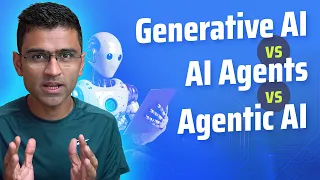
The landscape of artificial intelligence has evolved rapidly, introducing distinct categories that are often confused or used interchangeably. Generative AI, AI agents, and agentic AI systems represent three different approaches to building intelligent systems, each with unique capabilities and purposes. Understanding these distinctions is crucial for developers, product managers, and organizations planning to implement AI solutions. This video breaks down these concepts using intuitive explanations that make the differences clear without requiring deep technical background.
What Is Generative AI
Generative AI refers to models trained to generate new content based on patterns learned from training data. These systems, such as language models like GPT-4 or image generators like DALL-E, excel at producing text, images, code, or other outputs when prompted by users. The key characteristic of generative AI is that it responds to input and generates output in a single interaction—it does not plan, reflect on its actions, or modify its behavior based on outcomes. Generative AI is fundamentally reactive; it processes a prompt and returns a result without considering whether that result achieves any broader goal or objective.
The Nature of AI Agents
AI agents represent a step forward in autonomy and decision-making capability. An AI agent is a system that can perceive its environment, reason about observations, and take actions to achieve defined goals. Unlike generative AI, which simply responds to queries, agents operate with some degree of independence and can make sequential decisions. They possess memory, can evaluate different action paths, and adjust their behavior based on feedback from their environment. However, traditional AI agents typically operate within well-defined domains and require explicit programming of rules, decision trees, or reward functions to guide their behavior effectively.
Defining Agentic AI Systems
Agentic AI systems represent the most advanced category, combining the generative capabilities of large language models with the autonomous decision-making of agents. These systems leverage foundation models and their ability to reason, plan, and execute tasks with minimal explicit programming. An agentic AI system can break down complex problems into sub-tasks, execute them iteratively, evaluate results, and adapt its approach dynamically. Rather than relying on hardcoded rules, agentic systems use language models to reason through problems, make judgments, and decide what actions to take next. This approach enables more flexible, intelligent automation that can handle novel situations and unexpected challenges.
Key Differences in Autonomy and Reasoning
The primary distinction between these three paradigms lies in autonomy and reasoning capability. Generative AI is essentially a sophisticated pattern-matching system with no goal-oriented behavior—it generates content on demand but does not pursue objectives independently. Traditional AI agents have autonomy but typically require explicit rule definition and operate within constrained domains. Agentic AI systems combine generative capability with autonomous goal-seeking, allowing them to reason about problems using natural language understanding and adapt strategies based on outcomes. This makes agentic systems particularly powerful for complex, real-world tasks where the exact solution path cannot be predetermined and the system must learn and adjust during execution.
Real-World Applications and Use Cases
Generative AI excels in content creation, customer support through chatbots, code generation, and creative tasks where users seek immediate, high-quality outputs. AI agents have traditionally been used in game-playing systems, robotic process automation, and specialized domains like medical diagnosis systems where behavior can be predefined effectively. Agentic AI systems open new possibilities for complex automation scenarios—research assistants that can gather information from multiple sources, HR systems that conduct interviews and adapt questions based on responses, or software development assistants that can plan, code, test, and debug entire applications. These systems are beginning to power enterprise automation where flexibility and reasoning are essential.
Building Blocks and Implementation Considerations
Implementing agentic AI systems typically involves frameworks that orchestrate language models with tool use capabilities, memory systems, and planning mechanisms. Developers use tools like LangGraph, which enable structured workflows where agents can reason about available tools, decide when to use them, and process results iteratively. The architecture of agentic systems requires careful consideration of how the language model interacts with external tools, databases, and APIs, as well as how errors and unexpected outputs are handled. Unlike generative AI, which serves users on demand, and traditional agents, which follow explicit rules, agentic systems require thoughtful design around their reasoning loops and decision-making processes.
Future Trajectory and Strategic Importance
As large language models continue improving in reasoning and planning capabilities, agentic AI systems are becoming increasingly practical for enterprise adoption. Organizations are beginning to recognize that the future of AI integration lies not just in using language models for content generation, but in deploying them as autonomous agents that can manage complex workflows, interact with multiple systems, and achieve business objectives with minimal human intervention. Understanding these distinctions helps teams make informed decisions about which approach suits their specific needs—whether they need generative capabilities for content, traditional agents for rule-based automation, or agentic systems for complex, adaptive problem-solving.
What you will learn
- Distinguish between generative AI, AI agents, and agentic AI systems
- Understand how agentic systems combine reasoning with autonomous action
- Recognize appropriate use cases for each AI paradigm
- Learn key design considerations for building agentic AI applications
- Explore frameworks and tools for implementing agent-based systems
Concepts covered
Technologies used
Chapters 7 markers
Next suggested video


Reviews
No reviews yet. Be the first to rate this lesson.