-
01
 What is Agentic AI and How Does it Work?
13min
What is Agentic AI and How Does it Work?
13min
-
02
The Best Local Agentic Coding Workflow (Complete Guide)
44min
-
03
Build Your Own Claude Code | Full AI Coding Agent Tutorial
11h 59min
-
04
Agentic AI Crash Course using LangChain | LangChain Crash Course
2h 23min
-
05
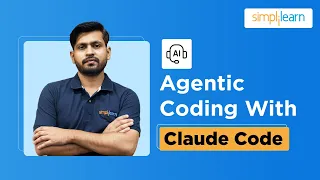
Agentic Coding with Claude Code | Agentic AI Coding Tutorial | Coding With Claude Code | Simplilearn
Current lesson
-
06
Google’s Free AI vs Claude Code & Codex – Which One Should You Use? (Antigravity 2.0 Masterclass)
16min
-
07
NEW Open Claude Code Is A FULLY FREE AI Coding Agent! (Tutorial)
11min
-
08
Stop Using Claude Code Without an Agentic OS
17min
-
09
How to Setup AI Agent Skills for Better Code | TRAE SOLO
20min
-
10
How I Turned Pi Into the Ultimate Coding Agent
21min



Summary
Introduction to Agentic Coding
Agentic coding represents a transformative approach to software development where AI models like Claude are integrated directly into the development workflow to automate tasks, optimize processes, and enhance code quality. Rather than treating AI as a standalone tool, agentic systems embed intelligent agents into the coding pipeline to handle repetitive, manual coding tasks that traditionally consume significant developer time. This tutorial demonstrates how developers can leverage Claude's capabilities to create intelligent command-line applications that not only perform specific functions but also showcase the principles of agentic AI in action. By combining Node.js with Claude's API, developers gain access to a powerful ecosystem for building scalable, AI-enhanced coding solutions.
Understanding Agentic AI Models
Agentic AI models differ fundamentally from traditional AI implementations because they actively participate in decision-making and task execution within a defined workflow. Claude, as a large language model, brings natural language understanding and code generation capabilities that enable it to interpret requirements, suggest optimizations, and even debug code in real-time. The key distinction is autonomy: agentic models can take initiative to solve problems, propose alternative approaches, and refine solutions based on feedback loops. In the context of coding, this means Claude can serve as an intelligent partner that understands your development goals and actively guides you toward more efficient implementations. The tutorial explores how these capabilities can be harnessed in practical development scenarios, specifically through building a command-line interface that demonstrates agentic principles in operation.
Project Architecture and Setup
The hands-on project centers on creating a Node.js Command Line Interface tool designed to convert CSV files into JSON format. This seemingly straightforward task serves as an excellent vehicle for understanding agentic coding principles because it encompasses multiple layers of complexity: file input/output handling, data transformation logic, error management, and integration with Claude's API. The project setup phase requires developers to establish the proper folder structure, install necessary dependencies, configure API credentials for Claude, and establish the basic Node.js project framework. Understanding the folder structure is critical because it determines how the application is organized, where configuration files are stored, how modules are separated, and how the tool will be packaged for distribution. A well-organized project structure makes it easier to extend functionality, maintain code quality, and integrate additional Claude-powered features as the application evolves.
Building the CLI Tool
The development process involves writing Node.js code that integrates Claude API calls to handle the CSV-to-JSON conversion. Rather than writing a rigid conversion algorithm, the agentic approach leverages Claude to intelligently parse CSV files, understand their structure, map columns to appropriate JSON fields, and handle edge cases that might arise from various CSV formats. The CLI tool accepts CSV files as input and outputs properly formatted JSON files, but the intelligence comes from how Claude interprets ambiguous data structures and suggests optimizations for the conversion process. Developers interact with Claude through the API to refine the conversion logic, test different approaches, and ensure the tool handles various CSV formats robustly. This interaction model demonstrates the core principle of agentic coding: the AI actively participates in problem-solving rather than passively executing pre-programmed instructions.
Integration of Claude's Capabilities
Claude's integration into the coding workflow enables real-time assistance, code suggestions, and optimizations that would traditionally require manual review or external tools. When building the CLI tool, developers can ask Claude to generate code snippets, review the implementation for potential issues, suggest performance improvements, and even help debug unexpected behavior. The tutorial demonstrates how to structure prompts and API calls to get the most effective assistance from Claude, including techniques for breaking complex tasks into manageable components that Claude can address systematically. By maintaining an iterative dialogue with Claude throughout development, developers can ensure that the final solution is not only functional but optimized for readability, performance, and maintainability. This collaborative approach between human developer and AI model exemplifies the future of software development.
Workflow Optimization and Automation
One of the primary benefits of agentic coding is the dramatic reduction in time spent on repetitive, mechanical aspects of development. Instead of manually writing boilerplate code, error handlers, and test cases, developers can delegate these tasks to Claude while focusing on architectural decisions and business logic. The CSV-to-JSON converter demonstrates how agentic systems can handle data validation, type checking, and format conversion without explicit programming for every edge case. Claude's ability to understand context and intent means that developers can describe requirements in natural language and receive functional code implementations. This automation extends beyond initial development to include ongoing refactoring, documentation generation, and performance optimization, fundamentally changing how developers allocate their time and attention within software projects.
Practical Applications and Extensions
The CLI tool built in this tutorial serves as a foundation for understanding how agentic coding principles scale to more complex applications. Once developers understand how to integrate Claude into a file conversion workflow, they can extend these patterns to build more sophisticated tools: API wrappers, data processing pipelines, code generation utilities, and automated testing frameworks. The techniques demonstrated apply across different domains of software development, from web application development to data science workflows. Developers can use Claude to assist with architecture decisions, suggest design patterns, and help evaluate trade-offs between different implementation approaches. The tutorial emphasizes that agentic coding isn't limited to specific problem domains but represents a fundamental shift in how developers approach software creation and maintenance.
Getting Started and Next Steps
The tutorial provides a structured path from project setup through running the complete CLI tool, ensuring that developers at various skill levels can follow along and replicate the results. By watching the folder structure creation phase, understanding how to configure Claude's API, and then executing the completed tool, developers gain hands-on experience with practical agentic coding. The journey from understanding these concepts to implementing working code reinforces the practical value of integrating AI into development workflows. Developers completing this tutorial will be equipped to apply agentic coding principles to their own projects, whether building command-line tools, web applications, or data processing solutions.
What you will learn
- Understand the core concepts and principles of agentic coding with AI models
- Set up and configure a Node.js project integrated with Claude's API
- Build a functional CLI tool that converts CSV files to JSON format
- Implement iterative development workflows using Claude for code refinement
- Automate repetitive coding tasks using agentic AI capabilities
- Optimize code quality and performance through AI-assisted review and suggestions
Concepts covered
Technologies used
Chapters 8 markers
Next suggested video
Reviews
No reviews yet. Be the first to rate this lesson.