-
04
 Lesson 4 – Agentic Coding using Claude Code
22min
Lesson 4 – Agentic Coding using Claude Code
22min
-
05
Lesson 5 – Agentic Coding using Claude Code
35min
-
06
Lesson 6 – Agentic Coding using Claude Code
46min
-
07
Lesson 7 – Agentic Coding using Claude Code
28min
-
08
Lesson 8 – Agentic Coding using Claude Code
37min
-
09
Lesson 9 – Agentic Coding using Claude Code
46min
-
10
Lesson 10 – Agentic Coding using Claude Code
49min
-
11
Lesson 11 – Agentic Coding using Claude Code
Current lesson
-
12
Lesson 12 – Agentic Coding using Claude Code
47min
-
13
Lesson 13 – Agentic Coding using Claude Code
54min
-
14
Lesson 14 – Agentic Coding using Claude Code
1h 04min
-
15
Lesson 15 – Agentic Coding using Claude Code
35min
Summary
The core problem with stateless LLMs
The interaction with a Large Language Model is inherently amnesiac. For every single prompt, the model processes the entire history from scratch. This stateless nature creates a technical bottleneck known as context window pressure. As development sessions grow, the token count balloons, including not just instructions and code but also a long tail of previous prompts and responses. The system is forced to reprocess a massive wall of text for each new request. The immediate cost of this approach is financial, as API pricing scales with input tokens, but the performance cost is arguably worse. The model's attention mechanism is diluted across a sprawling context, which degrades response quality and leads to hallucinations or the need for constant manual re-correction. The video frames this as the "naive approach," where an agent is set loose on a massive, undifferentiated pool of information with poor results.
How subagents introduce context isolation
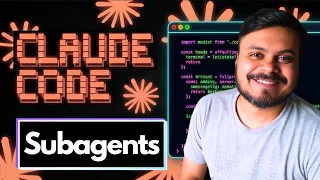
The fundamental shift proposed is moving from a monolithic prompt architecture to a delegated one. A subagent is a secondary LLM instance spun up by the primary agent to handle a discrete, narrow task. The primary agent no longer needs to dump the entire codebase into one context window. Instead, it defines a specific objective and hands the subagent only the essential files or parameters required for that micro-task. The subagent operates within a pristine, isolated context window where it reasons, searches, or edits code without being distracted by the noise of the broader conversation. Once the task finishes, the subagent collapses its work down into a finalized output, often just a code diff or a structured summary, and passes this compressed result back to the main thread. This method prevents the main conversation from being polluted by intermediate drafts and failed attempts.
Modularity and parallel execution advantages
This architecture transforms a sequential chain of tasks into a modular, parallelizable workflow. Just as microservices replaced monolithic applications, subagents replace monolithic prompts. The video highlights how different subagents can be dispatched simultaneously. For instance, a debugging agent can analyze error logs while a refactoring agent cleans up a separate file and a documentation agent updates a README. The total project time shifts from the sum of all tasks to roughly the duration of the longest single task. Specialization is a direct byproduct of this modularity. A primary agent can act as a generalist orchestrator, while subagents are tuned with specific custom instructions or tool permissions. A security audit subagent might have strict read-only access, preventing hallucinated deletions, while a testing subagent is authorized to execute shell commands. This role-based access control increases system safety in autonomous coding environments.
Built-in subagents in Claude Code
Claude Code ships with pre-configured cognitive architectures that mimic a senior developer's approach. The video offers an overview of these built-in agents, particularly the "Explore" agent. When a user asks a high-level question about a new repository, the primary agent does not read every file itself. It delegates to Explore, which uses a search-and-file-read loop inside its own private context to form a coherent mental map of the project structure. It returns only a polished, synthesized summary, saving thousands of tokens. Another built-in agent, Plan, likely mirrors the planning step common in agentic systems, where a strategy is drafted and checked before committing to expensive code generation. These built-in agents act as optimized tools that already encapsulate best practices for prompt chaining and context management, allowing developers to leverage complex multi-step logic without writing the orchestration code themselves.
Specialized real-world coding tasks
Beyond exploration, the subagent paradigm changes the nature of code review. Traditionally, dumping an entire pull request into an LLM yields a superficial review. With subagents, the review process can be broken down. A linting subagent checks style, a type-safety subagent focuses strictly on type mismatches, and a logic subagent examines recent changes against a ticket description, all running concurrently. The video also covers multi-stage pipelines where subagents chain together. A code generation subagent produces a candidate, a criticism subagent reviews it and sends feedback back to the generation subagent, and a final merge subagent integrates the validated code. This cyclical checking via isolated bots mimics a multi-developer workflow. Testing, too, benefits from this approach. A test-generation subagent can produce unit tests while a test-runner subagent executes them, with each operating in its own clean shell environment to avoid side effects.
Cost efficiency and resource management
The economic argument for subagents is framed around minimizing waste. In the naive approach, every prompt is a massive token sink. The video likely contrasts this with the subagent model, where the expensive reasoning loop is contained within a specialized context. By returning aggregated results, the main agent only processes high-signal, compressed data. This structural compression leads to direct cost savings on API usage. Resource management also applies to attention mechanisms. A primary agent juggling too many details is prone to forgetting constraints or neglecting core instructions. By delegating memory-intensive tasks, the orchestrator can maintain a crystal-clear focus on the overarching user goal, resulting in better architecture decisions.
Orchestration patterns and agentic flow
The true power emerges from the primary agent's ability to decide when to spawn, await, and integrate subagent results. The video describes this as an agentic workflow, where Claude Code acts as an autonomous operator. It decides whether reading a file requires a full context load or a quick delegated glance. This dynamic decision-making mirrors a team lead who knows when to call a meeting versus when a one-line email will suffice. The built-in subagents act as default tools, but the extension capability allows for custom specialized bots. The flow follows a pattern: task decomposition, subagent delegation with tight prompt construction, result collection, and orchestration into a final cohesive output. This process is invisible to the end user, who simply sees the primary agent performing at a higher level.
Getting started with agentic coding
For a developer new to this pattern, the shift from imperative prompting to declarative orchestration is the key paradigm change. Instead of telling an LLM "now open this file and change this line," the developer trusts the agent to plan the operation and use its tools, including subagents. The immediate benefit comes from using the built-in Explore command to understand new codebases without manual scoping. From there, developers can define custom subagents for repetitive tasks in their CLAUDE.md file, specifying system prompts and allowed tools. The video ultimately provides a roadmap for moving from simple conversational chat to constructing a resilient, efficient, and scalable autonomous development system where the whole is truly greater than the sum of its context-limited parts.
What you will learn
- Understand the token inefficiency of stateless LLM interactions
- Implement subagents to isolate context for discrete coding tasks
- Orchestrate parallel execution for code review and testing
- Leverage built-in agents like Explore for codebase analysis
- Design multi-stage pipelines for autonomous code generation
Concepts covered
Technologies used
Chapters 8 markers
Next suggested video
Reviews
No reviews yet. Be the first to rate this lesson.