-
01
 become an AI HACKER (it’s easier than you think)
16min
become an AI HACKER (it’s easier than you think)
16min
-
02
What Is a Prompt Injection Attack?
10min
-
03
Mastering LLM Security Testing: A Comprehensive Guide
1h 53min
-
04
Hacking LLMs Demo and Tutorial (Explore AI Security Vulnerabilities)
26min
-
05
Explained: The OWASP Top 10 for Large Language Model Applications
14min
-
06
Guide to Architect Secure AI Agents: Best Practices for Safety
13min
-
07
AI Red Teaming: A Developer’s Guide to LLM Security
8min
-
08
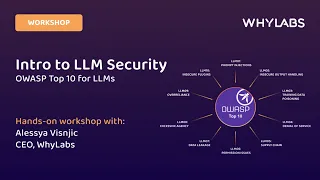
Intro to LLM Security – OWASP Top 10 for Large Language Models (LLMs)
57min
-
09
How to Pentest LLMs Like a Security Researcher Cybersecurity
1h 43min
-
10
Red Teaming AI: OWASP LLM Top 10 with Brian and Derek
Current lesson









Summary
Understanding AI Security Testing Differently
Traditional application security testing approaches often fail when applied directly to large language models and AI systems. This webcast explores why conventional security methodologies require significant adaptation for the unique threat landscape of LLM-based applications. The distinction lies in how AI systems process input, generate outputs, and interact with external systems in ways that differ fundamentally from traditional software architectures. Organizations deploying AI at scale must recognize that their existing penetration testing frameworks, vulnerability assessment processes, and security controls may leave critical AI-specific vulnerabilities unaddressed. The OWASP Top 10 for Large Language Models provides a structured taxonomy that acknowledges these differences and establishes a common vocabulary for AI security practitioners.
The OWASP Top 10 Framework for LLMs
OWASP's latest risk framework specifically addresses vulnerabilities and threats unique to large language model deployments. Rather than generic security principles, this framework identifies attack vectors that exploit specific characteristics of LLMs: their reliance on training data, their susceptibility to prompt injection, their potential for information disclosure through model outputs, and their integration with external systems and APIs. Each of the ten risk categories in the OWASP Top 10 for LLMs represents a distinct threat pattern that security teams must understand and test for. The framework serves as an industry standard that bridges the gap between traditional cybersecurity expertise and the emerging field of AI security, allowing organizations to apply familiar risk management processes to novel AI-specific threats.
Prompt Injection and Input Manipulation Attacks
Prompt injection represents one of the most critical threats to LLM security, where attackers craft specially designed inputs to manipulate model behavior and bypass intended constraints. These attacks range from simple attempts to extract system prompts to sophisticated techniques that force models to ignore safety guidelines, reveal sensitive information, or perform unintended actions. Unlike traditional input validation attacks on software, prompt injection exploits the semantic understanding capabilities of language models, making them fundamentally difficult to prevent through conventional input filtering. Red teamers demonstrate how attackers combine prompt injection with various manipulation techniques, including jailbreaking strategies that override model instructions, prompt hijacking that diverts the model's focus to attacker objectives, and indirect prompt injection through poisoned documents or web content. Understanding these attack mechanisms enables security teams to design more robust defenses and implement detection strategies that go beyond simple keyword blocking.
Training Data Poisoning and Model Integrity
Large language models depend entirely on their training data, making data integrity a critical security concern. Attackers targeting the training pipeline can subtly corrupt datasets, inject malicious patterns, or embed hidden behaviors that manifest only under specific conditions. Unlike traditional software where vulnerabilities are discovered after deployment, training data poisoning can be deliberately concealed within massive datasets and emerge only when models are exposed to trigger conditions in production. The OWASP framework emphasizes the importance of securing data pipelines, validating training sources, and implementing monitoring systems that detect anomalous model behavior that might indicate poisoning attacks. Red teamers focus on how defenders must establish data provenance, implement version control for training datasets, and create detection mechanisms that identify when models behave inconsistently with their expected training.
Information Disclosure and Data Leakage Risks
Large language models can inadvertently expose sensitive information from their training data through their generated outputs. This vulnerability exists because LLMs operate through pattern recognition and statistical prediction across massive datasets, creating scenarios where the model reproduces fragments of training data, including personal information, credentials, proprietary algorithms, or confidential business information. Red teaming exercises specifically target information disclosure by crafting prompts designed to extract sensitive data, test model boundary conditions, and identify edge cases where safety mechanisms fail. Security teams must implement detection systems that identify when models generate potentially sensitive information, establish clear data retention policies that minimize what sensitive information enters training pipelines, and create monitoring dashboards that track suspicious output patterns across deployed systems.
Supply Chain Integration and External System Risks
Modern LLM applications rarely operate in isolation; they integrate with retrieval systems, knowledge bases, external APIs, and downstream processing pipelines. Each integration point introduces attack surface area where threat actors can inject malicious content, intercept model outputs, or manipulate the systems that feed data into models. Red teamers examine how attackers leverage plugin vulnerabilities, compromise external data sources, exploit API integrations, and manipulate vector databases that power retrieval-augmented generation systems. The security implications extend beyond the model itself to encompass the entire ecosystem supporting AI application functionality. Defenders must implement strict access controls on model integrations, validate all external data sources before consumption, implement monitoring across API calls and data flow, and design architectures that assume upstream and downstream systems may be compromised.
Practical Red Teaming Methodology for AI Systems
Red teaming AI systems requires adapting traditional penetration testing approaches while developing AI-specific testing techniques. Security researchers employ both automated testing frameworks and manual exploration to identify vulnerabilities, test edge cases, and validate security controls. The methodology involves understanding the specific model architecture, testing various input vectors that exploit semantic vulnerabilities, measuring information disclosure across different output contexts, and evaluating how the system behaves under adversarial conditions. Effective red teaming considers not just individual vulnerabilities but also chained attacks that combine multiple weaknesses into sophisticated exploitation scenarios. Teams must document their findings clearly, distinguishing between exploitable vulnerabilities and theoretical risks, and prioritizing remediation efforts based on realistic attack impact and the organizational context where the AI system operates.
Building Security-First AI Deployment Practices
Securing AI applications requires shifting organizational mindset from testing AI systems after deployment to integrating security throughout the development lifecycle. A security-first approach to AI means involving security teams in model selection, reviewing training data sources before use, implementing robust logging and monitoring systems from initial deployment, and establishing clear incident response procedures for AI-specific security events. Organizations must balance the push to rapidly deploy innovative AI capabilities with the need to understand and mitigate genuine security risks. This involves creating feedback loops where red teaming results inform model improvements, establishing clear policies about what data models can access and how they can be used, and maintaining transparency about AI system capabilities and limitations with all stakeholders who interact with deployed systems.
Industry Adoption and Continuous Evolution
The OWASP Top 10 for LLMs represents the current consensus of AI security practitioners and serves as a living framework that evolves as the threat landscape matures. Organizations adopting this framework gain the benefit of industry-aligned security practices while contributing to the broader security community through shared threat intelligence and vulnerability disclosures. As AI systems become more integrated into critical business processes and infrastructure, the security community's understanding of LLM-specific threats will deepen, potentially introducing new categories of risk and refined detection mechanisms. Security teams should view the OWASP framework not as a static checklist but as a foundation upon which to build comprehensive AI security programs that adapt as threats evolve and defensive technologies mature.
What you will learn
- Understand the OWASP Top 10 AI-LLM risk framework and how it differs from traditional application security
- Identify prompt injection and input manipulation attack vectors targeting LLM systems
- Implement red teaming methodologies specifically designed for AI application security
- Recognize training data poisoning risks and establish data integrity controls
- Detect and prevent information disclosure vulnerabilities in LLM deployments
- Design secure AI architectures with attention to supply chain and integration risks
Concepts covered
Technologies used
Chapters 8 markers
Next suggested video


Reviews
No reviews yet. Be the first to rate this lesson.