-
01
 become an AI HACKER (it’s easier than you think)
16min
become an AI HACKER (it’s easier than you think)
16min
-
02
What Is a Prompt Injection Attack?
10min
-
03
Mastering LLM Security Testing: A Comprehensive Guide
Current lesson
-
04
Hacking LLMs Demo and Tutorial (Explore AI Security Vulnerabilities)
26min
-
05
Explained: The OWASP Top 10 for Large Language Model Applications
14min
-
06
Guide to Architect Secure AI Agents: Best Practices for Safety
13min
-
07
AI Red Teaming: A Developer’s Guide to LLM Security
8min
-
08
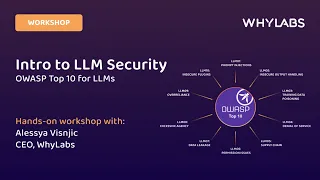
Intro to LLM Security – OWASP Top 10 for Large Language Models (LLMs)
57min
-
09
How to Pentest LLMs Like a Security Researcher Cybersecurity
1h 43min
-
10
Red Teaming AI: OWASP LLM Top 10 with Brian and Derek
1h 07min








Summary
Understanding Large Language Model Vulnerabilities
Large Language Models have become integral to modern applications, but they introduce unique security challenges that traditional cybersecurity approaches may not address. LLM security testing differs fundamentally from conventional application security because these models operate through probabilistic inference, making them susceptible to novel attack vectors. Understanding these vulnerabilities is the first step toward building robust AI systems that can withstand intentional and unintentional exploitation attempts.
The Fundamentals of LLM Pentesting
LLM pentesting, or penetration testing for language models, is a specialized discipline that combines traditional security testing methodologies with AI-specific attack techniques. Unlike conventional pentesting that focuses on finding code vulnerabilities, injection flaws, or authentication bypasses, LLM pentesting examines how models respond to adversarial inputs, prompt injection attacks, and data poisoning attempts. Security researchers test whether models can be manipulated to produce harmful outputs, leak training data, or behave in unexpected ways that could compromise applications relying on them.
Prompt Injection and Manipulation Attacks
One of the most critical vulnerabilities in LLM applications is prompt injection, where attackers craft carefully designed inputs to manipulate model behavior. These attacks work by embedding hidden instructions or context within seemingly innocent prompts, tricking the model into ignoring its original instructions and executing unintended actions. Security testers must learn to identify injection points, craft payloads that expose these weaknesses, and understand how different models respond to manipulated inputs. This knowledge enables development teams to implement proper input validation, output filtering, and architectural safeguards.
Data Extraction and Privacy Risks
Large Language Models trained on vast datasets can inadvertently memorize and regurgitate sensitive information from their training data. Security testing must verify whether models can be prompted to reveal personally identifiable information, proprietary business data, or other confidential content. Pentesting frameworks should include techniques for extracting training data, identifying privacy leakages, and assessing the model's resistance to membership inference attacks where attackers attempt to determine whether specific data was included in the training set.
Model Poisoning and Adversarial Robustness
Beyond external attacks, security professionals must understand how models can be compromised during training through data poisoning or fine-tuning attacks. Adversarial examples are specially crafted inputs that cause models to produce incorrect outputs, even when imperceptible to human observers. Comprehensive LLM security testing evaluates how robust models are against these adversarial attacks, whether they can be deliberately misled through carefully constructed inputs, and how to implement defenses that maintain model accuracy while enhancing security.
Building a Comprehensive Testing Framework
Effective LLM security testing requires a structured approach that combines manual testing, automated scanning, and red team exercises. Organizations should establish baseline security benchmarks, create test datasets with known attack patterns, and regularly audit model outputs for suspicious behaviors. A comprehensive framework includes vulnerability scanning specific to LLM architectures, monitoring for prompt injection attempts, tracking model drift that might indicate compromise, and implementing logging systems that capture concerning behavior patterns for forensic analysis.
Practical Implementation and Defense Strategies
Security teams implementing LLM pentesting need practical tools and techniques that can be deployed in production environments. This includes input sanitization strategies that remove or neutralize malicious prompts without significantly degrading model utility, output filtering mechanisms that prevent harmful content generation, and architectural patterns that isolate LLMs from sensitive data. Rate limiting, access controls, and user authentication become critical components of a defense-in-depth approach that makes exploitation significantly more difficult.
The Broader Security and Compliance Context
LLM security testing must align with organizational security policies and emerging regulatory frameworks governing AI systems. As governments and regulatory bodies develop standards for AI safety and security, organizations need comprehensive pentesting programs that demonstrate due diligence in identifying and mitigating LLM-specific risks. Documenting security assessments, maintaining detailed reports of identified vulnerabilities, and demonstrating remediation efforts becomes essential for compliance, liability reduction, and maintaining stakeholder trust in AI-powered systems.
What you will learn
- Identify and exploit prompt injection vulnerabilities in language models
- Conduct security assessments for LLM applications and architectures
- Implement data extraction and privacy testing techniques
- Design defense mechanisms against adversarial attacks
- Build comprehensive LLM security testing frameworks
Concepts covered
Technologies used
Chapters 8 markers
Next suggested video

Reviews
No reviews yet. Be the first to rate this lesson.