-
18
 Lesson 18 – n8n and AI Agents Automation Course
7min
Lesson 18 – n8n and AI Agents Automation Course
7min
-
19
Lesson 19 – n8n and AI Agents Automation Course
15min
-
20
Lesson 20 – n8n and AI Agents Automation Course
13min
-
21
Lesson 21 – n8n and AI Agents Automation Course
2min
-
22
Lesson 22 – n8n and AI Agents Automation Course
Current lesson
-
23
Lesson 23 – n8n and AI Agents Automation Course
21min
-
24
Lesson 24 – n8n and AI Agents Automation Course
24min
-
25
Lesson 25 – n8n and AI Agents Automation Course
10min
-
26
Lesson 26 – n8n and AI Agents Automation Course
20min
-
27
Lesson 27 – n8n and AI Agents Automation Course
23min
-
28
Lesson 28 – n8n and AI Agents Automation Course
20min
-
29
Lesson 29 – n8n and AI Agents Automation Course
14min




Summary
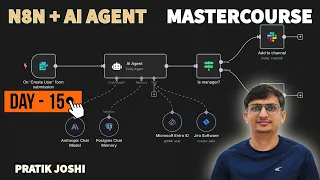
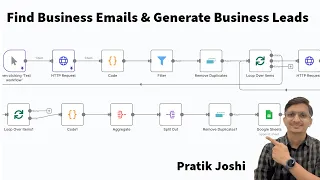
### Introduction to the Lead Generation Workflow This lesson focuses on constructing an automated system within n8n that leverages artificial intelligence to streamline the process of finding potential business clients. The core objective is to transform simple keyword inputs, like "coffee shop" or "plumber," into a list of verified email addresses gathered directly from business websites. By integrating with Google Maps for initial data discovery and employing AI to intelligently extract contact information, this workflow eliminates the manual grind typically associated with lead generation. You will see how to orchestrate various n8n nodes to create a seamless pipeline that identifies businesses, visits their online presence, and retrieves their email addresses for direct marketing campaigns.
### How the Workflow Identifies Target Businesses The process begins with a user-provided search term and geographic location, which are fed into a Google Maps node. This node simulates a search query, returning a list of businesses matching the criteria. The workflow is designed to handle pagination, ensuring it can gather data from multiple result pages if needed. Once the businesses are retrieved, the system enriches the data by extracting crucial details such as the business name, physical address, and website URL. This step is fundamental because the website URL is the gateway to the next phase—finding the business's email address. The workflow demonstrates how to configure the HTTP Request nodes to interact with Google Maps' internal APIs effectively.
### The Role of AI Agents in Data Extraction A key innovation in this lesson is the deployment of an AI Agent within n8n to autonomously navigate business websites. Instead of relying on rigid scraping rules that break when website structures change, the AI agent uses a language model to understand webpage content dynamically. It is instructed to look for email addresses, mirroring a human’s intuitive search process. The agent employs tools like a web browser or HTTP request capabilities to visit the extracted URLs. It then parses the page's text, searching for patterns that resemble email addresses, often on contact pages or page footers. This adaptive approach handles the chaotic variety of modern web design, dramatically increasing the success rate of data extraction compared to traditional scrapers.
### Configuring the Email Extraction Logic The heart of this automation lies in the precise instructions given to the AI agent. The lesson provides a detailed prompt that tells the agent its role as a lead generation specialist. It instructs the agent to visit a specific URL and locate an email address, with fallback strategies if the initial page yields no results, such as navigating to a '/contact' subpage. The AI is also trained to output the findings in a structured, machine-readable format, like JSON, making it easy for subsequent nodes to process the email. This segment highlights the importance of prompt engineering in AI-driven automation, showing how clear, structured command to the language model can turn a generic chatbot into a specialized worker for a business task.
### Handling Errors and Ensuring Robustness No real-world automation works perfectly on the first try, especially when dealing with live websites. The workflow incorporates error handling to manage situations where a website is down, a URL is invalid, or an email address simply isn't present. It uses n8n's error workflow capabilities and conditional logic to flag failed extractions without crashing the entire pipeline. The lesson covers setting up checks like verifying that a URL exists before the agent attempts to visit it. This defensive programming approach ensures the lead generation tool runs reliably over thousands of queries, logging errors for manual review while successfully compiling the contact details from cooperative websites.
### Finalizing the Lead List and Practical Applications The workflow concludes by compiling all successfully found email addresses into a clean, organized output, such as a Google Sheet or a direct CSV download. This final step ensures the generated leads are immediately usable for sales teams. Beyond the technical build, the lesson discusses the broader implications of this automation. It demonstrates how sales and marketing professionals can shift from manual prospecting to a strategic oversight role, feeding the machine keywords and receiving ready-to-use lead lists. The skills taught—combining APIs, HTTP requests, and autonomous AI agents—form a foundational blueprint for countless other business process automations beyond just email finding.
What you will learn
- Understand the lesson objective
- Apply the demonstrated workflow
- Validate the result in a practical project
Concepts covered
Technologies used
Chapters 6 markers
- Introduction to the n8n Google Maps lead generation workflow
- Setting up the Google Maps search node with keywords and location
- Extracting business names and website URLs from map results
- Introducing the AI Agent and crafting its email-finding instructions
- Testing the workflow and troubleshooting common errors
- Aggregating results and exporting the final email list
Next suggested video
Reviews
No reviews yet. Be the first to rate this lesson.