Ads
Free course

Free LLM Evaluation and Guardrails Course

Master LLM evaluation and guardrails with this 10-part practical course. Learn to implement safety layers, build evaluation pipelines, and measure model performance using LangChain, Guardrails AI, LangSmith, Amazon Bedrock, and structured testing across real-world...

10 lessons 17h 45min total Free

Course overview

This course provides a hands-on guide to the two sides of building trustworthy AI: evaluation and guardrails. You will move from foundational concepts like BLEU and ROUGE scoring to real-world techniques such as using LLMs as judges, creating golden datasets, and interpreting production traces. On the safety side, you will implement guardrails for AI agents, covering PII detection with LangChain, prompt injection defense, output validation, and continuous integration pipelines for AI-generated code. Tools like Amazon Bedrock, LangSmith, Guardrails AI, and Arize are used to create practical workflows that ensure your LLM applications are both reliable and safe.

Who this course is for

This course is built for AI developers, data scientists, and engineers who are deploying or maintaining large language models in production. It is especially useful if you are moving beyond prototypes and need to tackle real-world problems like detecting hallucinations, preventing harmful outputs, and measuring semantic quality beyond simple accuracy. The lessons assume a basic familiarity with Python and LLM concepts, but they start with beginner-friendly tutorials before progressing to advanced topics like building evaluation criteria for specific business use cases and architecting layered guardrail systems for healthcare applications.

How to study this sequence

Begin with the full 10-hour agentic AI overview to set the context, then immediately focus on the two evaluation fundamentals courses to learn both the metrics and the practical pipeline of labeling data and creating LLM judges. Next, alternate between the guardrails lessons to understand deterministic filtering and framework-based validation. Complete the course by seeing these concepts applied in specific production environments such as automated coding safeguards and AWS Bedrock evaluation setups. Replicate the spreadsheet-based evaluation framework and explore CI/CD guardrail implementations alongside the lectures.

What you should be able to do

You will finish with the ability to build a complete evaluation and safety stack for LLM agents. You can set up tracing and debugging with LangSmith, design evaluation criteria using production trace analysis, implement guardrails with Guardrails AI and LangChain to block prompt injections and validate outputs, and configure automated metrics to continuously monitor model behavior. You will be equipped to reduce hallucination risks and ensure your AI systems operate within defined safety and quality boundaries.


~/about-course

What you learn in this LLM Evaluation and Guardrails course

This course organizes 10 LLM Evaluation and Guardrails lessons in a practical order, starting with the base and moving toward examples you can repeat in your own projects.

The main practice points are Build autonomous agents using LangChain and LangGraph frameworks, Implement Retrieval-Augmented Generation for knowledge-grounded responses, Design and deploy vectorless RAG systems for specialized data retrieval and Apply guardrails and safety mechanisms for responsible agent deployment. Use this page to review the course proposal, check the key topics, and open the lessons in the recommended order.

What you will practice

  • Build autonomous agents using LangChain and LangGraph frameworks
  • Implement Retrieval-Augmented Generation for knowledge-grounded responses
  • Design and deploy vectorless RAG systems for specialized data retrieval
  • Apply guardrails and safety mechanisms for responsible agent deployment
  • Evaluate agentic system performance with comprehensive metrics and testing
  • Architect production-ready LLM gateways for enterprise deployments

Concepts covered

Agentic AI LangChain LangGraph Retrieval-Augmented Generation (RAG) Vectorless RAG Guardrails LLM Evaluation LLM Gateways

Course lessons

10 tutoriais organizados em sequência.

~/course-summary

Course summary

This LLM Evaluation and Guardrails course brings together 10 lessons in a guided sequence. It starts with "Complete Agentic AI Course In 10 Hours- Langchain, Langgraph, RAG,Vectorless RAG, Guardrails,Evals" and moves step by step, so each lesson supports the next one and helps turn the topic into practice.

During the course, the practical focus is on Build autonomous agents using LangChain and LangGraph frameworks, Implement Retrieval-Augmented Generation for knowledge-grounded responses, Design and deploy vectorless RAG systems for specialized data retrieval and Apply guardrails and safety mechanisms for responsible agent deployment. These points help you watch with a goal instead of treating the lesson as a loose introduction.

The course also introduces important ideas such as Agentic AI, LangChain, LangGraph, Retrieval-Augmented Generation (RAG) and Vectorless RAG, which makes it easier to understand later tutorials and decide when each resource is useful.

~/study-plan

How to get more from this course

Who this LLM Evaluation and Guardrails course is for

This advanced course is for learners who already understand the fundamentals of LLM Evaluation and Guardrails and want to develop deeper technical or professional skills.

What you can do after finishing

By the end, you should be able to review the main idea of the course and practice Build autonomous agents using LangChain and LangGraph frameworks, Implement Retrieval-Augmented Generation for knowledge-grounded responses, Design and deploy vectorless RAG systems for specialized data retrieval and Apply guardrails and safety mechanisms for responsible agent deployment with more confidence.

Recommended study order

Watch the 10 lessons in the order shown on this page. Pause after each lesson to repeat the examples and only move on when the previous step makes sense.

What to study next

After finishing the course, explore the LLM Evaluation and Guardrails topic to find related tutorials and keep studying with more context.

~/course-faq

Course questions

Is this LLM Evaluation and Guardrails course for beginners?

No. This course covers advanced LLM Evaluation and Guardrails topics and is best suited to learners who already understand the fundamentals.

How many lessons are in this course?

This course currently has 10 lessons and about 17h 45min in total.

What should I do after finishing the course?

The best next step is to explore the LLM Evaluation and Guardrails topic and choose a related tutorial that matches what you want to practice.

Is this course free?

Yes. This is a free course organized by CursoB so you can study LLM Evaluation and Guardrails in a structured sequence.

Do I need previous experience to follow the course?

Yes. You should already understand the fundamentals of LLM Evaluation and Guardrails before starting this advanced course.

Should I watch the lessons in order?

Yes. The recommended path is to watch the 10 lessons in the order shown, because each lesson helps prepare the next one.

Can I use this course for practical projects?

Yes. Use the course as a practical reference to train Build autonomous agents using LangChain and LangGraph frameworks, Implement Retrieval-Augmented Generation for knowledge-grounded responses, Design and deploy vectorless RAG systems for specialized data retrieval and Apply guardrails and safety mechanisms for responsible agent deployment and adapt the examples to your own projects.

Does this course include a certificate?

CursoB stopped issuing certificates for its own courses in May 2026. CursoB no longer offers completion certificates. Courses and tutorials remain free to study. If content is hosted on another platform, any certificate depends exclusively on the original author or platform rules.

Are the lessons updated?

CursoB periodically reviews the LLM Evaluation and Guardrails catalog and may add, remove, or reorder lessons when better content is found.

Where can I find more content on this subject?

Explore the LLM Evaluation and Guardrails topic to find related tutorials and complementary courses.

~/lesson-notes

What each course lesson covers

Use these notes to understand the sequence before opening each lesson.

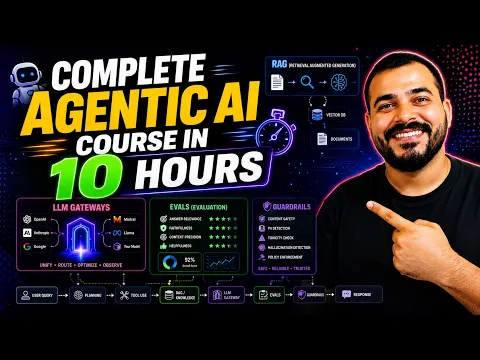
  1. 01 Complete Agentic AI Course In 10 Hours- Langchain, Langgraph, RAG,Vectorless RAG, Guardrails,Evals In this lesson, you practice Build autonomous agents using LangChain and LangGraph frameworks, Implement Retrieval-Augmented Generation for knowledge-grounded responses and Design and deploy vectorless RAG systems for specialized data retrieval.
  2. 02 LangSmith Tutorial – LLM Evaluation for Beginners In this lesson, you practice Set up and configure LangSmith for your first LLM project, Debug and trace execution of LangChain chains and agents and Evaluate and test LLM application performance systematically.
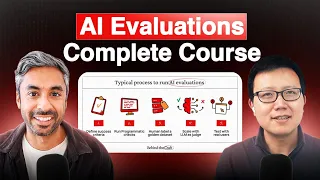
  3. 03 Complete Beginner’s Course on AI Evaluations in 50 Minutes (2025) | Aman Khan In this lesson, you practice Understand the four core types of AI evaluations and when to apply each one, Build a complete evaluation pipeline for an AI agent from scratch and Create and label a golden dataset for AI evaluation benchmarking.
  4. 04 Guardrails with LangChain: A Complete Crash Course for Building Safe AI Agents In this lesson, you practice Understand the fundamental purpose of guardrails in AI agent safety and compliance, Implement deterministic and model-based guardrail approaches for different use cases and Build custom input filtering and output validation guardrails in LangChain.
  5. 05 Guardrails for LLM Applications | Complete Tutorial for AI Developers WIth Guardrails AI In this lesson, you practice Understand what guardrails are and why they are essential for LLM applications, Implement schema-level validation and structured output control using Guardrails AI and Detect and prevent prompt injection attacks in production LLM systems.
  6. 06 AI Evaluations Clearly Explained in 50 Minutes (Real Example) | Hamel Husain In this lesson, you practice Understand why AI evaluations are critical infrastructure for production AI systems, Analyze real production traces to identify actual failure modes and patterns and Create clear evaluation criteria using simple spreadsheet-based frameworks.
  7. 07 Are you still babysitting AI coding agents? Build better guardrails! In this lesson, you practice Implement continuous integration pipelines specifically designed for AI coding agents, Use compiled languages and type systems as automatic guardrails for code quality and Configure linters and static analysis tools to enforce code standards autonomously.
  8. 08 LLM Evaluation – Build Reliable AI Apps | LLM evaluation metrics | LLM evaluation techniques In this lesson, you practice Understand core LLM evaluation metrics including BLEU, ROUGE, BERTScore, and semantic similarity measures, Design and implement human evaluation frameworks with inter-rater agreement measurement and Select appropriate benchmark datasets and interpret their limitations for real-world applications.
  9. 09 A Practical Guide to LLM Evaluation – Michelle Yi In this lesson, you practice Understand the limitations of academic benchmarks for production LLM systems, Implement automated evaluation metrics and assess their trade-offs and Design LLM-as-judge frameworks for nuanced qualitative assessment.
  10. 10 How to Setup LLM Evaluations Easily (Tutorial) In this lesson, you practice Understand how Amazon Bedrock evaluations framework operates and its key components, Configure AWS users, buckets, and IAM permissions for secure evaluation workflows and Create knowledge bases that ground language models with domain-specific documents.