-
01
 Complete Agentic AI Course In 10 Hours- Langchain, Langgraph, RAG,Vectorless RAG, Guardrails,Evals
11h 13min
Complete Agentic AI Course In 10 Hours- Langchain, Langgraph, RAG,Vectorless RAG, Guardrails,Evals
11h 13min
-
02
LangSmith Tutorial – LLM Evaluation for Beginners
36min
-
03
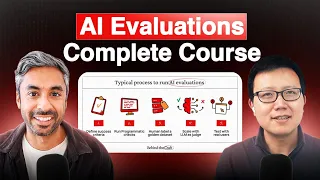
Complete Beginner’s Course on AI Evaluations in 50 Minutes (2025) | Aman Khan
Current lesson
-
04
Guardrails with LangChain: A Complete Crash Course for Building Safe AI Agents
38min
-
05
Guardrails for LLM Applications | Complete Tutorial for AI Developers WIth Guardrails AI
1h 26min
-
06
AI Evaluations Clearly Explained in 50 Minutes (Real Example) | Hamel Husain
52min
-
07
Are you still babysitting AI coding agents? Build better guardrails!
37min
-
08
LLM Evaluation – Build Reliable AI Apps | LLM evaluation metrics | LLM evaluation techniques
39min
-
09
A Practical Guide to LLM Evaluation – Michelle Yi
31min
-
10
How to Setup LLM Evaluations Easily (Tutorial)
17min







Summary
Understanding AI Evaluations Fundamentals
AI evaluations represent one of the most critical yet often overlooked aspects of building reliable AI systems. This 50-minute course introduces beginners to the complete workflow of creating evaluations for AI applications, specifically demonstrating how to assess the performance of an AI customer support agent. The course is structured as a live-building session where two product managers walk through the entire evaluation pipeline from scratch, making it accessible to anyone starting their journey in AI quality assurance. Rather than relying solely on theoretical concepts, the instructors demonstrate practical decision-making at each stage, showing viewers how to navigate common challenges and make informed choices when designing evaluation systems.
The Four Core Evaluation Types
One of the foundational insights covered in this course is understanding that AI evaluations fall into four distinct categories, each serving different purposes in the assessment framework. These evaluation types form the backbone of any comprehensive evaluation strategy, and knowing when and how to apply each one is essential for building robust assessment systems. The course breaks down these categories in a way that makes it clear why each type matters and how they complement each other in a production environment. By learning these four types early, practitioners gain a mental model that scales to increasingly complex evaluation scenarios across different AI applications and use cases.
Building Evals for Customer Support Agents
The practical core of this course revolves around a real-world scenario: evaluating an AI customer support agent. This use case is particularly valuable because customer support represents one of the most common deployment scenarios for AI systems, making the lessons directly applicable to many teams' immediate needs. The instructors walk through the entire process of designing evaluation criteria that capture what makes a good customer support interaction. This includes considerations like response accuracy, tone appropriateness, issue resolution, and customer satisfaction indicators. By following along with this concrete example, learners develop intuition about how to identify the right metrics and thresholds for their own AI systems.
Golden Dataset Creation and Labeling
A critical step in building reliable AI evaluations is creating a golden dataset—a curated collection of examples with human-verified labels that serve as the ground truth for evaluation. The course demonstrates the labeling process in detail, showing how to systematically annotate examples from the customer support agent's interactions. This stage is crucial because the quality of the golden dataset directly impacts the reliability of all downstream evaluations. The instructors explain how to approach labeling consistently, handle edge cases, and make decisions when examples don't fit neatly into predefined categories. Understanding this foundational work helps practitioners appreciate why golden datasets are often the most labor-intensive but valuable component of any evaluation system.
Leveraging LLM Judges for Scalability
While human labeling provides ground truth, scaling evaluations to thousands of interactions requires a different approach. The course explores how to use language models themselves as judges—having one LLM evaluate the outputs of another LLM. This scaling technique is revolutionary for teams that need to assess large volumes of AI outputs without proportionally increasing human annotation efforts. The instructors demonstrate how to craft prompts that guide the LLM judge to evaluate outputs according to your specific criteria. They show the technical implementation using Anthropic's console, revealing how to iterate on prompts to improve judge consistency and accuracy. This section transforms evaluation from a purely human-dependent process into a hybrid system that combines human judgment at the foundation with AI-powered scaling on top.
Aligning LLM Judges with Human Standards
One of the most sophisticated aspects of AI evaluations is ensuring that when you use an LLM as a judge, it actually aligns with how humans would judge the same outputs. This alignment problem is non-trivial because LLMs can develop blind spots or biases that diverge from human judgment. The course dedicates significant time to demonstrating techniques for measuring and improving this alignment. The instructors show how to compare LLM judge decisions against your golden dataset to identify divergences, then iteratively refine prompts to close these gaps. This process of alignment validation is essential for any team that wants to trust their automated evaluations in production environments. Understanding how to measure alignment and systematically improve it represents a key skill for practitioners working with LLM-based evaluation systems.
Prompt Engineering for Evaluation
Throughout the course, particular emphasis is placed on the art and science of crafting evaluation prompts. The instructors demonstrate how to use Anthropic's console to generate and test prompts, showing real examples of prompts that work well and others that need refinement. They explain the trade-offs between specificity and flexibility in evaluation prompts, and how overly rigid prompts can miss valid variations while overly loose prompts introduce too much noise. The process revealed in this section demonstrates that evaluation prompt engineering is a distinct skill that combines domain knowledge, understanding of LLM behavior, and iterative testing. By exposing learners to this hands-on process, the course builds practical competence that extends beyond the customer support example to any evaluation scenario.
Practical Application and Next Steps
The structure of this course—moving from conceptual foundations through four evaluation types to a complete live implementation—creates a learning arc that transforms viewers from evaluation novices to practitioners with hands-on experience. By the end of the 50 minutes, participants understand not just what evaluations are but how to build them in a production context. The course materials include takeaways and references that extend the learning beyond the video, providing resources for deepening expertise in evaluation techniques. This foundation prepares viewers to apply evaluation principles to their own AI projects, whether in customer support, content generation, code assistance, or any other AI application domain.
What you will learn
- Understand the four core types of AI evaluations and when to apply each one
- Build a complete evaluation pipeline for an AI agent from scratch
- Create and label a golden dataset for AI evaluation benchmarking
- Design and implement LLM judges for scalable evaluation
- Align LLM judge outputs with human judgment criteria
- Engineer effective evaluation prompts using LLM tools
Concepts covered
Technologies used
Chapters 8 markers
- What are AI evals and how to master them
- The 4 types of AI evaluations explained
- Live demo: Building evals for customer support
- Using Anthropic's console for prompt generation
- Creating evaluation criteria and standards
- Human labeling the golden dataset
- Scaling evals with LLM-judge prompts
- Aligning LLM judges with human judgment
Next suggested video
Reviews
No reviews yet. Be the first to rate this lesson.