-
02
 CS50x 2026 – Lecture 0 – Scratch
2h 00min
CS50x 2026 – Lecture 0 – Scratch
2h 00min
-
03
CS50x 2026 – Lecture 1 – C
2h 30min
-
04
CS50x 2026 – Lecture 2 – Arrays
2h 25min
-
05
CS50x 2026 – Lecture 3 – Algorithms
1h 59min
-
06
CS50x 2026 – Lecture 4 – Memory
2h 19min
-
07
CS50x 2026 – Lecture 5 – Data Structures
2h 06min
-
08
CS50x 2026 – Lecture 6 – Python
2h 29min
-
09
CS50x 2026 – Lecture 7 – SQL
2h 15min
-
10
CS50x 2026 – Artificial Intelligence
Current lesson
-
11
CS50x 2026 – Lecture 8 – HTML, CSS, JavaScript
2h 22min
-
12
CS50x 2026 – Lecture 9 – Flask
2h 26min
-
13
CS50x 2026 – Lecture 10 – The End
52min







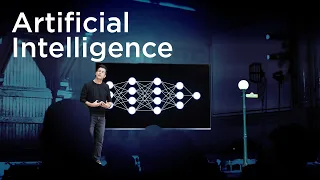



Summary
Harvard's Introduction to Artificial Intelligence
CS50x 2026 presents Harvard University's comprehensive introduction to artificial intelligence, delivered by renowned instructor David J. Malan. This 48-minute lecture serves as the foundational entry point into the intellectual enterprises of AI, bridging theoretical concepts with practical applications. The course tackles the essential components of modern AI systems, from classical machine learning approaches to cutting-edge generative models that have transformed how computers process information and generate human-like responses.
Generative AI and Its Impact
The lecture opens by addressing generative artificial intelligence, one of the most transformative developments in computer science. Generative AI systems are designed to create new content—text, images, code, and more—based on patterns learned from vast datasets. This technology underpins tools like ChatGPT, Claude, and other large language models that have captured mainstream attention. Understanding how these systems work requires grasping both the mathematical foundations and the practical limitations that arise when training models on real-world data.
Mastering Prompt Engineering
Prompt engineering emerges as a crucial skill in the AI era. Rather than simply asking an AI system a question, prompt engineering involves crafting carefully structured requests that guide generative models toward desired outputs. This discipline bridges the gap between user intent and model capability, enabling developers and end-users to extract maximum value from language models. The lecture explores how phrasing, context, and instruction clarity dramatically influence response quality, making prompt engineering both an art and a science.
Practical Tools: CS50.ai and Copilot
The course introduces CS50.ai, a tool developed for the CS50 community, and Microsoft's Copilot, demonstrating how AI assistants integrate into real workflows. These tools exemplify the practical deployment of large language models, showing students how theoretical AI concepts manifest in products used by millions. By examining these systems, learners gain insight into how prompt engineering translates into user-facing features and how different AI implementations handle similar tasks.
Classical Machine Learning Foundations
Before diving into modern deep learning, the lecture establishes classical machine learning concepts. Decision trees are presented as an intuitive machine learning algorithm that mirrors human decision-making processes. Decision trees partition feature space recursively, enabling the model to learn non-linear relationships in data. The minimax algorithm is then introduced as a game-theoretic approach to decision-making, illustrating how machines can think strategically in adversarial scenarios. These classical methods provide essential groundwork for understanding how machines learn patterns from examples.
The Shift to Deep Learning
The course transitions to machine learning more broadly, exploring how systems learn directly from data rather than relying on explicit programming. Machine learning encompasses supervised learning, unsupervised learning, and reinforcement learning paradigms. Deep learning represents a significant evolution, using artificial neural networks with multiple layers to learn hierarchical representations of data. These deep neural networks have revolutionized computer vision, natural language processing, and many other domains by discovering features automatically rather than requiring manual feature engineering.
Large Language Models and Modern AI
Large language models (LLMs) represent the pinnacle of current generative AI research. These models are trained on billions of text examples, learning statistical patterns that enable them to predict the next token in a sequence with remarkable accuracy. The scale of these models—measured in billions or trillions of parameters—combined with transformer-based architectures enables emergent abilities like few-shot learning, reasoning, and code generation. Understanding LLMs requires grasping both the transformer architecture's attention mechanisms and the practical implications of training and deploying models of unprecedented scale.
Addressing AI Hallucinations
The lecture concludes by confronting a critical limitation of generative AI: hallucinations. Language models, despite their sophistication, sometimes generate plausible-sounding but factually incorrect information. This phenomenon arises because LLMs predict text based on statistical likelihood rather than verifiable truth. Hallucinations represent a fundamental challenge in deploying AI systems for applications requiring high factual accuracy, such as medical diagnosis, legal documentation, or scientific research. Recognizing and mitigating hallucinations is essential for responsible AI deployment.
Bridging Theory and Practice
Throughout this lecture, CS50 maintains its tradition of connecting abstract computer science concepts to real-world applications. The progression from decision trees to deep learning to large language models shows how AI capabilities have evolved, and how each technique remains relevant in modern systems. Students emerge with both the conceptual frameworks necessary to understand AI research papers and practical knowledge for applying these tools in projects, whether building chatbots, training custom models, or prompting existing systems effectively.
What you will learn
- Understand how generative AI systems create new content from learned patterns
- Master prompt engineering techniques to optimize interactions with language models
- Apply classical machine learning algorithms like decision trees to real problems
- Grasp the architecture and capabilities of deep learning neural networks
- Recognize the strengths and limitations of large language models
- Identify and mitigate hallucinations in AI-generated responses
Concepts covered
Technologies used
Chapters 13 markers
Next suggested video
Reviews
No reviews yet. Be the first to rate this lesson.