-
02
 CS50x 2026 – Lecture 0 – Scratch
2h 00min
CS50x 2026 – Lecture 0 – Scratch
2h 00min
-
03
CS50x 2026 – Lecture 1 – C
2h 30min
-
04
CS50x 2026 – Lecture 2 – Arrays
2h 25min
-
05
CS50x 2026 – Lecture 3 – Algorithms
1h 59min
-
06
CS50x 2026 – Lecture 4 – Memory
2h 19min
-
07
CS50x 2026 – Lecture 5 – Data Structures
2h 06min
-
08
CS50x 2026 – Lecture 6 – Python
Current lesson
-
09
CS50x 2026 – Lecture 7 – SQL
2h 15min
-
10
CS50x 2026 – Artificial Intelligence
47min
-
11
CS50x 2026 – Lecture 8 – HTML, CSS, JavaScript
2h 22min
-
12
CS50x 2026 – Lecture 9 – Flask
2h 26min
-
13
CS50x 2026 – Lecture 10 – The End
52min
Summary
Python Fundamentals at Harvard Scale
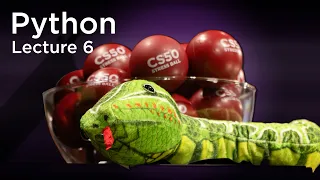
CS50x Lecture 6 represents a complete introduction to Python programming, delivered by Harvard University's renowned Computer Science department. This 150-minute session is designed for absolute beginners who wish to grasp the core concepts of one of the world's most popular programming languages. The lecture follows Harvard's pedagogical approach of building understanding from first principles, ensuring that learners develop not just syntax knowledge but genuine comprehension of programming logic. Python serves as the bridge between computational thinking and practical software development, making it an ideal starting point for anyone aspiring to master computer science or data engineering.
From Syntax to Problem-Solving
The lecture begins with Python's syntax and gradually escalates to practical problem-solving scenarios. Students are introduced to the language's design philosophy: readability and simplicity. The early segments establish how Python differs from lower-level languages, emphasizing its accessibility while maintaining the ability to express complex algorithms. Through hands-on examples like the Speller and Filter programs, the lecture demonstrates how Python's clean syntax translates directly into working software. This progression from theoretical concepts to executable code ensures that learners can immediately apply what they learn to real-world challenges.
Core Data Structures and Types
The lecture dedicates significant time to understanding Python's fundamental data types and structures. Integers, floats, strings, and boolean values form the foundation of any Python program. Beyond primitive types, the session explores lists and dictionaries—two of Python's most powerful built-in data structures. Lists allow for ordered collections of elements, enabling iteration and sequential data processing. Dictionaries provide key-value mapping capabilities, essential for organizing complex information efficiently. These data structures appear repeatedly in real-world applications, from data analysis to web development, making their mastery critical for any programmer.
Functions and Code Organization
Functions represent one of programming's most fundamental concepts for code reuse and organization. The lecture explains how to define, call, and return values from functions, demonstrating their role in breaking large problems into manageable pieces. By structuring code into discrete functions, developers can test individual components, collaborate effectively, and maintain codebases at scale. The session includes practical examples showing how functions transform procedural code into modular, understandable systems. Understanding function scope, parameters, and return types provides the groundwork for writing clean, maintainable Python code.
Control Flow and Conditional Logic
Conditionals form the backbone of decision-making in programming. The lecture covers if, elif, and else statements, showing how programs can branch based on different conditions. The Compare program example illustrates practical applications of relational operators and logical expressions. Control flow extends beyond conditionals to loops, where the session explores while and for loops for repetitive operations. The Meow and Mario examples demonstrate how loops reduce code duplication and enable elegant solutions to iterative problems. Mastering these control structures allows programmers to write efficient algorithms that adapt to varying inputs and conditions.
Object-Oriented Thinking and Exception Handling
The lecture introduces object-oriented programming concepts, showing how Python enables developers to model real-world entities as objects with properties and behaviors. This paradigm shift from procedural thinking to object-based design opens doors to more sophisticated architectures. Equally important is exception handling, which the Mario example and dedicated Exceptions section address. Try-except blocks allow programs to gracefully handle errors rather than crashing unexpectedly. Understanding when and how to catch exceptions is crucial for building robust applications that perform predictably even when encountering unusual inputs or runtime errors.
Working with External Libraries and Tools
The final sections introduce pip, csv modules, and sys libraries, demonstrating Python's ecosystem beyond the standard language. The pip package manager grants access to thousands of community-contributed libraries that extend Python's capabilities dramatically. The csv module enables reading and writing comma-separated data files, a ubiquitous format in data analysis and reporting. The sys module provides system-specific parameters and functions for command-line argument processing. These libraries exemplify Python's philosophy of "batteries included," where common tasks have well-designed solutions readily available. Learning to leverage external libraries transforms Python from a basic scripting language into a powerful platform for specialized domains.
Practical Application and Next Steps
Throughout the 150 minutes, real programs like Speller, Filter, and Mario reinforce conceptual learning with executable code. These examples move beyond toy programs to implementations that solve meaningful problems. The Truncation and Lists sections demonstrate data manipulation techniques applicable to countless real-world scenarios. By the lecture's conclusion, learners have seen Python's trajectory from simple calculations in the Calculator program to complex data structures and library usage. The breadth of material—from fundamental data types through exception handling to package management—creates a solid foundation for independent Python development. This comprehensive introduction prepares students to tackle projects ranging from simple scripts to data analysis pipelines, web applications, and automation tools.
What you will learn
- Understand Python syntax and core programming concepts
- Work with data types, lists, and dictionaries effectively
- Write and organize code using functions and control flow
- Handle errors gracefully with exception management
- Leverage external libraries and package management with pip
- Solve real-world problems through practical programming examples
Concepts covered
Technologies used
Chapters 16 markers
- Introduction
- Python Overview
- Speller Program
- Filter Example
- Functions and Organization
- Data Types Fundamentals
- Calculator Implementation
- Conditionals and Logic
- Object-Oriented Programming
- Loops and Iteration
- Exception Handling
- Lists and Collections
- Dictionaries
- System Module (sys)
- CSV Module
- Package Manager (pip)
Next suggested video
Reviews
No reviews yet. Be the first to rate this lesson.