-
01
 From Zero to Your First AI Agent in 25 Minutes (No Coding)
25min
From Zero to Your First AI Agent in 25 Minutes (No Coding)
25min
-
02
How to Build & Sell AI Agents: Ultimate Beginner’s Guide
3h 50min
-
03
Build & Sell n8n AI Agents (8+ Hour Course, No Code)
8h 26min
-
04
AI Agents Fundamentals In 21 Minutes
21min
-
05
Build an AI Agent From Scratch in Python – Tutorial for Beginners
34min
-
06
Don’t learn AI Agents without Learning these Fundamentals
56min
-
07
Building AI Agents that actually work (Full Course)
58min
-
08
Generative AI Vs Agentic AI Vs AI Agents
Current lesson
-
09
The AI Agent Tutorial That Should’ve Been Your First (no code)
16min
-
10
Generative AI vs AI agents vs Agentic AI
10min




Summary
Understanding the AI Landscape
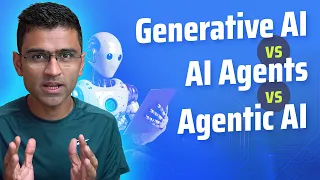
The field of artificial intelligence has evolved significantly over recent years, introducing distinct categories and approaches that serve different purposes. Generative AI, agentic AI, and AI agents are three terms frequently used in modern AI discussions, yet they represent different concepts and capabilities. Understanding the nuances between these categories is essential for professionals, researchers, and organizations looking to leverage AI technologies effectively. Each category brings its own set of characteristics, use cases, and architectural considerations that shape how AI systems interact with their environments and solve problems.
What is Generative AI
Generative AI refers to artificial intelligence systems designed primarily to create new content based on patterns learned from training data. These systems excel at generating text, images, code, audio, and other forms of media. Generative models like large language models (LLMs) work by predicting the next token in a sequence, enabling them to produce coherent and contextually relevant outputs. The foundation of generative AI lies in transformer architectures and deep learning techniques that allow these systems to understand and reproduce patterns from their training datasets. However, generative AI systems are typically reactive in nature, requiring user input or prompts to generate responses, and they do not maintain autonomous agency or long-term objectives beyond fulfilling immediate generation requests.
Core Characteristics of Agentic AI
Agentic AI represents a more advanced paradigm where AI systems possess autonomous decision-making capabilities and can operate independently to achieve specific goals. Unlike generative AI, which responds to prompts, agentic AI systems act proactively, adapting in real time to changing conditions and environments. These systems can perceive their surroundings, reason about complex problems, and take actions without constant human intervention. Agentic AI incorporates planning mechanisms, memory systems, and feedback loops that enable continuous learning and improvement. The distinguishing feature of agentic AI is its ability to break down complex, multi-step problems into manageable tasks, execute them sequentially or in parallel, and adjust strategies based on intermediate results and environmental feedback.
Understanding AI Agents
AI agents are concrete implementations or instances of agentic AI principles. An AI agent is a software entity designed to perceive its environment, make decisions based on that perception, and execute actions to accomplish predefined objectives. AI agents can range from simple rule-based systems that follow predetermined logic to sophisticated autonomous systems powered by large language models. These agents maintain internal state, plan their actions, and learn from outcomes to improve future performance. AI agents are widely deployed in robotics, game playing, autonomous vehicles, customer service automation, and data analysis tasks. The key distinction is that AI agents are the practical embodiment of agentic capabilities, whereas agentic AI refers more broadly to the paradigm and principles governing autonomous intelligent behavior.
Key Differences and Distinctions
The primary difference between generative AI and agentic AI lies in autonomy and goal orientation. Generative AI is content-creation focused and typically operates in a stateless manner, generating outputs in response to inputs without maintaining objectives or adapting strategies. Agentic AI, conversely, maintains persistent goals, adapts strategies based on real-time feedback, and operates with greater autonomy. AI agents serve as the practical implementation layer, bringing agentic principles into tangible systems. While generative AI can be incorporated into AI agents as a component for reasoning or planning, the presence of generative capabilities alone does not make a system agentic. An AI agent might use a large language model as its reasoning engine while adding perception modules, memory systems, planning algorithms, and action execution capabilities that transform it into a truly autonomous system.
Real-World Applications and Use Cases
Generative AI has found widespread adoption in content creation, code generation, customer support through chatbots, and creative applications like image synthesis and music generation. Organizations deploy generative AI to automate routine writing tasks, accelerate software development, and enhance user experiences through natural language interfaces. Agentic AI and AI agents, meanwhile, enable more complex automations such as autonomous data analysis, dynamic workflow optimization, intelligent resource allocation, and adaptive problem-solving in unpredictable environments. Manufacturing facilities deploy AI agents for quality control and process optimization, financial institutions use them for fraud detection and portfolio management, and healthcare systems leverage them for diagnostic assistance and treatment planning. The convergence of generative capabilities with agentic principles creates powerful systems capable of both generating insights and autonomously acting upon them.
Technical Considerations and Architecture
Building agentic AI systems requires integrating multiple technical components beyond what generative AI alone demands. A typical agentic AI architecture includes perception modules to gather environmental data, reasoning engines that may leverage LLMs for complex decision-making, planning systems that decompose goals into actionable steps, memory management to maintain context and learn from history, and execution layers that translate decisions into real-world actions. Generative AI components often serve as the reasoning or planning engine within larger agentic systems. The technical challenge lies not merely in building individual components but in orchestrating them into coherent systems that maintain safety, efficiency, and alignment with intended objectives while operating in dynamic, often uncertain environments.
Future Implications and Evolution
The trajectory of AI development points toward increasingly sophisticated agentic systems that combine generative capabilities with autonomous decision-making and real-time adaptation. Organizations investing in AI infrastructure today must understand these distinctions to make informed decisions about technology selection and implementation strategies. As agentic AI matures, ethical considerations regarding autonomous decision-making, accountability, transparency, and safety become increasingly critical. The evolution from purely generative AI toward agentic systems represents a fundamental shift in how organizations can leverage artificial intelligence, moving from tool-assisted productivity to genuinely autonomous problem-solving systems that operate with minimal human oversight once properly configured and deployed.
What you will learn
- Understand the core differences between generative AI, agentic AI, and AI agents
- Learn how agentic AI systems adapt in real-time and solve multi-step problems
- Identify practical applications of each AI category in business and research
- Explore the architectural components required for building autonomous agentic systems
- Recognize how generative AI integrates into broader agentic AI frameworks
Concepts covered
Technologies used
Chapters 7 markers
Next suggested video


Reviews
No reviews yet. Be the first to rate this lesson.