-
01
 you need to learn MCP RIGHT NOW!! (Model Context Protocol)
38min
you need to learn MCP RIGHT NOW!! (Model Context Protocol)
38min
-
02
Model Context Protocol (MCP), clearly explained (why it matters)
20min
-
03
Claude’s Model Context Protocol is here… Let’s test it
8min
-
04
Model Context Protocol (MCP) Explained for Beginners: AI Flight Booking Demo!
24min
-
05
MCP vs API: Simplifying AI Agent Integration with External Data
Current lesson
-
06
Why MCP really is a big deal | Model Context Protocol with Tim Berglund
11min
-
07
Model Context Protocol Clearly Explained | MCP Beyond the Hype
15min
-
08
MCP Tutorial: Build Your First MCP Server and Client from Scratch (Free Labs)
40min
-
09
The Ultimate MCP Crash Course – Build From Scratch
1h 15min
-
10
Full Course (Lessons 1-11) MCP for Beginners
50min







Summary
Understanding the Model Context Protocol
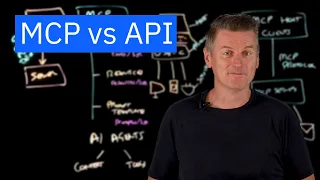
The Model Context Protocol (MCP) represents a significant shift in how AI agents interact with external systems and data sources. Unlike traditional APIs, which require explicit, hardcoded integrations, MCP introduces a standardized approach that enables AI agents to dynamically discover and utilize tools and data sources without predefined configurations. This protocol was designed specifically to address the limitations of conventional API integration patterns when applied to large language models and AI agents. Martin Keen's presentation breaks down the fundamental differences between these two approaches, offering insights into why MCP is becoming increasingly relevant in modern AI workflows.
How MCP Enables Dynamic Discovery
One of the core advantages of MCP over traditional APIs is its ability to support dynamic discovery of capabilities and resources. While standard APIs require developers to manually specify endpoints, authentication methods, and available functions before runtime, MCP allows AI agents to explore and understand what tools and data sources are available at execution time. This dynamic nature means that new capabilities can be added to an MCP-enabled system without requiring changes to the agent itself, significantly reducing friction in AI system development. The protocol effectively acts as a translator between AI agents and external resources, allowing seamless communication regardless of the underlying implementation details of those resources.
Tool Execution and External Integration
MCP streamlines the process of executing tools and accessing external data in ways that traditional API calls cannot easily match. Rather than requiring developers to write wrapper code around each API endpoint, MCP provides a unified interface through which agents can discover, understand, and invoke tools. This means that an AI agent can be presented with a new tool or data source through MCP without requiring modifications to the agent's core logic. The protocol handles the complexity of translating natural language requests into appropriate tool invocations, managing parameters, and returning results in a structured format that the agent can understand and use. This abstraction layer significantly reduces development time and makes AI systems more flexible and maintainable.
Traditional API Limitations in AI Workflows
Traditional API design focuses on human developers as the primary consumers of the interface. Each API typically has its own authentication mechanism, documentation, parameter structures, and error handling patterns. When AI agents need to integrate with multiple APIs, this heterogeneity creates significant challenges. The agent must be explicitly programmed with knowledge of each API's specifics, making the system brittle and difficult to extend. Additionally, many legacy APIs were not designed with the use case of autonomous AI agents in mind, leading to inefficiencies in how agents must structure requests and interpret responses. MCP addresses these issues by providing a consistent protocol that abstracts away API-specific details while still enabling full access to the underlying functionality and data.
Simplifying LLM Workflows at Scale
When deploying large language models in production environments, integration complexity becomes a significant operational burden. Traditional approaches require building custom integration layers for each external service, which must be maintained as services evolve. MCP dramatically simplifies this landscape by providing a standardized way for LLMs to access external tools and data sources. This means that scaling AI systems becomes more straightforward—new tools can be added through the MCP interface without requiring changes to the core AI application. For enterprises managing multiple AI agents across different use cases, this standardization translates to reduced development costs, faster time-to-market, and more reliable systems. The protocol essentially removes the integration complexity from the AI layer, allowing developers to focus on training and optimizing their models rather than building bespoke connectors.
MCP's Advantage Over Point Solutions
The fundamental difference between MCP and traditional APIs lies in the design philosophy. APIs are typically point-to-point solutions where the consumer must understand and adapt to the provider's interface. MCP inverts this relationship by creating a standard protocol that providers implement, ensuring that all tools and data sources present a consistent interface to agents. This approach scales far better than traditional APIs when dealing with AI systems that need to access numerous external resources. Agents using MCP can treat all integrated tools uniformly, applying the same interaction patterns regardless of whether they are connecting to cloud databases, third-party services, or internal systems. This uniformity reduces cognitive load on both developers and AI systems, leading to more reliable and maintainable solutions.
Practical Implications for AI Integration
For organizations implementing AI agents in production, choosing between MCP and traditional API integration has significant practical implications. Systems built on MCP foundations are inherently more extensible—adding new data sources or tools requires minimal changes to existing agent code. The protocol also facilitates better separation of concerns, where the AI agent focuses on reasoning and decision-making while MCP handles the mechanical details of tool invocation and data retrieval. Furthermore, MCP's standardization makes it easier to audit and control what external resources an AI agent can access, which is crucial for security and compliance in enterprise environments. Teams that adopt MCP early gain a competitive advantage in rapidly deploying AI applications that can adapt to changing business requirements without extensive rearchitecting.
The Future of AI Integration Standards
As AI agents become more prevalent in enterprise and consumer applications, standardized integration protocols like MCP will likely become the default approach for connecting agents to external systems. The advantages of dynamic discovery, reduced development overhead, and improved maintainability position MCP as a foundational technology for the next generation of AI systems. Organizations that invest in understanding and implementing MCP now will be better positioned to leverage AI agents effectively as the technology matures and becomes more widely adopted across industries.
What you will learn
- Understand the differences between Model Context Protocol and traditional API approaches
- Learn how MCP enables dynamic discovery and tool execution in AI agents
- Apply MCP concepts to simplify external data integration in LLM workflows
- Evaluate when to use MCP versus traditional APIs for AI integration scenarios
- Implement standardized AI agent interfaces using MCP principles
Concepts covered
Technologies used
Chapters 8 markers
Next suggested video

Reviews
No reviews yet. Be the first to rate this lesson.