-
01
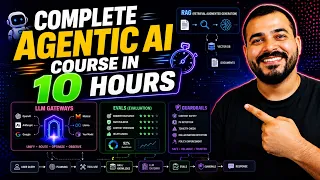
 Complete Agentic AI Course In 10 Hours- Langchain, Langgraph, RAG,Vectorless RAG, Guardrails,Evals
11h 13min
Complete Agentic AI Course In 10 Hours- Langchain, Langgraph, RAG,Vectorless RAG, Guardrails,Evals
11h 13min
-
02
LangSmith Tutorial – LLM Evaluation for Beginners
36min
-
03
Complete Beginner’s Course on AI Evaluations in 50 Minutes (2025) | Aman Khan
51min
-
04
Guardrails with LangChain: A Complete Crash Course for Building Safe AI Agents
38min
-
05
Guardrails for LLM Applications | Complete Tutorial for AI Developers WIth Guardrails AI
Current lesson
-
06
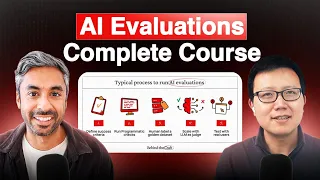
AI Evaluations Clearly Explained in 50 Minutes (Real Example) | Hamel Husain
52min
-
07
Are you still babysitting AI coding agents? Build better guardrails!
37min
-
08
LLM Evaluation – Build Reliable AI Apps | LLM evaluation metrics | LLM evaluation techniques
39min
-
09
A Practical Guide to LLM Evaluation – Michelle Yi
31min
-
10
How to Setup LLM Evaluations Easily (Tutorial)
17min





Summary
Understanding Guardrails in Software and AI
Guardrails represent a critical control mechanism in both traditional software development and modern artificial intelligence systems. In conventional software engineering, guardrails function as protective boundaries that ensure applications behave within defined parameters, preventing unintended side effects and maintaining system stability. When applied to Large Language Models and generative AI applications, guardrails take on heightened importance by acting as validation layers that constrain model outputs to meet specific requirements, safety standards, and business logic constraints. This comprehensive 86-minute tutorial by Sunny Savita explores the foundational concepts of guardrails and their practical implementation using the Guardrails AI framework, a specialized library designed specifically for developers building production-grade AI systems.
The Evolution of AI Safety and Output Validation
As Large Language Models have become increasingly powerful and widely deployed, the need for robust output validation has grown proportionally critical. Unlike traditional software systems where behavior is deterministic and fully controlled, LLMs generate probabilistic outputs that can sometimes produce hallucinations, leak sensitive information, or fail to conform to required data structures. Guardrails AI addresses these challenges by providing a systematic framework for validating and controlling model outputs at the schema level, ensuring that generated content adheres to predefined specifications. The framework encompasses multiple validation strategies, from simple format checks to complex semantic validations, making it possible for developers to enforce consistency and reliability across their AI pipelines without requiring extensive custom code.
Core Concepts of the Guardrails Framework
The Guardrails AI framework introduces several foundational concepts that enable developers to build safer, more controlled LLM applications. At its core, the framework allows developers to define validation rules and constraints that automatically process and validate model outputs before they reach end users or downstream systems. These guardrails can detect and prevent prompt injection attacks, enforce structured output formats such as JSON schemas, validate that responses contain specific required fields, and ensure that generated content meets business logic requirements. The framework operates by intercepting model outputs and running them through a series of validators that either accept the output as compliant or trigger remediation strategies such as regeneration, filtering, or user alerts, depending on the severity and nature of the validation failure.
Preventing Prompt Injection and Security Threats
One of the most dangerous vulnerabilities in LLM applications involves prompt injection attacks, where malicious actors embed instructions within user input designed to override the model's original objectives. Guardrails AI provides sophisticated mechanisms for detecting and mitigating these attacks by validating not only the model's output but also analyzing patterns that suggest injection attempts. The framework can identify when a model has been influenced by injected instructions and either reject the output or flag it for human review. This security layer is particularly crucial for applications deployed in production environments where user input cannot be fully trusted, and where failures could impact business operations, user safety, or data integrity. The tutorial covers practical examples demonstrating how prompt injection vulnerabilities manifest and how Guardrails AI's detection mechanisms prevent them from compromising system integrity.
Schema-Level Control and Structured Outputs
Modern AI applications frequently require LLM outputs to conform to specific data structures—JSON schemas that define required fields, data types, nested objects, and validation rules. Guardrails AI excels at enforcing these structural requirements at the schema level, ensuring that every model output can be reliably parsed and integrated into downstream systems. Rather than accepting whatever format the model happens to generate, developers can define exact specifications for required outputs, including field names, data types, required versus optional parameters, and constraint rules. This approach eliminates the common problem of parsing failures and incompatible data formats that plague naive LLM integrations. The framework includes built-in support for popular schema definition methods, including JSON Schema and Pydantic models, making it straightforward for developers familiar with modern Python development practices to implement schema validation in their applications.
Practical Implementation with Guardrails AI Library
The hands-on portion of the tutorial demonstrates the actual implementation of Guardrails AI within a real application context. Developers learn how to install the Guardrails library, import necessary components, and initialize guardrails within their LLM pipelines. The tutorial covers how to connect guardrails to popular language models including OpenAI's GPT, Google's Gemini, and other compatible providers. Practical examples show how to instantiate validators, define custom validation rules specific to particular use cases, and integrate the framework with existing LLMOps tools and orchestration frameworks like LangChain and LangGraph. The tutorial emphasizes pragmatic patterns that developers can immediately apply to their own projects, providing sufficient code examples and walkthrough demonstrations to demystify the implementation process.
Integration with Modern AI Development Stacks
Guardrails AI is designed to fit seamlessly into contemporary AI development workflows and technology stacks. The framework integrates naturally with LangChain for building language model applications, works alongside FastAPI for serving AI endpoints, and complements advanced retrieval strategies like Retrieval-Augmented Generation (RAG). Developers building multi-agent systems with LangGraph can incorporate guardrails to ensure that each agent's outputs meet quality and safety standards before being passed to subsequent agents in the pipeline. The tutorial contextualizes guardrails within the broader ecosystem of production AI development, showing how this framework complements other essential tools and patterns like LangChain, structured outputs, and advanced orchestration techniques. Understanding where guardrails fit within this larger technology landscape helps developers make informed architectural decisions when designing complex AI systems.
Key Takeaways for Production-Ready AI Systems
The comprehensive exploration of Guardrails AI equips developers with the knowledge necessary to build AI applications that are not merely functional but truly production-ready. This means systems that gracefully handle edge cases, resist adversarial attacks, validate their outputs automatically, and maintain high standards of data integrity and consistency. For AI developers, GenAI engineers, and technical teams building customer-facing or mission-critical AI applications, understanding and implementing guardrails is no longer optional—it represents a fundamental requirement of professional AI development. The framework provides concrete tools and patterns for addressing these requirements without requiring developers to build custom validation systems from scratch. By mastering guardrails, developers can focus their efforts on building powerful AI features while delegating safety, validation, and control concerns to a mature, specialized framework.
What you will learn
- Understand what guardrails are and why they are essential for LLM applications
- Implement schema-level validation and structured output control using Guardrails AI
- Detect and prevent prompt injection attacks in production LLM systems
- Integrate Guardrails AI with LangChain, FastAPI, and other AI development frameworks
- Build validators to enforce business logic constraints on model outputs
Concepts covered
Technologies used
Chapters 8 markers
Next suggested video
Reviews
No reviews yet. Be the first to rate this lesson.