Course overview
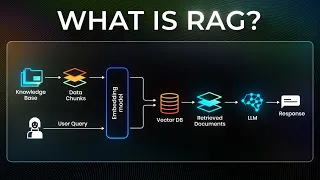
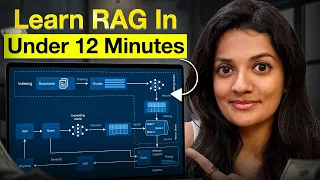
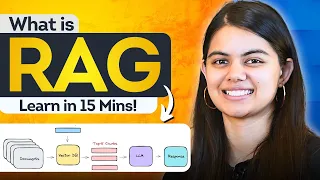
This course delivers a comprehensive, hands-on journey into Retrieval Augmented Generation (RAG) and the vector databases that power it. You will move from foundational concepts to advanced implementations, learning how to ground large language models with real-time, external data. The curriculum covers the complete RAG pipeline: indexing, retrieval, and generation. You will explore critical techniques like document chunking, semantic similarity search, query expansion, and multi-hop reasoning. Through step-by-step tutorials, you will work with core technologies including LangChain, FAISS, MongoDB Atlas, and various embedding models to build systems that produce accurate, factual, and contextually relevant outputs.
Who this course is for
This course is ideal for software developers, data scientists, and AI practitioners who want to move beyond standalone large language models. It serves learners who need to build AI applications that can access proprietary, up-to-date, or domain-specific knowledge without retraining. Whether you are a beginner seeking a clear conceptual foundation or an experienced engineer looking to implement production RAG systems, the content scales. You will find value if you work with customer support bots, internal document search, or any system requiring an LLM to provide grounded, verifiable answers from external data sources.
How to study this sequence
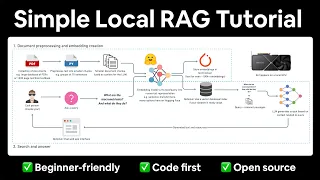
Begin with the foundational lessons on embeddings and vector databases to build a solid conceptual base before moving to the core RAG architecture tutorials. Follow the sequence to first understand the three-stage pipeline, then implement simple systems, and finally tackle advanced optimization patterns like query decomposition and HyDE. For the hands-on tutorials, code along with the provided Python examples using LangChain and vector stores like FAISS. Once you complete the full pipeline, revisit the advanced techniques lesson to refine your system with fallback strategies, reranking, and agentic approaches for robust, production-ready performance.
What you should be able to do
Upon completing this course, you will be able to design and implement a complete Retrieval Augmented Generation system from scratch. You will have practical experience building semantic search functionality, integrating vector databases, and optimizing retrieval pipelines to reduce hallucinations. You will understand how to select appropriate embedding models and chunking strategies for different document types. The final result is the ability to build an AI application that can intelligently chat with your own document collections, providing accurate, source-grounded answers by combining the generative power of LLMs with your specific data.