-
01
 Learn RAG From Scratch – Python AI Tutorial from a LangChain Engineer
2h 33min
Learn RAG From Scratch – Python AI Tutorial from a LangChain Engineer
2h 33min
-
02
OpenAI Embeddings and Vector Databases Crash Course
18min
-
03
What is a Vector Database? Powering Semantic Search & AI Applications
9min
-
04
RAG Explained For Beginners
10min
-
05
RAG Explained in 12 Minutes
12min
-
06
Vector Search RAG Tutorial – Combine Your Data with LLMs with Advanced Search
1h 11min
-
07
Complete RAG Crash Course With Langchain In 2 Hours
2h 08min
-
08
What is RAG ? | Completely Explained in 15 Minutes
Current lesson
-
09
Local Retrieval Augmented Generation (RAG) from Scratch (step by step tutorial)
5h 40min
-
10
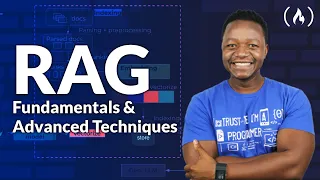
RAG Fundamentals and Advanced Techniques – Full Course
1h 36min




Summary
Understanding RAG Fundamentals
Retrieval-Augmented Generation (RAG) represents a significant advancement in how large language models can access and utilize information. Unlike traditional LLMs that rely solely on training data frozen at a specific point in time, RAG systems augment the generative capabilities of language models by integrating a retrieval mechanism that can fetch relevant information from external knowledge sources. This architectural approach addresses one of the most critical limitations of standalone LLMs: their inability to access current information or domain-specific knowledge that wasn't present in their training datasets. By combining retrieval and generation in a unified pipeline, RAG enables more accurate, contextually relevant, and up-to-date responses across diverse use cases.
Why RAG Outperforms Traditional LLMs
Traditional large language models generate responses based entirely on patterns learned during training, which inherently limits their knowledge to information available up to their training cutoff date. This creates substantial challenges when handling queries requiring real-time information, specialized domain knowledge, or proprietary company data. RAG systems overcome these limitations by first retrieving relevant documents or knowledge chunks from external databases before generating responses. This two-stage approach dramatically improves factual accuracy, reduces hallucinations, and enables models to incorporate information they were never explicitly trained on. Organizations can update their knowledge bases independently without retraining the underlying language model, providing cost-effective flexibility and ensuring that systems always have access to the most current information available.
The Complete RAG Pipeline Architecture
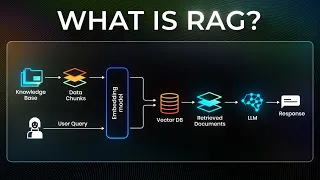
A functional RAG system operates through several interconnected stages that work seamlessly together. The pipeline begins with a user query, which is processed through an embedding model that converts the text into a numerical vector representation. This query embedding is then used to search a vector database containing embeddings of documents from the knowledge base. The retrieval stage returns the most semantically similar documents based on vector similarity metrics. These retrieved documents are subsequently packaged with the original query as context and sent to the language model, which generates a response informed by this additional context. The final response reflects both the model's inherent knowledge and the specific information retrieved from external sources, resulting in answers grounded in current and relevant information rather than generic training-based knowledge.
Core Technical Implementation Pillars
Successful RAG implementation depends on several critical technical pillars working in harmony. The first pillar is the embedding model, which must effectively convert both documents and queries into comparable vector representations while preserving semantic meaning. Vector databases form the second pillar, storing embeddings efficiently and enabling rapid similarity searches across large knowledge bases. The retrieval mechanism constitutes the third pillar, responsible for selecting the most relevant documents based on the query embedding and applying ranking algorithms when necessary. The language model generation component is the fourth pillar, which takes the context from retrieved documents and synthesizes responses that integrate this information naturally. Data preprocessing and chunking strategies form the fifth pillar, determining how documents are split and prepared for embedding to balance granularity with semantic coherence. Each component must be optimized and coordinated to ensure that the entire system delivers accurate, relevant, and performant results.
Common RAG Architectures and Use Cases
Organizations deploy RAG across multiple distinct architectures tailored to specific requirements. The basic RAG architecture retrieves documents once and feeds them directly to the language model, suitable for straightforward question-answering scenarios over static knowledge bases. Advanced architectures incorporate reranking layers that refine the initial retrieval results, query expansion techniques that generate multiple search queries to improve coverage, and iterative retrieval mechanisms that refine results through multiple passes. Conversational RAG systems maintain dialogue history to provide context-aware responses in multi-turn interactions. Enterprise RAG deployments often implement sophisticated architectures with semantic chunking, metadata filtering, and relevance feedback mechanisms. Use cases span customer support automation where systems answer questions by retrieving relevant documentation, enterprise search enabling employees to find information across organizational knowledge bases, legal and compliance applications requiring access to specific regulatory documents, medical decision support retrieving relevant clinical research, and research assistant tools helping scholars navigate vast publication databases.
Practical Benefits for Modern Organizations
RAG delivers substantial operational and strategic advantages for modern organizations implementing AI solutions. Companies can maintain large language model deployments without the prohibitive cost and complexity of constant retraining, updating their knowledge bases independently to reflect current information, policy changes, or new products. The integration of reliable retrieval mechanisms significantly reduces hallucinations and improves factual accuracy, building user confidence in AI-generated responses. RAG enables organizations to leverage proprietary data and specialized knowledge without exposing sensitive information to training procedures or relying on external model providers. Response latency remains low compared to traditional retrieval-augmented search systems, since generation happens only once with relevant context rather than requiring multiple database lookups and manual synthesis. Organizations can audit and trace which documents influenced specific responses, providing transparency and accountability critical for regulated industries.
Implementation Considerations and Trade-offs
Implementing RAG systems requires careful consideration of multiple technical and business trade-offs. The quality of retrieved documents directly impacts response quality, making document selection and knowledge base organization critical success factors. Latency increases compared to non-augmented generation due to the retrieval step, requiring optimization strategies like caching and index management. The effectiveness of vector embeddings depends on model selection and training data, with domain-specific embedding models often outperforming general-purpose alternatives. Chunking strategies must balance granularity with semantic completeness, as overly fine or coarse chunking reduces retrieval effectiveness. Relevance ranking and reranking add computational cost but often significantly improve results, requiring evaluation to determine optimal complexity levels. Organizations must establish processes for knowledge base maintenance, quality assurance, and continuous improvement as systems operate in production environments.
What you will learn
- Understand the core principles of Retrieval-Augmented Generation and how it differs from traditional LLMs
- Implement the complete RAG pipeline including embedding, retrieval, and generation stages
- Evaluate different RAG architectures and select appropriate designs for specific use cases
- Optimize retrieval mechanisms using vector databases and semantic search techniques
- Deploy RAG systems in enterprise environments with proper knowledge base management
Concepts covered
Technologies used
Chapters 5 markers
Next suggested video
Reviews
No reviews yet. Be the first to rate this lesson.