-
01
 Learn RAG From Scratch – Python AI Tutorial from a LangChain Engineer
2h 33min
Learn RAG From Scratch – Python AI Tutorial from a LangChain Engineer
2h 33min
-
02
OpenAI Embeddings and Vector Databases Crash Course
18min
-
03
What is a Vector Database? Powering Semantic Search & AI Applications
9min
-
04
RAG Explained For Beginners
10min
-
05
RAG Explained in 12 Minutes
12min
-
06
Vector Search RAG Tutorial – Combine Your Data with LLMs with Advanced Search
Current lesson
-
07
Complete RAG Crash Course With Langchain In 2 Hours
2h 08min
-
08
What is RAG ? | Completely Explained in 15 Minutes
17min
-
09
Local Retrieval Augmented Generation (RAG) from Scratch (step by step tutorial)
5h 40min
-
10
RAG Fundamentals and Advanced Techniques – Full Course
1h 36min




Summary
Understanding Vector Embeddings and Search
Vector embeddings represent text, images, or other data as numerical arrays in high-dimensional space, enabling machines to understand semantic meaning rather than just matching keywords. This foundational concept allows language models and search systems to grasp the contextual relationships between different pieces of information. By converting unstructured data into dense vector representations, developers can leverage the power of large language models to perform intelligent searches and retrieval tasks. Vector search differs fundamentally from traditional keyword-based search because it captures meaning rather than surface-level pattern matching, making it invaluable for modern AI applications.
The Role of Vector Search in Modern Applications
Vector search has become essential infrastructure for building AI-powered applications that need to understand and retrieve information based on semantic similarity. When combined with large language models like GPT-4, vector search enables retrieval-augmented generation, or RAG, a technique that allows models to access external knowledge bases and provide more accurate, contextually relevant responses. This approach solves the problem of knowledge cutoff dates in language models and allows developers to integrate proprietary or real-time data into their AI systems. The ability to search through millions of vectors efficiently has made this technology practical and scalable for production applications.
MongoDB Atlas Vector Search Capabilities
MongoDB Atlas provides a managed vector search service that integrates seamlessly with the MongoDB database, allowing developers to store both traditional data and vector embeddings in the same document structure. This eliminates the need to maintain separate vector databases and simplifies the architecture of applications. Atlas Vector Search uses efficient indexing and retrieval mechanisms to search through high-dimensional vector spaces at scale, supporting millions of documents with fast query performance. The service is particularly valuable because it allows developers to combine traditional queries with vector similarity searches, enabling hybrid approaches that leverage both exact matching and semantic relevance.
Project 1: Building a Semantic Movie Search Engine
The first project demonstrates how to create a semantic search system for a movie database using vector embeddings. Rather than searching by genre tags or keywords, the system understands natural language queries and finds movies based on plot similarity and thematic content. This project teaches the practical mechanics of converting movie descriptions into embeddings, indexing them in MongoDB Atlas, and querying them based on user input. The semantic approach means users can search for concepts like "a story about overcoming personal challenges" and receive relevant movie recommendations, showcasing how vector search captures meaning beyond simple keyword matching.
Project 2: RAG System with LangChain and OpenAI
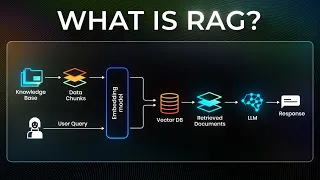
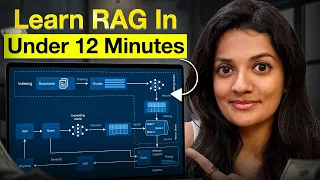
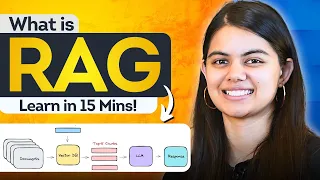
The second project builds a retrieval-augmented generation system that combines MongoDB Atlas vector search with LangChain, an orchestration framework for language models, and OpenAI's GPT-4 API. This project demonstrates the complete RAG pipeline: converting documents into embeddings, storing them in Atlas, retrieving relevant context based on user queries, and passing that context to GPT-4 for generating informed responses. RAG is particularly powerful because it allows language models to cite sources and provide answers grounded in specific documents or datasets, significantly improving factual accuracy and trustworthiness. The LangChain framework abstracts away much of the complexity involved in coordinating between vector databases, language models, and application logic.
Project 3: Intelligent Documentation Chatbot
The third project extends RAG concepts into a conversational interface by building a chatbot that accesses a documentation knowledge base to answer user questions accurately. The chatbot uses vector search to identify relevant documentation sections, feeds them as context to the language model, and generates responses that are grounded in the actual documentation. This project is particularly relevant for enterprise applications where companies need to provide customer support or internal knowledge access without manually curating FAQ responses. The conversational format makes complex information more accessible while the RAG foundation ensures accuracy and verifiability.
Practical Architecture and Integration Patterns
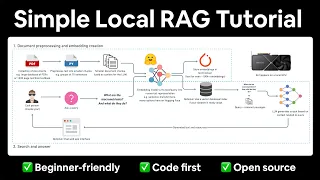
Across all three projects, several architectural patterns emerge for integrating vector search with language models. The basic pattern involves an embedding model that converts raw text into vectors, a vector database that indexes and retrieves these vectors efficiently, and a language model that generates responses based on retrieved context. LangChain provides abstractions that handle the orchestration between these components, reducing boilerplate code and making the integration more maintainable. Understanding these patterns allows developers to extend the projects to their own use cases, whether building search engines, question-answering systems, or more sophisticated AI applications.
Getting Started with the Code and Resources
The tutorial provides complete code examples and repositories that developers can clone and run locally or adapt for their own projects. MongoDB Atlas offers a free tier suitable for learning and small-scale projects, while LangChain and OpenAI APIs are similarly accessible with free tier options or pay-as-you-go pricing. The combination of these tools creates a modern tech stack that is both powerful and accessible to developers of various skill levels. Working through the three projects sequentially builds foundational knowledge about vector embeddings and RAG before tackling more complex chatbot scenarios.
What you will learn
- Understand how vector embeddings represent data semantically
- Implement vector search in MongoDB Atlas for semantic similarity queries
- Build retrieval-augmented generation systems with LangChain and OpenAI
- Create a chatbot that accesses external documentation for accurate responses
- Integrate multiple AI tools and databases into production-ready applications
Concepts covered
Technologies used
Chapters 7 markers
Next suggested video
Reviews
No reviews yet. Be the first to rate this lesson.