-
01
 Every Claude Code Concept Explained for Normal People
27min
Every Claude Code Concept Explained for Normal People
27min
-
02
Master 95% of Claude Code in 36 Mins (as a beginner)
36min
-
03
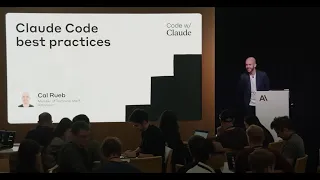
Claude Code best practices | Code w/ Claude
Current lesson
-
04
The Ultimate Claude Code Guide | MCP, Skills & More
37min
-
05
How I use Claude Code (Senior Software Engineer Tips)
9min
-
06
7 Secret Prompts That Make Claude CODE 10x Better
10min
-
07
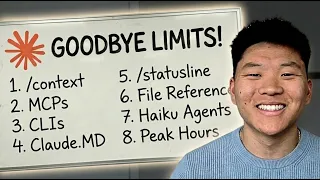
18 Claude Code Token Hacks in 18 Minutes
18min
-
08
How to Build Claude Agent Teams Better Than 99% of People
16min
-
09
How to Make Claude Code Your AI Engineering Team
21min
-
10
Claude Code Essentials
12h 20min




Summary
Understanding Claude's Architecture for Code Generation
Claude represents a significant advancement in AI-assisted code development, built on principles that prioritize accuracy, safety, and practical utility. This presentation from Anthropic's Code w/ Claude event explores the foundational strategies that enable developers to leverage Claude most effectively when writing, debugging, and optimizing code. Cal Rueb, a Member of Technical Staff at Anthropic, walks through the practical methodologies that transform Claude from a simple code completion tool into a comprehensive development partner. Understanding these best practices begins with recognizing how Claude processes context, interprets intent, and generates code that aligns with both functional requirements and production standards.
Prompt Engineering for Code Tasks
One of the most critical aspects of working with Claude is structuring prompts in ways that elicit high-quality, reliable code outputs. Rather than asking Claude for broad coding solutions, developers achieve better results by being explicit about requirements, constraints, and desired patterns. This includes clearly specifying programming languages, frameworks, error handling expectations, and any architectural decisions that should influence the generated code. The presentation emphasizes that well-formed prompts act as contracts between developer intention and AI output, reducing ambiguity and increasing the likelihood that the generated code will require minimal revision. Additionally, providing context—such as existing codebase patterns, style guides, or performance requirements—significantly enhances Claude's ability to generate code that integrates seamlessly into real-world projects.
Leveraging Claude for Code Review and Refactoring
Beyond initial code generation, Claude proves invaluable as a code review partner. Developers can paste existing code and ask Claude to identify potential bugs, security vulnerabilities, performance bottlenecks, and stylistic improvements. This collaborative approach transforms code review from a one-way process into an educational dialogue. Claude can explain why certain patterns are problematic, suggest concrete improvements with examples, and help developers understand the reasoning behind best practices. Refactoring with Claude becomes more efficient because the AI can propose changes incrementally, explain trade-offs between different approaches, and help maintain consistency across codebases. For teams without dedicated code review resources, Claude provides immediate, tireless feedback that accelerates learning and improves code quality.
Context Windows and Token Management
Understanding Claude's context window—the amount of text the model can process in a single interaction—is essential for working effectively with larger codebases and complex projects. The presentation covers strategies for managing token usage efficiently, such as summarizing irrelevant code sections, focusing on specific functions rather than entire files, and structuring multi-turn conversations to maintain continuity while staying within limits. Developers learn when it makes sense to split code analysis into multiple requests versus condensing information to stay within a single context window. This knowledge directly impacts cost-efficiency and response speed, particularly for teams building production systems where API costs and latency matter significantly.
Building Robust Error Handling and Testing Strategies
Claude excels at helping developers anticipate failure modes and construct comprehensive error handling logic. By describing edge cases and potential runtime issues upfront, developers can ask Claude to generate code that addresses these scenarios proactively. The presentation demonstrates how Claude can help write unit tests, integration tests, and even property-based tests that catch bugs before code reaches production. Claude can generate test cases for functions, explain what each test validates, and help developers achieve higher code coverage. This collaborative testing approach reduces the cognitive load of thinking through every possible failure mode independently, while simultaneously improving overall software reliability.
Debugging and Troubleshooting with Claude
When code behaves unexpectedly, Claude becomes an effective debugging partner. Developers can paste error messages, logs, and relevant code snippets, then ask Claude to diagnose the issue. The AI analyzes patterns, considers environmental factors, and often identifies root causes that might take humans longer to spot. Beyond simple fixes, Claude helps developers understand why bugs occur, teaching them patterns to avoid in the future. This educational dimension means that using Claude for debugging yields long-term benefits beyond solving individual problems. The presentation shows how structuring debugging requests—including clear descriptions of expected versus actual behavior—leads to more accurate diagnoses and faster resolution times.
Security Considerations and Safe Code Practices
Security vulnerabilities often hide in seemingly innocent code patterns. Claude helps developers identify and eliminate common security risks such as SQL injection vulnerabilities, improper authentication, insecure deserialization, and unsafe cryptographic practices. By asking Claude to review code specifically through a security lens, developers can catch issues that might otherwise reach production. The presentation emphasizes that Claude is not a replacement for professional security audits, but rather a first line of defense that catches obvious vulnerabilities and helps developers develop security awareness. Teams integrating Claude into their development pipeline gain the ability to shift security considerations earlier in the development lifecycle, reducing remediation costs.
Optimizing for Performance and Scalability
While correctness matters most, performance increasingly impacts user experience and operational costs. Claude assists in identifying algorithmic inefficiencies, suggesting more optimal data structures, and recommending architectural patterns that scale better. Developers can ask Claude to analyze code for performance bottlenecks, profile hot paths, and suggest concrete optimizations with explanations of their impact. The presentation covers scenarios where Claude recommends caching strategies, database query optimizations, and asynchronous processing patterns. This guidance helps developers write code that works correctly and performs efficiently from the start, rather than discovering performance problems after deployment.
What you will learn
- Master prompt engineering techniques to generate production-quality code with Claude
- Leverage Claude for comprehensive code review, debugging, and refactoring workflows
- Optimize context window usage and manage token efficiency in API interactions
- Build robust error handling, testing strategies, and security practices collaboratively
- Apply performance optimization and architectural patterns using Claude's guidance
Concepts covered
Technologies used
Chapters 9 markers
- Introduction and event opening
- Understanding Claude's code capabilities
- Prompt engineering fundamentals for code
- Context windows and token management
- Code review and refactoring strategies
- Testing and error handling with Claude
- Security analysis and vulnerability detection
- Performance optimization techniques
- Q&A and final recommendations
Next suggested video


Reviews
No reviews yet. Be the first to rate this lesson.