-
01
 become an AI HACKER (it’s easier than you think)
16min
become an AI HACKER (it’s easier than you think)
16min
-
02
What Is a Prompt Injection Attack?
10min
-
03
Mastering LLM Security Testing: A Comprehensive Guide
1h 53min
-
04
Hacking LLMs Demo and Tutorial (Explore AI Security Vulnerabilities)
26min
-
05
Explained: The OWASP Top 10 for Large Language Model Applications
Current lesson
-
06
Guide to Architect Secure AI Agents: Best Practices for Safety
13min
-
07
AI Red Teaming: A Developer’s Guide to LLM Security
8min
-
08
Intro to LLM Security – OWASP Top 10 for Large Language Models (LLMs)
57min
-
09
How to Pentest LLMs Like a Security Researcher Cybersecurity
1h 43min
-
10
Red Teaming AI: OWASP LLM Top 10 with Brian and Derek
1h 07min







Summary
Understanding OWASP Top 10 for LLMs
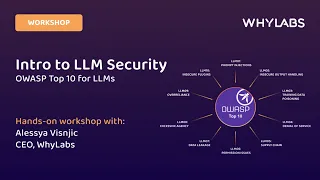
The Open Worldwide Application Security Project (OWASP) has established a critical framework identifying the top ten security risks specific to Large Language Model applications. As LLMs become increasingly integrated into business operations and consumer-facing applications, understanding these vulnerabilities has become essential for security professionals, developers, and organizations deploying AI systems. The OWASP Top 10 for LLMs represents a comprehensive effort to standardize threat assessment and mitigation strategies in the AI security landscape, addressing risks that differ significantly from traditional software vulnerabilities.
Direct Prompt Injection Attacks
Direct prompt injection represents one of the most immediate threats to LLM systems. This attack vector occurs when malicious actors craft carefully engineered prompts designed to override the model's original instructions or bypass safety guardrails. By injecting malicious commands directly into user input, attackers can manipulate the model's behavior, forcing it to ignore its intended constraints or produce harmful outputs. The vulnerability exists because LLMs process all text input as instructions, making it difficult to distinguish between legitimate user queries and injected commands designed to subvert the system's core functionality.
Indirect Prompt Injection Vulnerabilities
Indirect prompt injection extends the threat surface beyond direct user input to include data sources the model retrieves or processes during operation. When an LLM ingests information from external sources—such as web pages, documents, databases, or third-party APIs—attackers can embed malicious instructions within those sources. These hidden instructions may not be immediately visible to users but become activated when the model processes the contaminated data. This attack vector is particularly dangerous because it can affect multiple users and applications drawing from the same compromised data sources, making detection and mitigation significantly more challenging than direct injection attacks.
Insecure Output Handling Risks
Insecure output handling occurs when applications fail to properly validate, sanitize, or contextualize the text generated by LLMs before presenting it to users or downstream systems. LLMs can produce plausible-sounding but false information, malicious code, or manipulated content that appears legitimate. If output is used directly without verification—such as executing generated code, trusting generated information for critical decisions, or displaying generated content without review—downstream systems become vulnerable. This vulnerability extends beyond the LLM itself to encompass how the entire application pipeline treats model outputs, requiring comprehensive validation mechanisms at every stage where LLM-generated content interfaces with users, systems, or decision-making processes.
Training Data Contamination and Poisoning
Training data security represents a foundational vulnerability in LLM systems. The data used to train and fine-tune models can be intentionally poisoned or inadvertently contaminated with malicious, biased, or sensitive information. When models are trained on compromised datasets, these vulnerabilities become embedded in the model's weights and behaviors, persisting regardless of subsequent security measures applied at deployment. Organizations must carefully vet their training data sources, implement data governance practices, and understand the provenance of datasets used in model development. Additionally, the risk extends to fine-tuning processes where proprietary or sensitive organizational data might be inadvertently exposed or used in ways that compromise model security and privacy.
Over-Reliance on LLM Outputs
Over-reliance represents a critical organizational and operational vulnerability where users, developers, or decision-makers trust LLM outputs without appropriate skepticism or verification. Large Language Models, while remarkably capable, are probabilistic systems that can produce confident-sounding but incorrect information—a phenomenon known as hallucination. When organizations deploy LLMs for high-stakes applications such as medical diagnosis, legal analysis, financial advice, or security decisions without implementing human oversight or verification protocols, they expose themselves to significant risks. This vulnerability is exacerbated in scenarios where users lack the expertise to identify when the model has provided incorrect or incomplete information, leading to potentially harmful decisions made on the basis of AI-generated content treated as authoritative.
Implementing Comprehensive Security Strategies
Addressing these OWASP Top 10 vulnerabilities requires a multi-layered approach combining technical controls, organizational policies, and user education. Organizations should implement input validation and output sanitization, establish clear guardrails within prompts, employ monitoring systems to detect unusual behavior patterns, and maintain human oversight in critical decision-making processes. Additionally, security teams must stay informed about emerging attack vectors and evolving best practices in LLM security, as this field continues to develop rapidly. The goal is not to eliminate LLM deployment but to create robust frameworks that enable organizations to leverage the technology's benefits while minimizing security risks.
Building Secure AI Futures
The OWASP Top 10 for LLMs provides a crucial roadmap for securing AI systems as they become more prevalent in enterprise and consumer applications. By understanding these vulnerabilities and implementing appropriate safeguards, organizations can build more resilient systems that protect both their operations and their users. This proactive approach to AI security, informed by community-driven threat assessment, helps establish the foundations for trustworthy and secure artificial intelligence deployment across industries.
What you will learn
- Understand the OWASP Top 10 security risks specific to Large Language Model applications
- Identify and mitigate direct and indirect prompt injection attack vectors
- Implement secure output handling practices for LLM-generated content
- Evaluate training data security and prevent data poisoning vulnerabilities
- Establish appropriate human oversight to prevent over-reliance on AI outputs
Concepts covered
Technologies used
Chapters 6 markers
Next suggested video

Reviews
No reviews yet. Be the first to rate this lesson.