-
01
 you need to learn MCP RIGHT NOW!! (Model Context Protocol)
38min
you need to learn MCP RIGHT NOW!! (Model Context Protocol)
38min
-
02
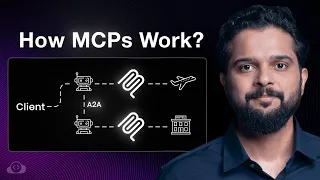
Model Context Protocol (MCP), clearly explained (why it matters)
20min
-
03
Claude’s Model Context Protocol is here… Let’s test it
8min
-
04
Model Context Protocol (MCP) Explained for Beginners: AI Flight Booking Demo!
24min
-
05
MCP vs API: Simplifying AI Agent Integration with External Data
13min
-
06
Why MCP really is a big deal | Model Context Protocol with Tim Berglund
11min
-
07
Model Context Protocol Clearly Explained | MCP Beyond the Hype
15min
-
08
MCP Tutorial: Build Your First MCP Server and Client from Scratch (Free Labs)
40min
-
09
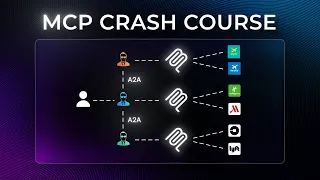
The Ultimate MCP Crash Course – Build From Scratch
Current lesson
-
10
Full Course (Lessons 1-11) MCP for Beginners
50min







Summary
Understanding the Model Context Protocol
The Model Context Protocol, commonly known as MCP, represents a revolutionary approach to how AI agents interact with external systems and data sources. As artificial intelligence continues to evolve and AI agents become increasingly sophisticated, MCP servers and clients are gaining significant traction in the development community. This comprehensive crash course provides an in-depth exploration of MCP fundamentals, explaining not only what MCP is and how it works at a conceptual level, but also delivering practical, hands-on guidance for building custom MCP servers and clients from the ground up. The protocol serves as a standardized interface that enables AI models to access tools, resources, and information beyond their training data, making it essential knowledge for modern web developers working with AI integration.
Core Architecture and Protocol Design
At its heart, MCP establishes a bidirectional communication protocol between clients and servers, allowing AI agents to request and receive information in a structured, predictable manner. The architecture separates concerns into distinct components: servers that expose capabilities, and clients that consume those capabilities on behalf of AI models. Understanding this separation is crucial because it enables modularity and allows developers to build specialized servers that handle specific domains or data sources. The protocol relies on clear message formats and standardized request-response patterns, ensuring that regardless of the underlying implementation, any MCP-compliant client can communicate with any MCP-compliant server. This standardization is what makes MCP powerful in ecosystem development, as it creates interoperability and reduces friction when integrating multiple services together.
Building MCP Servers From Ground Up
Constructing an MCP server requires understanding multiple layers of functionality that work together seamlessly. The server setup phase involves initializing the basic infrastructure, configuring communication protocols, and establishing the foundation upon which all other features will be built. Once the server is running, developers implement tools—callable functions that the client can invoke to perform specific actions or retrieve particular data. Tools represent the primary way an AI agent extends its capabilities beyond its base knowledge, enabling it to interact with external systems, databases, or APIs. The server must clearly define what each tool does, what parameters it accepts, and what format it returns, ensuring the AI can understand and use these tools appropriately.
Advanced Server Features and Resource Management
Beyond basic tools, sophisticated MCP servers expose resources—pieces of information or data sources that the AI can reference and consult. Resources differ from tools in that they represent static or semi-static data that the AI might want to read or search through, rather than actions to perform. Resource templates add another layer of abstraction, allowing servers to define patterns for how resources are organized and accessed. Prompts provide another powerful server feature, enabling developers to package pre-built prompts or prompt templates that guide AI behavior in specific ways. The sampling capability allows servers to generate data or examples on demand, useful when the AI needs synthetic information for testing, learning, or exploration. Together, these features create a rich ecosystem where servers can expose not just functions, but also knowledge bases, guidance, and generated content.
Implementing MCP Clients for AI Integration
On the client side, developers build applications that connect to MCP servers and route capabilities to AI models. Client setup involves establishing the connection to one or more servers and preparing the client to handle requests from the AI agent. Clients must implement tool discovery and invocation, allowing them to understand what tools the connected servers expose and call those tools when the AI decides they are necessary. Just as servers expose resources and resource templates, clients must be able to request and process these resources, presenting them in a format the AI can consume effectively. Clients also handle prompt management, retrieving and using server-provided prompts to better structure AI interactions. The sampling capability on the client side allows the AI to request generated or sample data, which can be invaluable for few-shot learning or testing scenarios.
Querying AI Through MCP Architecture
The true power of MCP emerges when clients query AI models while providing access to server capabilities. When an AI receives a question or task, it can introspect the available tools, resources, and prompts provided by the connected MCP servers. The AI then orchestrates its responses by deciding which tools to call, which resources to reference, and which prompts to follow. This creates a feedback loop where the AI becomes significantly more capable and grounded than it would be working in isolation. Developers implementing this pattern must design their queries thoughtfully, ensuring that the AI has all the context it needs to make good decisions about which server capabilities to use. This involves thinking about how to surface the most relevant tools and resources to the AI, potentially filtering or prioritizing based on the specific task at hand.
Practical Implementation Patterns and Best Practices
Successfully building MCP servers and clients requires understanding several practical patterns and conventions. Functions exposed through MCP should follow principles of clarity and determinism, making it easier for AI models to predict their behavior and outcomes. Clean separation of concerns between different tools and resources makes the entire system more maintainable and easier for AI agents to navigate. When designing resources, developers should consider how AI models will search and filter through them, potentially organizing data hierarchically or providing summary information alongside detailed content. The examples and code provided in this crash course demonstrate real-world patterns that have proven effective in production deployments, offering a template for developers building their own implementations.
Future of MCP and AI Integration Landscape
As AI agents continue to become more capable and autonomous, the importance of standardized protocols like MCP will only increase. The protocol provides a stable foundation upon which the next generation of AI applications will be built, enabling developers to focus on domain-specific logic rather than communication mechanics. Mastering MCP now positions developers at the forefront of AI integration, equipping them with skills that will be increasingly in demand as enterprises adopt AI agents for complex workflows and decision-making processes.
What you will learn
- Understand the Model Context Protocol architecture and design principles
- Build fully functional MCP servers with tools, resources, and prompts
- Implement MCP clients that connect to servers and manage AI interactions
- Design and expose resources and resource templates for AI consumption
- Integrate AI models with MCP-enabled applications using sampling and querying
Concepts covered
Technologies used
Chapters 14 markers
Next suggested video

Reviews
No reviews yet. Be the first to rate this lesson.