-
01
 Learn RAG From Scratch – Python AI Tutorial from a LangChain Engineer
Current lesson
Learn RAG From Scratch – Python AI Tutorial from a LangChain Engineer
Current lesson
-
02
OpenAI Embeddings and Vector Databases Crash Course
18min
-
03
What is a Vector Database? Powering Semantic Search & AI Applications
9min
-
04
RAG Explained For Beginners
10min
-
05
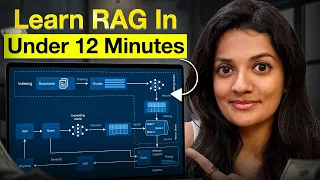
RAG Explained in 12 Minutes
12min
-
06
Vector Search RAG Tutorial – Combine Your Data with LLMs with Advanced Search
1h 11min
-
07
Complete RAG Crash Course With Langchain In 2 Hours
2h 08min
-
08
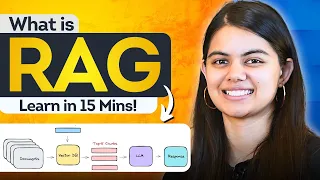
What is RAG ? | Completely Explained in 15 Minutes
17min
-
09
Local Retrieval Augmented Generation (RAG) from Scratch (step by step tutorial)
5h 40min
-
10
RAG Fundamentals and Advanced Techniques – Full Course
1h 36min



Summary
Understanding Retrieval Augmented Generation
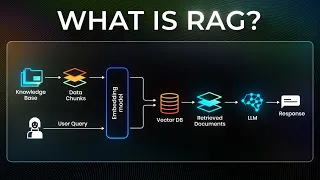
Retrieval Augmented Generation, commonly known as RAG, represents a transformative approach to leveraging Large Language Models by grounding them with custom, proprietary data. Rather than relying solely on the knowledge embedded during model training, RAG combines the generative power of LLMs with the ability to retrieve relevant information from external data sources in real time. This hybrid approach addresses one of the most pressing limitations of standalone language models: their inability to access current, domain-specific, or confidential information. By implementing RAG, developers can build AI applications that provide accurate, contextually relevant responses while maintaining control over the data sources that inform those responses.
The architecture of RAG systems comprises three fundamental stages that work in concert. The indexing phase prepares custom documents and knowledge bases for efficient retrieval by breaking them into chunks and converting them into vector embeddings. The retrieval stage uses these embeddings to find the most relevant passages when a user poses a question. Finally, the generation phase feeds both the retrieved context and the original query to an LLM, which synthesizes this information into a coherent, grounded answer. Understanding each of these phases in depth, along with the sophisticated techniques that optimize them, forms the foundation of this comprehensive course.
Core Architecture and Fundamentals
The course begins with a detailed overview of how RAG systems function at a fundamental level. Lance Martin, a LangChain software engineer with a PhD background, guides learners through the essential components that make RAG effective. The indexing process involves tokenizing documents, creating semantic embeddings using models like sentence transformers, and storing these representations in vector databases. This enables fast similarity-based retrieval when queries arrive. The retrieval mechanism then uses the user's question to find the k most relevant document chunks based on semantic similarity in the embedding space. Understanding the nuances of chunking strategies, embedding models, and vector store implementations is critical for building production-ready systems.
The generation phase completes the loop by passing the retrieved context to a language model alongside the original query. The LLM uses this grounded information to generate responses that are both factually accurate and contextually appropriate. This three-stage pipeline significantly reduces hallucinations—a common problem when LLMs generate responses without external information to anchor them. The course meticulously explores how each component interacts, how to measure performance at each stage, and how to optimize the overall system for quality and efficiency.
Advanced Query Translation Techniques
Moving beyond basic RAG, the course introduces sophisticated query transformation strategies that enhance retrieval effectiveness. Multi-Query generation creates several semantically equivalent versions of a user's question, retrieving relevant documents for each variant and combining results to improve coverage. RAG Fusion extends this concept by reranking retrieved documents based on scores across multiple queries, maximizing the probability of finding truly relevant information. Query Decomposition breaks complex questions into simpler sub-questions, retrieves answers for each, and synthesizes them into comprehensive responses—particularly valuable for multi-step reasoning tasks.
Step Back prompting is a technique where the system first generates a high-level conceptual question before tackling the specific user query, ensuring that foundational knowledge is retrieved alongside detailed information. Hypothetical Document Embeddings (HyDE) flips the traditional retrieval paradigm by generating hypothetical documents that would answer the query, then embedding and using those to find real relevant passages. These advanced techniques recognize that different query types benefit from different retrieval strategies, and mastering their application allows developers to build more robust and intelligent RAG systems.
Intelligent Routing and Query Construction
The course emphasizes the importance of directing queries to the most appropriate processing pipeline based on their characteristics. Routing mechanisms analyze incoming questions and decide whether to invoke RAG retrieval, use a knowledge base, execute a database query, or handle the request through other means. Query construction goes deeper by converting natural language questions into structured queries that can be executed against SQL databases, vector stores, or other data sources. This is particularly powerful for applications that need to integrate multiple data backends and decide dynamically which sources contain the answer.
These techniques acknowledge that not all questions benefit equally from semantic retrieval over embeddings. Some queries are more efficiently answered through structured database access, while others may require a combination of both approaches. Learning to implement smart routing based on query characteristics and available data sources separates production systems from basic prototypes. The course provides practical implementations of these patterns using LangChain, demonstrating how to build flexible, intelligent RAG applications.
Multi-Representation and Advanced Indexing Strategies
Beyond simple document chunking, the course explores sophisticated indexing approaches that enhance retrieval quality. Multi-Representation indexing stores documents in multiple forms—original text, summarized text, and other representations—allowing queries to match against whichever form is most semantically relevant. RAPTOR (Recursive Abstractive Processing for Tree-Organized Retrieval) builds hierarchical summaries of documents, enabling retrieval at different levels of abstraction depending on the query's scope. ColBERT introduces late interaction between queries and document chunks, offering more granular relevance matching than traditional embedding-based approaches.
These advanced indexing techniques address a fundamental challenge in RAG: the mismatch between how information is indexed and how users ask questions. A query focused on high-level concepts may retrieve low-level details that don't help, while a specific question might miss an answer buried in a summary. Multi-representation and hierarchical indexing strategies provide flexibility to retrieve information at the appropriate level of detail and abstraction.
CRAG, Adaptive RAG, and Production Considerations
Toward the end of the course, attention turns to production-grade RAG systems that must handle uncertainty and continuously adapt. Corrective RAG (CRAG) evaluates the relevance of retrieved documents and adjusts the retrieval strategy if documents fall below quality thresholds, either by reformulating queries, expanding search scope, or falling back to the base LLM. Adaptive RAG takes this further by dynamically choosing between different RAG pathways based on real-time assessment of whether retrieval is likely to improve the final answer.
These techniques acknowledge that real-world data is messy, relevance is not always detectable from embeddings alone, and systems must be resilient to failure modes. Building confidence scoring, fallback strategies, and adaptive behaviors into RAG systems transforms them from brittle prototypes into reliable production applications. The course concludes with discussion of emerging trends and future directions in RAG research, providing context for how this field continues to evolve.
Building RAG with LangChain
Throughout the course, practical implementation examples use LangChain, an open-source framework designed to simplify building applications with language models. LangChain provides abstractions for common RAG components—document loaders, text splitters, embedding models, vector stores, and retrieval chains—reducing boilerplate and allowing developers to focus on architecture decisions. The course includes code examples and a GitHub repository with implementations of each technique, enabling learners to move from theory to working code quickly.
The practical focus ensures that learners not only understand RAG theory but can implement it effectively. LangChain's flexibility allows adaptation to various use cases, from question-answering systems over documents to agents that reason across multiple data sources. Learning RAG through LangChain provides both conceptual depth and practical tooling needed for real-world AI applications.
What you will learn
- Implement the three-stage RAG pipeline: indexing, retrieval, and generation
- Apply advanced query translation techniques including Multi-Query, RAG Fusion, and Decomposition
- Build intelligent routing and query construction systems for dynamic data access
- Optimize indexing strategies using multi-representation and hierarchical approaches like RAPTOR
- Design adaptive RAG systems with corrective mechanisms and fallback strategies
Concepts covered
Technologies used
Chapters 17 markers
- Overview
- Indexing
- Retrieval
- Generation
- Query Translation: Multi-Query
- Query Translation: RAG Fusion
- Query Translation: Decomposition
- Query Translation: Step Back
- Query Translation: HyDE
- Routing
- Query Construction
- Indexing: Multi Representation
- Indexing: RAPTOR
- Indexing: ColBERT
- Corrective RAG
- Adaptive RAG
- The Future of RAG
Next suggested video
Reviews
No reviews yet. Be the first to rate this lesson.