-
01
 Learn RAG From Scratch – Python AI Tutorial from a LangChain Engineer
2h 33min
Learn RAG From Scratch – Python AI Tutorial from a LangChain Engineer
2h 33min
-
02
OpenAI Embeddings and Vector Databases Crash Course
18min
-
03
What is a Vector Database? Powering Semantic Search & AI Applications
9min
-
04
RAG Explained For Beginners
10min
-
05
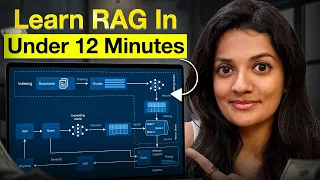
RAG Explained in 12 Minutes
12min
-
06
Vector Search RAG Tutorial – Combine Your Data with LLMs with Advanced Search
1h 11min
-
07
Complete RAG Crash Course With Langchain In 2 Hours
Current lesson
-
08
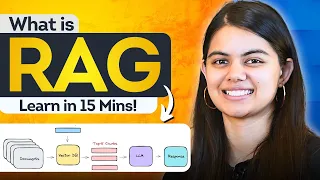
What is RAG ? | Completely Explained in 15 Minutes
17min
-
09
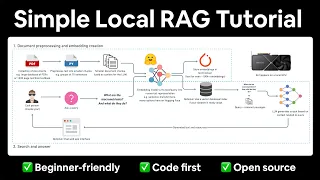
Local Retrieval Augmented Generation (RAG) from Scratch (step by step tutorial)
5h 40min
-
10
RAG Fundamentals and Advanced Techniques – Full Course
1h 36min




Summary
Understanding Retrieval-Augmented Generation
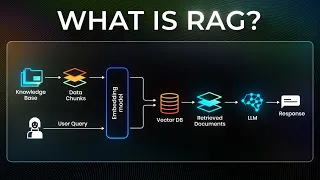
Retrieval-Augmented Generation (RAG) represents a transformative approach to optimizing large language model outputs by integrating external knowledge sources into the generation process. Rather than relying solely on parameters learned during training, RAG systems dynamically retrieve relevant information from authoritative knowledge bases and inject this context into the LLM before generating responses. This architectural pattern has become increasingly critical as organizations seek to ground LLM outputs in accurate, up-to-date, domain-specific information without the prohibitive costs and complexity of model retraining.
The Core Architecture of RAG Systems
RAG systems operate through a well-defined pipeline that combines retrieval and generation stages seamlessly. The process begins when a user query is received; the system retrieves relevant documents or passages from an external knowledge base using semantic similarity or traditional information retrieval techniques. These retrieved documents are then concatenated with the original query and passed to an LLM, which generates a response grounded in the retrieved context. This two-stage approach ensures that LLM outputs remain factually accurate and relevant to specific organizational needs, while maintaining the flexibility and generalization capabilities that make large language models powerful.
Why RAG Matters for Modern AI Applications
Large Language Models are trained on vast volumes of public data containing billions of parameters, enabling them to perform remarkable tasks such as question answering, language translation, and text completion. However, these models face inherent limitations when dealing with proprietary information, real-time data, or domain-specific knowledge that falls outside their training distribution. RAG solves this problem elegantly by allowing organizations to leverage their existing LLM infrastructure while augmenting it with domain-specific knowledge bases. This approach eliminates the need for expensive and time-consuming model retraining, making it a cost-effective solution for enterprises seeking to deploy AI systems across specialized domains.
Implementing RAG with LangChain Framework
LangChain has emerged as the go-to framework for building RAG applications due to its comprehensive tooling and abstraction layers. The framework provides modular components for document loading, text splitting, embedding generation, vector storage, and retrieval chains. Developers can quickly prototype and deploy RAG systems by composing these building blocks, whether they're working with PDF documents, web content, or structured databases. LangChain's integration with multiple LLM providers, embedding models, and vector stores makes it possible to build flexible RAG pipelines that can adapt to various architectural requirements and scaling scenarios.
Key Components in a Production RAG Pipeline
A robust RAG system requires careful orchestration of several critical components working in concert. Document ingestion and preprocessing ensure that raw knowledge sources are cleaned, normalized, and prepared for retrieval. Embedding models transform documents and queries into dense vector representations that capture semantic meaning, enabling efficient similarity-based retrieval. Vector databases store these embeddings and enable fast approximate nearest-neighbor search at scale. The retrieval component selects the most relevant documents based on query similarity, while the generation stage leverages an LLM to synthesize these retrieved documents into coherent, contextually-grounded responses. Each component must be optimized for latency, accuracy, and relevance to ensure the RAG system delivers reliable results.
Real-World Applications and Use Cases
RAG technology has unlocked practical applications across numerous industries and domains. Organizations deploy RAG systems for customer support automation, enabling chatbots to answer questions grounded in company knowledge bases and product documentation. Legal and financial firms use RAG to analyze contracts, regulations, and compliance documents with unprecedented accuracy. Healthcare organizations apply RAG to ground clinical decision support systems in the latest medical literature and internal protocols. Educational institutions leverage RAG to power intelligent tutoring systems that draw from curriculum materials and educational resources. The common thread across these applications is the need to combine the generative capabilities of LLMs with the reliability and specificity that domain knowledge provides.
Advantages Over Fine-Tuning and Model Retraining
When organizations need to incorporate new knowledge into AI systems, they face multiple options: fine-tuning on domain-specific data, full model retraining, or adopting RAG. Fine-tuning and retraining require substantial computational resources, time, and expertise, often taking weeks or months to complete. RAG, by contrast, allows knowledge updates in near real-time simply by refreshing the underlying knowledge base. This flexibility becomes crucial in fast-moving industries where information evolves rapidly. Additionally, RAG systems remain agnostic to the specific LLM powering generation, allowing organizations to upgrade or switch language models without rebuilding their knowledge infrastructure. This modularity and cost-effectiveness have made RAG the preferred architecture for many enterprises deploying AI at scale.
Getting Started with RAG Development
The comprehensive RAG crash course with LangChain provides learners with hands-on experience building end-to-end retrieval-augmented generation systems. Through two intensive hours, the course covers foundational concepts, architectural patterns, practical implementation details, and best practices for deploying RAG systems in production environments. Participants gain exposure to document processing workflows, embedding techniques, vector database integration, and prompt engineering strategies that maximize retrieval and generation quality. By completing this course, learners acquire the skills to architect RAG solutions for their own organizations, whether for customer-facing applications, internal knowledge systems, or specialized domain applications.
What you will learn
- Understand the fundamental principles and architecture of Retrieval-Augmented Generation systems
- Implement end-to-end RAG pipelines using LangChain framework and its modular components
- Integrate vector databases and embedding models for efficient document retrieval
- Optimize retrieval quality and generation accuracy in production RAG applications
- Apply RAG to real-world use cases across customer support, legal, healthcare, and enterprise domains
Concepts covered
Technologies used
Chapters 9 markers
- Introduction to RAG and course overview
- What is Retrieval-Augmented Generation
- RAG architecture and pipeline components
- Introduction to LangChain framework
- Document loading and text preprocessing
- Embeddings and vector databases
- Building retrieval chains with LangChain
- Practical RAG implementation walkthrough
- Production deployment and optimization strategies
Next suggested video
Reviews
No reviews yet. Be the first to rate this lesson.