Ads
Free course

Free OpenAI Codex Course: Build AI Coding Agents

Move beyond autocomplete and learn to build true agentic AI workflows with OpenAI Codex. This course covers agent planning, operational policies, custom skill creation, and automated CI/CD pipelines using Python, FastAPI, Pytest, and GitHub...

7 lessons 2h 56min total Free

Course overview

This course by Artem Istranin explores the OpenAI Codex platform as an agent for automated software development. Spanning seven lessons, it moves from core architectural concepts to hands-on implementation, demonstrating how to build fast, well-tested applications. You will see how to design a REST API with FastAPI, structure agentic planning for architecture alignment, enforce project standards through operational policies, and create reusable Docker skills. Advanced topics include integrating the Model Context Protocol for live documentation grounding and building automated code review bots into a GitHub Actions pipeline.

Who this course is for

This course is designed for Python developers and software engineers who want to integrate AI beyond simple chat interfaces. It is suitable for those comfortable with the command line and version control who are looking to automate repetitive coding, testing, and deployment tasks. Developers curious about agentic workflows, technical leads evaluating AI for team pipelines, and anyone interested in applying large language models to concrete software engineering problems will find the practical examples relevant and directly applicable.

How to study this sequence

Follow the lessons in sequential order, as each episode builds on the workflows established in the previous one. Start by understanding the agentic workflow theory, then apply it by building a FastAPI application with automated tests. After mastering planning and policy enforcement through AGENTS.md files, move on to creating reusable skills and containerizing applications. The final lessons on context protocols and CI/CD integration combine all earlier techniques. Replicate the code in your own environment using Python, VS Code, and GitHub to cement the concepts.

What you should be able to do

By completing this course, you will understand how to configure and supervise an OpenAI Codex agent for real software engineering tasks. You will be able to define system designs that an agent can follow, encode project rules into persistent instruction files, and generate production-ready Docker setups. You should also be able to integrate an AI agent into a CI/CD pipeline with GitHub Actions to perform tasks like automated testing, code review, and cloud deployment using the Model Context Protocol.
~/about-course

What you learn in this OpenAI Codex course

This course organizes 7 OpenAI Codex lessons in a practical order, starting with the base and moving toward examples you can repeat in your own projects.

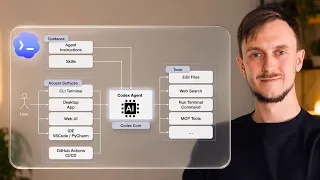
The main practice points are Understand the architectural components of the OpenAI Codex AI coding agent, Differentiate between simple autocomplete tools and true agentic AI workflows, Apply function calling to enable the agent to use CLI and IDE tools and Design scalable automation workflows for Python debugging and refactoring. Use this page to review the course proposal, check the key topics, and open the lessons in the recommended order.

What you will practice

  • Understand the architectural components of the OpenAI Codex AI coding agent
  • Differentiate between simple autocomplete tools and true agentic AI workflows
  • Apply function calling to enable the agent to use CLI and IDE tools
  • Design scalable automation workflows for Python debugging and refactoring
  • Integrate the agent with GitHub Actions and CI/CD pipelines
  • Evaluate the practical limitations and safety guardrails of autonomous coding agents

Concepts covered

AI Coding Agent Agentic Workflow Function Calling LLM Guidance Layers Tool Orchestration CI/CD Automation Code Refactoring Software Engineering Automation

Course lessons

7 tutoriais organizados em sequência.

~/course-summary

Course summary

This OpenAI Codex course brings together 7 lessons in a guided sequence. It starts with "Lesson 1 – OpenAI Codex Full Course: AI Coding Agent Tutorial with Python Examples" and moves step by step, so each lesson supports the next one and helps turn the topic into practice.

During the course, the practical focus is on Understand the architectural components of the OpenAI Codex AI coding agent, Differentiate between simple autocomplete tools and true agentic AI workflows, Apply function calling to enable the agent to use CLI and IDE tools and Design scalable automation workflows for Python debugging and refactoring. These points help you watch with a goal instead of treating the lesson as a loose introduction.

The course also introduces important ideas such as AI Coding Agent, Agentic Workflow, Function Calling, LLM Guidance Layers and Tool Orchestration, which makes it easier to understand later tutorials and decide when each resource is useful.

~/study-plan

How to get more from this course

Who this OpenAI Codex course is for

This course is useful for anyone who wants a direct introduction to OpenAI Codex before moving into longer studies. It works especially well when you want to understand the subject through organized lessons instead of scattered searches.

What you can do after finishing

By the end, you should be able to review the main idea of the course and practice Understand the architectural components of the OpenAI Codex AI coding agent, Differentiate between simple autocomplete tools and true agentic AI workflows, Apply function calling to enable the agent to use CLI and IDE tools and Design scalable automation workflows for Python debugging and refactoring with more confidence.

Recommended study order

Watch the 7 lessons in the order shown on this page. Pause after each lesson to repeat the examples and only move on when the previous step makes sense.

What to study next

After finishing the course, explore the OpenAI Codex topic to find related tutorials and keep studying with more context.

~/course-faq

Course questions

Is this OpenAI Codex course for beginners?

Yes. The course is presented as an entry point for OpenAI Codex and can be used before moving into more advanced tutorials.

How many lessons are in this course?

This course currently has 7 lessons and about 2h 56min in total.

What should I do after finishing the course?

The best next step is to explore the OpenAI Codex topic and choose a related tutorial that matches what you want to practice.

Is this course free?

Yes. This is a free course organized by CursoB so you can study OpenAI Codex in a structured sequence.

Do I need previous experience to follow the course?

You do not need advanced experience. The course starts from the main ideas of OpenAI Codex and moves through the lessons step by step.

Should I watch the lessons in order?

Yes. The recommended path is to watch the 7 lessons in the order shown, because each lesson helps prepare the next one.

Can I use this course for practical projects?

Yes. Use the course as a practical reference to train Understand the architectural components of the OpenAI Codex AI coding agent, Differentiate between simple autocomplete tools and true agentic AI workflows, Apply function calling to enable the agent to use CLI and IDE tools and Design scalable automation workflows for Python debugging and refactoring and adapt the examples to your own projects.

Does this course include a certificate?

CursoB stopped issuing certificates for its own courses in May 2026. CursoB no longer offers completion certificates. Courses and tutorials remain free to study. If content is hosted on another platform, any certificate depends exclusively on the original author or platform rules.

Are the lessons updated?

CursoB periodically reviews the OpenAI Codex catalog and may add, remove, or reorder lessons when better content is found.

Where can I find more content on this subject?

Explore the OpenAI Codex topic to find related tutorials and complementary courses.

~/lesson-notes

What each course lesson covers

Use these notes to understand the sequence before opening each lesson.

  1. 01 Lesson 1 – OpenAI Codex Full Course: AI Coding Agent Tutorial with Python Examples In this lesson, you practice Understand the architectural components of the OpenAI Codex AI coding agent, Differentiate between simple autocomplete tools and true agentic AI workflows and Apply function calling to enable the agent to use CLI and IDE tools.
  2. 02 Lesson 2 – OpenAI Codex Full Course: AI Coding Agent Tutorial with Python Examples In this lesson, you practice Configure an OpenAI Codex agent for a live coding workflow, Design and build a REST API with FastAPI using AI-generated code and Generate automated tests with pytest directly from AI prompts.
  3. 03 Lesson 3 – OpenAI Codex Full Course: AI Coding Agent Tutorial with Python Examples In this lesson, you practice Understand the Agentic Planning Mode in OpenAI Codex, Review and refine an AI-generated frontend implementation plan and Align a coding plan with a pre-existing system design.
  4. 04 Lesson 4 – OpenAI Codex Full Course: AI Coding Agent Tutorial with Python Examples In this lesson, you practice Define operational policies for AI coding agents using AGENTS.md files, Organize agent rules with hierarchical and local override configurations and Integrate Codex-generated code into GitHub Actions CI/CD pipelines.
  5. 05 Lesson 5 – OpenAI Codex Full Course: AI Coding Agent Tutorial with Python Examples In this lesson, you practice Create a reusable FastAPI Dockerizer skill with OpenAI Codex Skill Creator, Differentiate between explicit agent invocation and implicit context-aware skill triggering and Apply progressive disclosure to manage the AI agent’s context window for reliable code generation.
  6. 06 Lesson 6 – OpenAI Codex Full Course: AI Coding Agent Tutorial with Python Examples In this lesson, you practice Understand how the Model Context Protocol connects AI models to external tools, Configure a Context7 MCP server to provide up-to-date documentation to Codex and Use AI agents to generate accurate code by grounding it in live library data.
  7. 07 Lesson 7 – OpenAI Codex Full Course: AI Coding Agent Tutorial with Python Examples In this lesson, you practice Build an automated AI code reviewer using Python and the OpenAI API, Configure GitHub Actions workflows to trigger on pull request events and Craft effective prompts to get actionable code feedback from Codex.