More from this course
OpenAI Codex Full Course: AI Coding Agent Tutorial with Python Examples
Lesson 6 of 7-
01
 Lesson 1 – OpenAI Codex Full Course: AI Coding Agent Tutorial with Python Examples
10min
Lesson 1 – OpenAI Codex Full Course: AI Coding Agent Tutorial with Python Examples
10min
-
02
Lesson 2 – OpenAI Codex Full Course: AI Coding Agent Tutorial with Python Examples
41min
-
03
Lesson 3 – OpenAI Codex Full Course: AI Coding Agent Tutorial with Python Examples
21min
-
04
Lesson 4 – OpenAI Codex Full Course: AI Coding Agent Tutorial with Python Examples
34min
-
05
Lesson 5 – OpenAI Codex Full Course: AI Coding Agent Tutorial with Python Examples
27min
-
06
Lesson 6 – OpenAI Codex Full Course: AI Coding Agent Tutorial with Python Examples
Current lesson
-
07
Lesson 7 – OpenAI Codex Full Course: AI Coding Agent Tutorial with Python Examples
11min
Summary
The core problem with isolated AI models
Even the most sophisticated large language models operate within a bubble, limited to the data they were trained on. This training cutoff means they are inherently unaware of recent library updates, proprietary internal documentation, or the specific nuances of a live cloud environment. For an AI coding agent to be genuinely practical in a production setting, it needs a way to bridge this gap. This is not a hypothetical limitation; it’s a daily friction point for developers who find that AI generates plausible-looking but subtly broken code because it referenced an outdated API endpoint or a deprecated function signature. The promise of AI-assisted development hinges on solving this very problem of grounding.
Introducing the Model Context Protocol
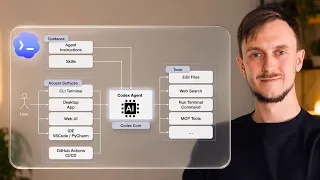
The Model Context Protocol, commonly abbreviated as MCP, is presented as the architectural solution to this isolation problem. It is an open standard that creates a structured interface between AI models and external systems. Instead of treating a model like OpenAI Codex as a closed box that only accepts prompts, MCP allows it to dynamically discover and interact with external tools and data sources. This transforms the AI from a static predictor of text into an agent capable of querying live information. This protocol acts as a universal adapter, meaning Codex doesn't need a custom integration for every single tool; it just needs to know how to talk MCP, and a whole ecosystem of context-aware servers becomes instantly accessible.
Hands-on with Context7 MCP server
The practical exploration of the lesson centers on Context7, a specific MCP server designed to solve a critical pain point: documentation staleness. Context7 acts as a live, always-up-to-date library for package documentation. When Codex generates Python code and needs to use a specific function from a library, instead of guessing based on its training data, it can route a query through Context7. The workflow involves configuring the MCP server endpoint so that Codex recognizes it as an available resource. Once connected, the AI agent’s decision-making shifts. It no longer relies solely on its static weights but actively checks the latest function signatures, parameter lists, and usage examples, dramatically reducing the likelihood of hallucination in the generated code.
Understanding MCP tools in context
Beyond simple documentation retrieval, the lesson delves into the broader concept of MCP Tools and how they maintain a persistent context during a coding session. An MCP server can expose a collection of tools, each representing a specific capability like reading a file, making an API call, or provisioning infrastructure. The critical insight here is the stateful nature of these interactions. When Codex invokes a tool, the result is injected back into the conversation context, allowing the model to make sequential decisions. This mirrors how a human developer works: query a database to see the current schema, then write a migration script based on the actual state rather than an assumption. This contextual awareness is what elevates the AI from a simple snippet generator to an actual coding agent.
From code generation to deployment with Terraform
The lesson makes a crucial pivot from theoretical code assistance to the practical domain of infrastructure management. It demonstrates that the same MCP principles can be applied to connect Codex with infrastructure-as-code tools like Terraform. The scenario involves provisioning resources on Google Cloud Platform. By using a terminal tool or an MCP adapter that allows Codex to execute shell commands, the AI agent can initialize Terraform workspaces, plan infrastructure changes, and apply configurations. This segment highlights a paradigm shift where natural language requests can be translated directly into cloud resource provisioning, although it also implicitly underscores the importance of human review before an AI agent applies changes to billing accounts and live production environments.
Automating a continuous deployment pipeline
Building on the Terraform foundation, the narrative advances toward a complete production-style continuous deployment pipeline. The objective is to deploy a containerized application to Google Cloud Run. The demonstration addresses the full lifecycle: coding the application, containerizing it with Docker, pushing the image to an artifact registry, and deploying it to a serverless platform. Codex, augmented with MCP tools, assists not just with the Python business logic but also with generating the Dockerfile and Terraform configuration files. This holistic approach ensures that the application and its underlying infrastructure are treated as a cohesive unit, managed through a unified codebase that the AI agent can understand and modify cohesively.
Automating updates with GitHub Actions
The final technical milestone involves closing the automation loop by integrating GitHub Actions. The goal is to ensure that any update to the application code or the infrastructure definition automatically triggers a new deployment. The configuration involves setting up a workflow file within the repository that authenticates to Google Cloud, rebuilds the container image, and updates the Cloud Run service. Using Codex alongside MCP, developers receive guidance on writing these workflow YAML files correctly, including the necessary secrets management. This represents the pinnacle of the automation lesson, where a push to a git repository’s main branch becomes the sole manual step required to deliver updated, reliable software to a public endpoint.
The implications for AI-driven development
What this lesson ultimately demonstrates is a strategic framework rather than just a technical tutorial. The combination of OpenAI Codex with the Model Context Protocol marks a move away from isolated AI chat interfaces. The automated pipeline built using Terraform, Google Cloud Run, and GitHub Actions serves as a case study for a future where AI agents manage the entire operational lifecycle of a project. The underlying message is that developers who learn to configure these protocols and define infrastructure as code will be positioned to harness the full potential of AI, not just as a coding assistant, but as a force multiplier for system reliability, documentation accuracy, and deployment velocity.
What you will learn
- Understand how the Model Context Protocol connects AI models to external tools
- Configure a Context7 MCP server to provide up-to-date documentation to Codex
- Use AI agents to generate accurate code by grounding it in live library data
- Provision Google Cloud infrastructure using Codex and Terraform
- Implement a continuous deployment pipeline with Cloud Run and GitHub Actions
Concepts covered
Technologies used
Chapters 7 markers
Next suggested video

Reviews
No reviews yet. Be the first to rate this lesson.