More from this course
OpenAI Codex Full Course: AI Coding Agent Tutorial with Python Examples
Lesson 1 of 7-
01
 Lesson 1 – OpenAI Codex Full Course: AI Coding Agent Tutorial with Python Examples
Current lesson
Lesson 1 – OpenAI Codex Full Course: AI Coding Agent Tutorial with Python Examples
Current lesson
-
02
Lesson 2 – OpenAI Codex Full Course: AI Coding Agent Tutorial with Python Examples
41min
-
03
Lesson 3 – OpenAI Codex Full Course: AI Coding Agent Tutorial with Python Examples
21min
-
04
Lesson 4 – OpenAI Codex Full Course: AI Coding Agent Tutorial with Python Examples
34min
-
05
Lesson 5 – OpenAI Codex Full Course: AI Coding Agent Tutorial with Python Examples
27min
-
06
Lesson 6 – OpenAI Codex Full Course: AI Coding Agent Tutorial with Python Examples
30min
-
07
Lesson 7 – OpenAI Codex Full Course: AI Coding Agent Tutorial with Python Examples
11min
Summary
The evolution from autocomplete to agentic AI
The landscape of software development is shifting rapidly, and the introduction of OpenAI Codex marks a pivotal moment in this evolution. This course episode dissects the architecture of Codex, redefining it not merely as an advanced autocomplete engine but as a true AI coding agent. The hours spent on boilerplate code, debugging arcane errors, and laboriously refactoring legacy systems are being compressed by agentic workflows that can reason, plan, and execute multi-step technical tasks. By understanding the underlying mechanisms of Codex, developers can move from passively receiving code suggestions to actively delegating complex engineering responsibilities to a machine counterpart.
The foundational idea here is a shift in perspective. An autocomplete tool acts like a highly intelligent typewriter, finishing your sentences based on statistical probability. An agent, however, operates with autonomy. It interprets a high-level goal, navigates a complex environment like a file system or a command-line interface, selects the right development tools, executes a sequence of actions, and iteratively corrects its course based on the results. This lesson lays the groundwork for that paradigm shift, illustrating how Codex orchestrates various components to function as a cohesive, autonomous unit capable of driving Python projects forward.
Deconstructing the OpenAI Codex architecture
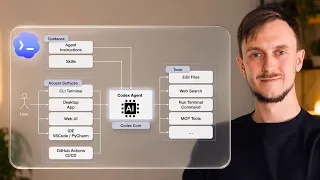
At the heart of Codex lies a sophisticated architecture that transforms a large language model into a goal-oriented entity. The episode breaks down this structure, starting with the reasoning engine provided by foundational LLMs. These models are not simply prompted for code; they are wrapped in guidance layers that constrain and direct their behavior towards specific coding conventions and safety parameters. This is where the raw power of a generative model is refined into a professional software engineering tool. The guidance is the difference between asking an open-ended question and giving a junior developer a strict technical specification to follow.
Beyond the model itself, the architecture integrates a toolkit that the agent can wield. This includes direct access to the Command Line Interface for running scripts and managing environments, as well as integration with Integrated Development Environments like VS Code. By linking these surfaces, Codex gains eyes and hands. It can read the contents of a project directory, execute terminal commands to run tests, analyze the standard output and error streams, and then make surgical edits to the source files. This closed-loop system of perception, reasoning, and action is what elevates it from a mere chatbot into a functional coding agent.
Function calling and tool integration in practice
A critical component detailed in the course is the mechanism of function calling, which serves as the nervous system connecting the agent's logic to its toolset. Codex does not just hallucinate actions; it generates structured requests to invoke specific functions for reading files, writing code, or executing shell commands. This structured approach ensures that the agentic workflow is deterministic and reliable, rather than a chaotic stream of text. The process functions as a translation layer, converting natural language intent into precise API calls that the development environment can interpret.
The practical application of this is extensive, from debugging a failing test suite to refactoring a monolithic script. The demonstrated workflow shows how Codex can be prompted to perform a task, after which it selects the appropriate tool—perhaps a Python linter or a test runner—via function calling, executes it, and then interprets the results. If a unit test fails, the agent does not simply guess a fix; it reads the assertion error, inspects the relevant function, and crafts a targeted patch. This tool-use logic extends to CI/CD pipelines and GitHub Actions, where the agent can manage entire cloud-based workflows, marking the arrival of AI-powered software engineering at scale.
Multi-surface access for unified automation
The versatility of Codex is further magnified by its deployment across multiple surfaces: the CLI, IDEs, and a web interface. This lesson clarifies how the agentic capabilities are not locked behind a single user interface. In the terminal, Codex becomes a powerful assistant for system-level operations, dependency management, and remote server configuration. It transforms the command line from a manual prompt into a conversational interface where complex bash commands are generated and executed with context awareness. For developers who live in the terminal, this creates a seamless automation layer.
Simultaneously, the IDE integration allows for a more visual and interactive pairing experience. The agent functions as a tireless collaborator who understands the entire project structure. Within environments like GitHub Actions, it operates as a backend automation engine, running CI/CD workflows autonomously. This cross-surface availability ensures that the agentic workflow is continuous. A developer might use the web interface to scaffold a project, move to the IDE for feature development with agentic code reviews, and then rely on the CLI version to orchestrate the deployment pipeline, all powered by the same underlying Codex architecture.
Building scalable agentic coding workflows
A major focus of the episode is moving beyond single-shot prompts to designing true agentic workflows. This involves chaining together multiple tools, commands, and reasoning steps to accomplish a larger engineering objective. Instead of a simple “write a function” prompt, an agentic workflow might involve “scan the repository for security vulnerabilities, generate a patch for each one, run the existing test suite to ensure no regressions, and file a structured report.” Such a sequence requires orchestration, and Codex is equipped to handle this by maintaining state across various tool calls.
These scalable workflows are particularly relevant for Python projects, where the agent can leverage the rich ecosystem of testing frameworks like Pytest. The lesson highlights how automation agents can integrate with testing and QA processes, generating test cases, fixtures, and even performing complex refactoring across multiple modules simultaneously. The architecture supporting this is designed for extensibility, allowing developers to add custom tools to the agent’s repertoire. By doing so, the agent’s capabilities can be tailored to specific domains or proprietary internal libraries, making it a versatile core for a bespoke AI-powered software engineering pipeline.
Practical applications in debugging and code review
The transformation from theory to practice is most visible in the applications of debugging and code review. The episode explains how Codex approaches a broken codebase not with random guesses, but with a systematic methodology. It utilizes its tool-calling ability to run static analysis, check error logs, and isolate problematic sections of code. This stands in stark contrast to traditional debugging that relies heavily on a developer’s manual intuition and endurance. The agent acts as a tireless investigator that can parse stack traces and correlate them with source code changes in mere seconds.
For refactoring, the agent goes beyond cosmetic changes. It can analyze data flows, identify performance bottlenecks, and restructure classes and functions to improve readability and efficiency. The course teases how these capabilities are crucial for modern software maintenance, where the cost of technical debt often outweighs the initial development. By shifting the burden of understanding large, complex systems onto the agent, developers are freed to focus on high-level design decisions and business logic, turning the tedious process of code archaeology into an automated function of the workflow.
Key considerations for AI-powered development
While the capabilities are vast, the introductory lesson also implicitly sets the stage for understanding the limitations of AI coding agents. The reliability of an agentic system is deeply dependent on the clarity of the guidance layer and the precision of the tool definitions. A poorly defined tool or an ambiguous prompt can still lead the agent down a rabbit hole of erroneous actions. Therefore, the course introduces Codex not as an infallible oracle, but as a high-speed junior engineer that requires expert supervision to ensure alignment with project goals and security standards.
Moreover, the integration with production environments via GitHub Actions and CI/CD represents both a massive opportunity and a significant risk. The ability to automate pull request reviews, merges, and deployments requires robust guardrails. Developers looking to immediately apply these concepts, particularly with the companion examples provided in the course repository, will learn that designing safe and effective agentic loops is the new frontier of AI software engineering. The future workflow is not about replacing developers, but about creating symbiotic relationships where human creativity directs the tactical execution of a tireless coding agent.
What you will learn
- Understand the architectural components of the OpenAI Codex AI coding agent
- Differentiate between simple autocomplete tools and true agentic AI workflows
- Apply function calling to enable the agent to use CLI and IDE tools
- Design scalable automation workflows for Python debugging and refactoring
- Integrate the agent with GitHub Actions and CI/CD pipelines
- Evaluate the practical limitations and safety guardrails of autonomous coding agents
Concepts covered
Technologies used
Chapters 5 markers
Next suggested video

Reviews
No reviews yet. Be the first to rate this lesson.