More from this course
OpenAI Codex Full Course: AI Coding Agent Tutorial with Python Examples
Lesson 4 of 7-
01
 Lesson 1 – OpenAI Codex Full Course: AI Coding Agent Tutorial with Python Examples
10min
Lesson 1 – OpenAI Codex Full Course: AI Coding Agent Tutorial with Python Examples
10min
-
02
Lesson 2 – OpenAI Codex Full Course: AI Coding Agent Tutorial with Python Examples
41min
-
03
Lesson 3 – OpenAI Codex Full Course: AI Coding Agent Tutorial with Python Examples
21min
-
04
Lesson 4 – OpenAI Codex Full Course: AI Coding Agent Tutorial with Python Examples
Current lesson
-
05
Lesson 5 – OpenAI Codex Full Course: AI Coding Agent Tutorial with Python Examples
27min
-
06
Lesson 6 – OpenAI Codex Full Course: AI Coding Agent Tutorial with Python Examples
30min
-
07
Lesson 7 – OpenAI Codex Full Course: AI Coding Agent Tutorial with Python Examples
11min
Summary
Structuring AI agent behavior with AGENTS.md
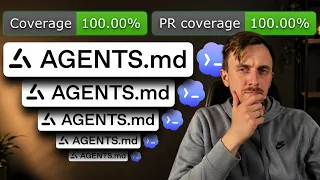
The episode opens by addressing a fundamental challenge in AI-assisted software development: maintaining consistency and adherence to project rules as repositories grow. The central solution presented is the AGENTS.md file, a markdown document that serves as a persistent instruction set for the Codex AI coding agent. This file defines operational policies, coding standards, and project-specific conventions that the agent must follow during code generation, editing, or refactoring tasks. The instructor demonstrates how to craft effective directives within AGENTS.md to guide the model’s output so it aligns with architectural decisions and team preferences.
By moving beyond simple one-off prompts and establishing a formalized policy document, developers can treat the AI as a more reliable team member capable of reproducing consistent patterns across multiple sessions and contributors. The segment emphasizes structuring the file similarly to open-source project guidelines, covering topics such as naming conventions, directory structures, and preferred libraries. This practice transforms the coding agent from a conversational assistant into an institutionalized part of the software engineering workflow, which is especially valuable in professional and production-oriented settings.
Organizing policies with a hierarchical structure
Building on the concept of centralized rules, this section introduces a hierarchical approach to organizing agent instructions across large, multi-component repositories. Instead of relying on a single monolithic configuration file, the tutorial showcases how to use local and inherited AGENTS.md files to create layered policies. The root directory contains the global operational policies, while subdirectories can have specialized or overriding rules that apply only to the code within that specific scope, ensuring flexibility without sacrificing global standards.
The demonstration illustrates resolving conflicts between global and local rules, showing how the Codex agent parses and merges these hierarchical instructions at runtime. This architecture solves the problem of having one-size-fits-all instructions that might be inappropriate for specialized modules, such as a frontend component versus a backend data-processing service. Understanding this layered application of policies is crucial for developers aiming to implement AI coding assistants in monorepos or complex systems, enabling granular control while keeping the overall project governance manageable and transparent.
Automating quality with Continuous Integration
The course progresses to integrating the AI agent’s output into modern DevOps pipelines, focusing on GitHub Actions as the primary automation engine. This segment demonstrates how to configure continuous integration workflows that automatically trigger when the developer and the Codex agent push new branches or open pull requests. The configuration ensures that every code change—whether human-generated, AI-generated, or a collaborative combination—runs through the same rigorous set of automated checks before it is eligible for merging into protected branches.
The practical example covers the creation of YAML workflow files that define steps for setting up the Python environment, installing dependencies from a lock file, and running a suite of checks. The instructor demonstrates creating workflow triggers for push and pull request events, configuring Python version matrices to test against multiple environments, and defining job dependencies. This automation layer is presented not just as a gatekeeper but as a critical enabler that allows developers to safely delegate more complex tasks to the AI agent, knowing that any deviations from the defined quality standards will be caught and reported immediately without manual review overhead.
Enforcing test coverage through coverage gates
After establishing the CI pipeline, the lecture dives into the practical implementation of code coverage enforcement using tools like Pytest and the Coverage.py library. The instructor explains how to configure coverage gates directly within the GitHub Actions workflow, setting a minimum threshold percentage that new code contributions must meet. If the AI agent generates new functionality without corresponding test cases, the coverage score falls below the configured gate, and the CI run fails, blocking the pull request from merging, which ingrains a safety-first approach into AI-assisted coding.
The segment includes a technical walkthrough of the commands and configuration files needed to run coverage analysis, generate XML or HTML reports, and post the results as actionable status checks on the pull request. The lesson underscores that discipline around testing becomes even more paramount when an AI can generate hundreds of lines of code in seconds. Setting a hardening coverage gate prevents codebase entropy and ensures that the accelerated development pace enabled by AI does not compromise long-term maintainability or introduce unnoticed regressions.
Visualizing metrics with coverage reporting
Moving beyond simple pass/fail gates, this part of the lesson focuses on transparency and human-readable artifact generation through automated coverage reporting. The tutorial demonstrates how to set up a reusable GitHub Actions workflow that runs test suites with coverage collection, generates detailed HTML reports, and publishes them as job artifacts or directly as pull request comments using community actions. This provides developers with an immediate, visual representation of which lines were covered and, more importantly, which logical branches remain untested.
Having automated reports attached directly to pull requests creates a feedback loop that is both fast and informative, allowing a human reviewer to quickly assess the risk and quality of an AI-generated contribution alongside the standard code diff. The segment covers the workflow syntax for uploading reports and the security considerations for using comment-posting actions. This practice closes the loop between AI code generation and human oversight, offering a practical mechanism for using metrics to guide deep review sessions where they are most needed without bogging down every simple change.
Overriding behavior with AGENTS.override.md
The course addresses a common operational scenario: handling urgent hotfixes, experimental branches, or specialized tasks where the standard global agent policies are too restrictive. The solution presented is the AGENTS.override.md file, an extension mechanism that allows developers to temporarily or contextually modify the agent’s operating rules without permanently altering the base configuration. This file can relax constraints, elevate specific permissions, or inject task-specific context that is relevant only for a particular branch or session.
A demonstration shows how placing this override file in a branch signals the Codex agent to adopt a different set of behavioral guidelines for that isolated environment, such as bypassing certain style checks during rapid prototyping or focusing on a specific type of refactoring. The key takeaway is establishing a control plane that remains auditable and version-controlled while still providing the operational flexibility that real-world software engineering demands, striking a balance between strict policy adherence and the need for pragmatic exceptions during critical development phases.
Key strategies for scalable AI development
Drawing the session to a close, the instructor synthesizes the core strategies into a cohesive model for scaling AI-assisted development across growing engineering teams. The final insights emphasize viewing the AI coding agent not as a standalone tool but as an integrated part of a safety-belted software supply chain. The combination of structured policy files, hierarchical rule inheritance, and automated CI/CD guardrails creates a system-of-record for AI actions, making the previously opaque process of AI code generation transparent and auditable.
The episode’s concluding wisdom focuses on practical adoption paths for teams at various maturity levels. It advocates starting with a simple AGENTS.md to codify team standards, implementing a basic CI trigger, and progressively adding coverage gates and override mechanisms as confidence in the automated pipeline grows. These operational best practices make AI-powered development predictable and enterprise-ready, moving past the basic tutorial phase into a sustainable engineering discipline where the AI agent acts as a high-velocity contributor operating within a well-orchestrated quality framework.
What you will learn
- Define operational policies for AI coding agents using AGENTS.md files
- Organize agent rules with hierarchical and local override configurations
- Integrate Codex-generated code into GitHub Actions CI/CD pipelines
- Enforce strict test coverage gates on AI-generated contributions
- Generate automated coverage reports within pull request workflows
- Apply temporary policy overrides for hotfixes or experimental branches
Concepts covered
Technologies used
Chapters 9 markers
Next suggested video

Reviews
No reviews yet. Be the first to rate this lesson.