-
01
 Lesson 1 – n8n and AI Agents Automation Course
4min
Lesson 1 – n8n and AI Agents Automation Course
4min
-
02
Lesson 2 – n8n and AI Agents Automation Course
Current lesson
-
03
Lesson 3 – n8n and AI Agents Automation Course
3min
-
04
Lesson 4 – n8n and AI Agents Automation Course
3min
-
05
Lesson 5 – n8n and AI Agents Automation Course
9min
-
06
Lesson 6 – n8n and AI Agents Automation Course
7min
-
07
Lesson 7 – n8n and AI Agents Automation Course
2min
-
08
Lesson 8 – n8n and AI Agents Automation Course
5min
-
09
Lesson 9 – n8n and AI Agents Automation Course
4min
-
10
Lesson 10 – n8n and AI Agents Automation Course
6min
-
11
Lesson 11 – n8n and AI Agents Automation Course
9min
-
12
Lesson 12 – n8n and AI Agents Automation Course
7min
Summary
The Foundation of No-Code Automation with n8n
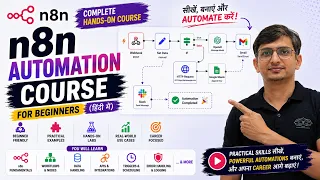
The modern digital landscape demands efficiency, and the ability to connect disparate applications seamlessly has become a critical business need. This lesson introduces the foundational concepts of n8n, a transformative platform at the intersection of workflow automation and artificial intelligence. n8n is presented as a powerful, no-code solution, radically changing how individuals and organizations approach repetitive tasks. The core premise revolves around democratizing the ability to create custom integrations without the traditional barrier of complex programming.
By exploring the visual interface and flexible design, the content sets the stage for understanding how complex processes can be simplified. The lesson emphasizes that automation is no longer the exclusive domain of developers. Instead, n8n provides a robust environment where logic, trigger events, and automated actions converge in a clear, visually intuitive flowchart format. This approach fundamentally shifts the perspective on digital process management, moving away from isolated tools towards a cohesive, automated ecosystem.
Understanding the Core Architecture of n8n
The lesson delves into the structural elements that make n8n a unique player in the automation market, distinguishing it from traditional SaaS platforms. A significant advantage highlighted is its open-source, self-hostable nature, which offers users complete control over their data and infrastructure. This architecture appeals to privacy-conscious professionals and enterprises dealing with sensitive information, allowing them to run workflows securely within their own environment. The discussion naturally extends to the platform's credential management and error handling, which are designed to be robust yet user-friendly.
The visual programming interface is a central pillar of the platform’s appeal, turning complex code into manageable, interconnected blocks. The lesson explains how nodes act as the fundamental building blocks for triggers, actions, and data transformations. By linking these nodes, users can synthesize a complete workflow that interacts with various third-party services like email, chat applications, and spreadsheets. The technical emphasis is placed on the ability to handle conditional logic, splits, and merges, enabling the creation of highly sophisticated, branching automation paths.
Bridging the Gap Between AI and Workflow Scenarios
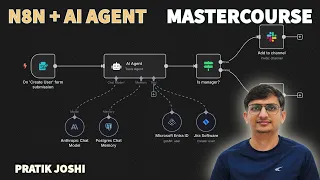
Beyond simple task automation, the content explores the concept of integrating AI agents directly into the n8n canvas. This fusion of automation and artificial intelligence represents a leap forward in what business process management can achieve. The lesson frames AI agents not as a separate, daunting technology, but as an accessible node within the workflow that can process unstructured data, generate text, or make classification decisions. This integration allows for the creation of dynamic systems that don't just follow static rules but adapt based on the data they process.
The introduction covers how n8n connects to popular large language model APIs to enable sophisticated features like semantic search, document summarization, or intelligent customer support routing. By treating AI models as just another service to integrate, the platform removes the mystique from artificial intelligence. It empowers users to build hybrid automations where a form submission can be automatically analyzed by an AI before triggering a tailored response sequence. This symbiotic relationship between deterministic workflows and probabilistic AI outputs forms the strategic core of the "Zero to Hero" masterclass.
Key Features Empowering Technical and Non-Technical Users
The video meticulously outlines the various features that make n8n an inclusive tool for a wide spectrum of users. For non-technical stakeholders, the emphasis is on the visual builder and the library of pre-built templates, which allow for rapid prototyping without writing a single line of code. The platform is depicted as a bridge that reduces the cognitive load required to translate a business logic idea into a functioning, digital reality. The drag-and-drop interface and detailed documentation support a shallow learning curve, giving domain experts the power to automate their own specific departmental needs.
Conversely, the lesson also acknowledges the developer community, highlighting features that cater to advanced technical requirements. Programmers can inject custom JavaScript or Python code directly into their workflows, breaking the limitations of standard node functionalities. The ability to create and share custom nodes or modules ensures the platform is infinitely extensible, adapting to highly niche software stacks. The balance between accessibility and deep-code customization is presented as a strategic design choice, ensuring that the tool scales in capability as the user’s technical skill matures.
Real-World Applications and Practical Scenarios
Moving from theory to practice, the instructor provides concrete, real-world examples to solidify the platform’s value proposition. These use cases are designed to resonate with professionals grappling with daily operational inefficiencies. A primary scenario discussed involves automating social media management, where content created in a spreadsheet can be automatically formatted, scheduled, and posted across multiple platforms without manual intervention. This highlights the time-saving potential of freeing creative staff from routine, repetitive posting mechanics.
Another powerful application addressed is in sales and marketing operations, particularly lead management and CRM enrichment. The n8n framework can monitor incoming form submissions, enrich the contact data via external APIs, detect spam using a language model, and create a new deal in a CRM system—all in fractions of a second. There is also a focus on internal IT operations, such as automated user provisioning or server monitoring alerts routed through communication channels. These practical examples confirm that n8n is not merely a theoretical tool but a practical solution for building resilient, cost-effective operational pipelines that reduce human error.
Preparing for the Advanced Automation Journey Ahead
As the concluding segment of the foundational lesson, the focus shifts to the forward-looking journey of the complete masterclass. The viewer is prepared for a progressive learning path that transitions sharply from foundational theory into building the first fully functional automation. The importance of understanding the n8n execution logic—how data flows from a trigger node through to the final action—is stressed as a prerequisite for the hands-on labs to come. It emphasizes that a solid grasp of today’s interface overview is critical for absorbing the complex AI agent behaviors planned for later modules.
The instructor sets clear expectations for the technical stack that will be utilized, reinforcing the "Zero to Hero" trajectory. It teases upcoming deep dives into specific AI integrations, how to build RAG (Retrieval-Augmented Generation) pipelines, and the construction of autonomous decision-making agents. This final segment is crafted to transform initial curiosity into actionable commitment, ensuring that users are psychologically and technically ready to download the required tools and engage actively with the subsequent step-by-step build-along sessions.
What you will learn
- Understand the fundamental concepts of n8n as a no-code automation platform
- Identify the key features that make n8n suitable for both non-technical users and developers
- Recognize the open-source, self-hosted architecture and its benefits for data privacy
- Explore how AI agents are integrated into n8n workflows for advanced data processing
- Analyze real-world automation examples in social media, lead management, and IT operations
Concepts covered
Technologies used
Chapters 8 markers
Next suggested video
Reviews
No reviews yet. Be the first to rate this lesson.