-
11
 Lesson 11 – Claude Certified Architect – Full Course
31min
Lesson 11 – Claude Certified Architect – Full Course
31min
-
12
Lesson 12 – Claude Certified Architect – Full Course
33min
-
13
Lesson 13 – Claude Certified Architect – Full Course
51min
-
14
Lesson 14 – Claude Certified Architect – Full Course
31min
-
15
Lesson 15 – Claude Certified Architect – Full Course
34min
-
16
Lesson 16 – Claude Certified Architect – Full Course
27min
-
17
Lesson 17 – Claude Certified Architect – Full Course
36min
-
18
Lesson 18 – Claude Certified Architect – Full Course
34min
-
19
Lesson 19 – Claude Certified Architect – Full Course
43min
-
20
Lesson 20 – Claude Certified Architect – Full Course
42min
-
21
Lesson 21 – Claude Certified Architect – Full Course
51min
-
22
Lesson 22 – Claude Certified Architect – Full Course
Current lesson
Summary
The Final Step in Certification Prep
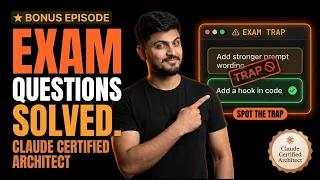
Preparing for a professional certification exam is a journey that often feels like assembling a complex puzzle. You gather pieces from different sources: video lectures, official documentation, hands-on projects, and community discussions. Each piece adds to your understanding, but the true test is not in recalling these fragments in isolation. The Claude Certified Architect exam is specifically designed to assess your ability to synthesize knowledge and apply it under pressure. This video serves as the final, crucial step in that journey, acting as the keystone that locks all the other pieces into place. It transforms theoretical knowledge into practical exam performance by focusing exclusively on the application of concepts to real exam-style questions.
The course series, which spans over twenty episodes, has covered the vast syllabus in detail, from multi-agent coordinators and MCP tool design to the nuances of structured output and reliability engineering. This bonus episode does not introduce new theoretical concepts. Instead, it provides a high-intensity training ground. It is built on the premise that understanding a topic and being able to answer a tricky multiple-choice question on it are two distinct skills. The video is designed to bridge this gap by providing what is essentially a series of mental rehearsals for the actual test. By working through problems, understanding the traps, and internalizing a strategic approach, candidates can convert their hard-earned knowledge into the confidence and precision required on exam day.
Deconstructing the Art of Distraction
Multiple-choice exams at a professional level have a unique anatomy. The correct answer is only part of the equation; the wrong answers, known as distractors, are carefully engineered to be plausible. A significant portion of this session is dedicated to exposing the mechanics of these distractors. The instructor introduces a powerful analytical framework for classifying these traps into four main archetypes, a tool that fundamentally changes how a candidate reads a question. The first type is the "partially correct" distractor, which contains a true statement that is ultimately irrelevant to the specific question being asked. It preys on the candidate's impulse to latch onto a recognized term or concept without fully validating its contextual relevance.
The second archetype involves answers that are diametrically opposed to established best practices. These are often easy to eliminate if a candidate has a strong foundational understanding, but they can be seductive when couched in technical jargon. The third, and perhaps most dangerous, is the "plausible but suboptimal" distractor. This answer isn't technically wrong; it could work, but it is not the most effective, scalable, or best-practice approach that the exam is designed to test. It targets the practical architect who has developed workarounds in the real world but needs to align their thinking with the idealized frameworks of the certification. The final trap is the "super set" answer, a perfectly correct but incomplete option that is encompassed by a broader, more comprehensive correct answer. Recognizing this hierarchy of correctness is a high-order exam skill.
A Live Walkthrough of the Official Mindset
With the theory of distraction established, the core of the video shifts to a live problem-solving session. The instructor takes the official sample questions provided by the certifying body and performs a real-time, step-by-step dissection. This process is less about revealing the correct letter and more about externalizing the internal monologue of a successful test-taker. For each question, the narrative begins by framing the scenario to isolate the core problem, stripping away narrative fluff to identify the exact architectural challenge. This demonstrates the critical first skill: understanding precisely what is being asked before reading any of the options.
Following this, each of the four potential answers is evaluated against the question’s core requirement. The instructor verbalizes why a specific distractor is appealing, categorizing it into the previously defined trap types, and then methodically explains the specific clause or technical principle that makes it the wrong choice. This is a crucial pedagogical technique. By hearing the justification for rejection, candidates build a mental library of red flags. The session does not just prove why the right answer is correct; it proves why the wrong answers are wrong. This dual-layered validation process creates a deeper, more robust understanding that is highly resilient to the pressure of a testing environment, where questions are often reframed and answers reordered.
Filling the Gap with Novel Scenarios
Relying solely on official sample questions for preparation can create a false sense of security. A candidate might inadvertently memorize the answers to a small set of public questions without mastering the underlying reasoning. To counter this, the video introduces a series of brand-new, original practice questions that intentionally target the "white space" of the official syllabus. These questions are designed to cover ground and combine domains in ways the standard materials do not, forcing a genuine application of knowledge. This section simulates the uncertainty of the actual exam, where the phrasing and scenarios will inevitably feel fresh.
The value of these bonus questions lies in their ability to test the transferability of skills. A candidate is forced to fall back on their trained intuition and the distractor-analysis framework, as rote recall is no longer useful. The questions serve as an excellent diagnostic tool, helping candidates identify weak spots in their understanding that may not have been apparent when only reviewing familiar material. This segment transforms the study session from a review into a true assessment, boosting a candidate's adaptability and ensuring they are prepared for the full breadth of the exam’s scope. It directly addresses the common post-exam feeling of "I wasn't prepared for that type of question" by actively generating those very questions in a learning environment.
The Strategic Playbook for Test Day
Technical knowledge and practiced reasoning can be undermined by poor test-taking strategy. The final portion of the video is dedicated to an "exam-day playbook," a tactical guide to channeling one's hard work into maximum performance. This is not a review of code or concepts, but a checklist of operational wisdom. It covers essential meta-skills such as time management, teaching candidates how to avoid the trap of spending half their allotted time on the first five questions. The playbook provides a concrete protocol for dealing with mental blocks, instilling a disciplined procedure: flag the question, eliminate one or two obviously wrong answers to increase the odds on a future guess, and immediately move on to secure easier points.
The playbook also addresses the common challenge of second-guessing. It provides an evidence-based rule for when to change an answer and when to trust one's first instinct, drawing on statistical patterns of test-taker behavior. A highlight of this section is the distillation of the entire course’s high-priority concepts onto a single-page digital cheat sheet, a powerful tool for the final hours before the exam. This document serves as a confidence anchor, containing the crucial models, syntax patterns, and architectural decision trees that are most critical to have at the top of one's mind. The combination of strategic tactics and a final quick-reference guide is designed to ensure that a candidate enters the testing center calm, focused, and in a state of peak mental readiness.
A Complete and Accessible Final Review
A distinguishing feature of this educational resource is its commitment to being a comprehensive and accessible public good. It is explicitly structured as a free, no-strings-attached offering, with a clear rejection of common commercial models like paywalls or paid mock-exam upselling. The entire reasoning process for each question is laid bare, mirroring the kind of direct, honest explanation a mentor would give a protégé the night before a critical evaluation. This approach fosters a level of trust and intellectual generosity that is rare in professional certification prep, aligning the creator’s goal directly with the learner’s success.
Furthermore, the video is situated within a larger, no-cost ecosystem designed to support complete mastery. It is part of a full twenty-part course series that methodically covers every domain on the official exam syllabus. For those who learn by doing and inspecting, a companion repository offers all the associated code, architectural diagrams, and consolidated cheat sheets. This multi-modal approach—video for reasoning, code for implementation, diagrams for architecture—creates an immersive learning environment. The call to action is not a purchase link, but an invitation to engage with the community by reporting the questions that cause difficulty. This feedback loop ensures the content remains dynamic and responsive, continually refining its focus on the areas where learners genuinely struggle.
What you will learn
- Identify and counter the four main types of multiple-choice distractors
- Apply a systematic reasoning process to deconstruct complex architectural scenarios
- Evaluate answer choices by distinguishing between effective, suboptimal, and technically correct-but-irrelevant options
- Integrate an exam-day playbook including time management, flagging protocols, and a final review strategy
Concepts covered
Technologies used
Chapters 7 markers
Next suggested video


Reviews
No reviews yet. Be the first to rate this lesson.