-
11
 Lesson 11 – Claude Certified Architect – Full Course
31min
Lesson 11 – Claude Certified Architect – Full Course
31min
-
12
Lesson 12 – Claude Certified Architect – Full Course
33min
-
13
Lesson 13 – Claude Certified Architect – Full Course
51min
-
14
Lesson 14 – Claude Certified Architect – Full Course
31min
-
15
Lesson 15 – Claude Certified Architect – Full Course
34min
-
16
Lesson 16 – Claude Certified Architect – Full Course
27min
-
17
Lesson 17 – Claude Certified Architect – Full Course
36min
-
18
Lesson 18 – Claude Certified Architect – Full Course
34min
-
19
Lesson 19 – Claude Certified Architect – Full Course
43min
-
20
Lesson 20 – Claude Certified Architect – Full Course
Current lesson
-
21
Lesson 21 – Claude Certified Architect – Full Course
51min
-
22
Lesson 22 – Claude Certified Architect – Full Course
1h 00min









Summary
The Silent Killer of Agentic Systems
Production multi-agent systems often run unsupervised for hours, promising autonomous report generation or complex task completion. Yet, a common nightmare scenario sees them produce absolutely nothing by morning: no error log, no partial output, just silence. This failure mode is rarely a fundamental logic flaw but rather a breakdown in error propagation. When subagents encounter issues, they must communicate those failures in a way that allows a coordinator agent to understand, decide, and recover. Without structured error handling, exceptions are swallowed, retries loop into the void, and context is lost, leaving developers with no trace of what went wrong.
How Subagents Fail Silently
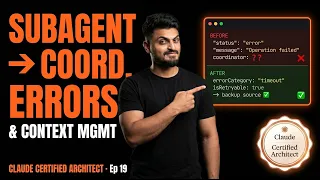
The primary cause of silent failures in agentic systems is the treatment of errors as simple, unstructured strings. A generic error like "Operation failed" is catastrophic for multi-agent recovery because it gives a coordinator no actionable information. The coordinator cannot determine if the failure is retriable, if it needs an escalation, or if an alternative tool path should be tried. This course module distinguishes sharply between tool-level handling and agent-level error management. While syntax errors or unhandled exceptions can crash a single thread, agent-level failures are more insidious—they involve logical dead ends, empty result sets, or authorization blocks that, if not explicitly caught and formatted, simply cause the agent to stop with no output.
Building Structured Errors for Recovery
To build resilient systems, developers must move from vague messages to structured, machine-readable error objects. The course introduces a four-property response format that coordinators need: an error category, a severity level, a suggested user action, and a suggested agent action. By classifying errors into actionable categories such as access failures, empty results, or timeouts, the coordinator agent can implement an escalation matrix. This structured approach flips the failure model from a dead stop to a decision tree, enabling the system to return partial results alongside a controlled error state, thus preserving any useful work completed before the fault occurred.
The Critical Distinction Between Access and Emptiness
A key exam trap and production pitfall is conflating an access failure with an empty result set. They may look identical because both prevent the system from returning data, but their root causes and remedies are vastly different. An access failure suggests a configuration, permission, or authentication problem that will persist regardless of retries. An empty result, however, indicates the tool worked correctly but found no matching data, which is valid information for a downstream process. Mistaking one for the other leads to either infinitely retrying a banned endpoint or incorrectly flagging a legitimate zero-state as a crash.
Managing Context Degradation in Long Sessions
Beyond error propagation, the course addresses a critical constraint of long-running Claude Code sessions: context window degradation. As a conversation extends, tokens from earlier turns risk being truncated or forgotten, causing the agent to lose track of findings established hours ago. This is not a bug but a fundamental architectural limit of current LLM memory management. The solution lies in externalizing memory. The session's volatile state must be actively written to a persistent file outside the immediate context window.
Persistence with the Scratchpad Pattern
The primary mitigation strategy taught is the `scratchpad.md` file pattern. This is an external text file that the Claude agent is instructed to update with critical findings, current task status, and recovery checkpoints. It acts as a manifest for crash recovery, ensuring that if a session crashes at 3 AM, a new session can read the file and resume work without losing the previous four hours of computation. This pattern transforms a stateless run into a stateful, durable workflow, bridging the gap between ephemeral agent loops and reliable production execution.
Interactive Recovery Commands and Exam Focus
For interactive development and manual oversight, the module covers the `/compact` command, which frees up context space mid-session by summarizing the current history before the window is exhausted. While essential for maintaining a responsive coding assistant, the course emphasizes that this interactive tool must be complemented by automated structures like the scratchpad file for fully autonomous runs. The session wraps up with a live exam drill on Sample Question 8 from Domain 5, walking through the pragmatic application of these patterns under certification conditions.
Preparing for Production and Certification
This lesson sits within a broader professional certification track designed to equip architects with concrete patterns for agentic systems. By internalizing the difference between vague and structured errors, implementing external memory persistence, and mastering the escalation matrix, candidates prepare not just for an exam but for the realities of deploying AI agents that do not silently disappear overnight. The final mile requires replacing hope with verified recovery logic, ensuring every component in the chain knows how to ask for help when it fails.
What you will learn
- Diagnose why generic error messages cause complete multi-agent system collapses
- Construct structured error responses with category, severity, user action, and agent action
- Distinguish access failures from empty result sets to avoid critical logic traps
- Implement external memory using scratchpad files for stateful, durable agent runs
- Apply an escalation matrix to enable automatic coordinator recovery in production
Concepts covered
Technologies used
Chapters 12 markers
- Introduction to Silent Failures
- Why Subagents Fail Without Trace
- Tool vs Agent-Level Error Logic
- Vague Errors vs Structured Error Objects
- The Four Properties of an Error Response
- Returning Partial Results on Failure
- Tricky Exam Scenario on Error Categories
- Designing the Escalation Matrix
- Context Window Degradation in Long Sessions
- Persistent Memory via scratchpad.md
- The /compact Recovery Command
- Certification Exam Tips and Tricks
Next suggested video


Reviews
No reviews yet. Be the first to rate this lesson.