-
11
 Lesson 11 – Claude Certified Architect – Full Course
31min
Lesson 11 – Claude Certified Architect – Full Course
31min
-
12
Lesson 12 – Claude Certified Architect – Full Course
33min
-
13
Lesson 13 – Claude Certified Architect – Full Course
51min
-
14
Lesson 14 – Claude Certified Architect – Full Course
31min
-
15
Lesson 15 – Claude Certified Architect – Full Course
34min
-
16
Lesson 16 – Claude Certified Architect – Full Course
27min
-
17
Lesson 17 – Claude Certified Architect – Full Course
36min
-
18
Lesson 18 – Claude Certified Architect – Full Course
34min
-
19
Lesson 19 – Claude Certified Architect – Full Course
Current lesson
-
20
Lesson 20 – Claude Certified Architect – Full Course
42min
-
21
Lesson 21 – Claude Certified Architect – Full Course
51min
-
22
Lesson 22 – Claude Certified Architect – Full Course
1h 00min









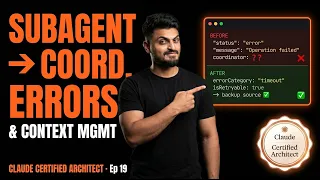


Summary
The Core Challenge of AI Agent Memory
Building a reliable AI agent requires more than just a good prompt. Developers often find that an agent which performed flawlessly in testing can suddenly fail in production, making errors that seem like simple forgetfulness. This is not a model hallucination or a calculation mistake, but a fundamental architecture problem known as context management. The Claude Certified Architect course addresses this head-on, treating it as the highest-leverage skill for AI engineers in 2026. The central issue is that an agent’s working memory, its context window, is a finite and surprisingly fragile resource. When critical information falls out of this window or gets buried by noise, the agent loses the plot, leading to inaccurate replies and broken workflows.
Understanding the Context Window
To solve the memory problem, one must first understand the structure of the context window itself. It is not a simple text bucket. Research into large language models reveals a "lost in the middle" effect, where information placed in the center of a long prompt is significantly less likely to be recalled accurately. The model pays the most attention to the very beginning and the very end of the context. This has profound implications for how agent conversations should be structured. Knowing this, developers can place critical system instructions at the top and the most recent user query at the bottom. However, a long-running agent conversation naturally pushes the vital early instructions and middle-conversation facts out of these high-attention zones, causing the agent to forget its original goal.
The Silent Context Eater
One of the most insidious threats to an agent's memory is not the conversation itself, but the output of tools. When an agent calls an API or queries a database, the resulting payload can be massive. The course reveals a shocking pattern: tool results can silently consume four times more context than the actual chat dialogue. A developer might not notice this bloat during short tests, but in a production loop over many turns, verbose JSON dumps or full web-page scrapes rapidly fill the context window. This pushes the original instructions and crucial user facts out of the window entirely. The agent is then left operating only on recent, raw tool outputs without the grounding it needs, acting like it has forgotten the original mission.
Progressive Summarization and Attention Curves
Instead of trying to cram everything in, a mature context strategy uses progressive summarization. As a conversation grows, older parts are compressed into dense summaries. This condenses the history into a format that retains semantic meaning while taking up a fraction of the space. This technique works in harmony with the LLM's attention curve by ensuring that the current task instructions and the most recent interactions sit in the high-attention end zone. By progressively summarizing the middle of the conversation, developers keep the context window lean and focused. The goal is not to save every word ever spoken, but to carry forward the essential narrative thread so the agent’s reasoning remains consistent.
The Case Facts Block Pattern
For facts that must never be forgotten, like a user’s account ID, a specific refund amount quoted, or an email address, simple summarization is too risky. The course introduces the Case Facts Block pattern as a durable solution. This is a dedicated, non-negotiable section at the very top of the context window where immutable facts are stored. Regardless of what the rest of the conversation looks like, this block persists. On every turn of the agentic loop, the system adds the user message and tool results, but re-inserts the Case Facts Block at the very top. This guarantees the model’s high-attention window always has direct access to the truth, preventing misquotes and fatal errors in long-running autonomous tasks.
Trimming at the Hook Layer
To further combat the silent context eater, the architecture requires trimming tool outputs before they are ever passed to the model. The course advocates for a "Trim First, Then Pass" philosophy at the hook layer. Instead of dumping a raw 200KB API response into the context, a pre-processing hook slices it down to only the relevant fields. For scenarios like structured data extraction, this can achieve over ninety-five percent context reduction. The structure of the information also matters immensely; clean, minimal JSON or a concise table is often far more token-efficient and model-friendly than sprawling prose. This active curation of context is what separates robust production systems from fragile prototypes.
The Rules of Escalation
Context management is only half the battle. The second part of the domain covers when an AI agent must hand control over to a human operator. This is a minefield of anti-patterns, and the certification exam specifically targets them. There are only three valid triggers for escalation: when the agent encounters missing or impossible execution conditions, when it hits a pre-defined business rule stop-loss to prevent damage, and most critically, when the user explicitly requests to speak to a human. The non-negotiable golden rule is that an explicit human request must trigger an immediate handoff with zero additional processing, as trying to "solve first" is a guaranteed exam trap.
Exam Traps and the Decision Framework
A large part of certification readiness is identifying when not to escalate. The exam is designed with distractors that appear to be valid triggers but are not. Low confidence by itself is not a reason to escalate; the agent should first use tools to seek clarification. Similarly, a standard high-workload task is not an escalation trigger if the system was designed to handle it. The course delivers a formal Escalation Decision Framework to evaluate these situations. This mental model is demonstrated through a live agent demonstration and a full walkthrough of a sample exam question, showing how to choose between resolving, seeking more context, or escalating, ensuring candidates can map any given scenario to the correct Task Statements for Domain 5.
What you will learn
- Diagnose why AI agents forget mid-conversation and link it to context window mechanics
- Apply the Case Facts Block pattern to preserve immutable critical facts across agent loops
- Implement progressive summarization to maintain semantic history without token bloat
- Configure hook-layer trimming to reduce tool output noise by over 95%
- Distinguish valid escalation triggers from the exact distractors used on the certification exam
Concepts covered
Technologies used
Chapters 12 markers
- Your AI Agent has a Memory Problem
- The Context Window: Your Agent's Memory
- Progressive Summarisation
- Your LLM's Attention Curve
- Tool Results: The Silent Context Eater
- The Case Facts Method
- Trim First, Then Pass
- When to Escalate to Human
- When not to escalate
- The Escalation Decision Framework
- Live Demo: Agent Escalation
- Exam Question & Summary
Next suggested video


Reviews
No reviews yet. Be the first to rate this lesson.