-
01
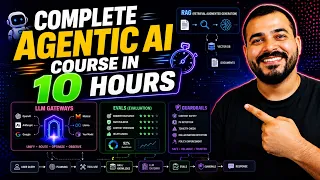
 Complete Agentic AI Course In 10 Hours- Langchain, Langgraph, RAG,Vectorless RAG, Guardrails,Evals
Current lesson
Complete Agentic AI Course In 10 Hours- Langchain, Langgraph, RAG,Vectorless RAG, Guardrails,Evals
Current lesson
-
02
LangSmith Tutorial – LLM Evaluation for Beginners
36min
-
03
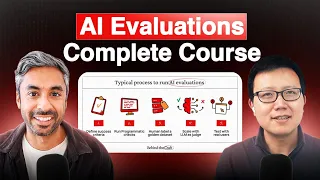
Complete Beginner’s Course on AI Evaluations in 50 Minutes (2025) | Aman Khan
51min
-
04
Guardrails with LangChain: A Complete Crash Course for Building Safe AI Agents
38min
-
05
Guardrails for LLM Applications | Complete Tutorial for AI Developers WIth Guardrails AI
1h 26min
-
06
AI Evaluations Clearly Explained in 50 Minutes (Real Example) | Hamel Husain
52min
-
07
Are you still babysitting AI coding agents? Build better guardrails!
37min
-
08
LLM Evaluation – Build Reliable AI Apps | LLM evaluation metrics | LLM evaluation techniques
39min
-
09
A Practical Guide to LLM Evaluation – Michelle Yi
31min
-
10
How to Setup LLM Evaluations Easily (Tutorial)
17min





Summary
Understanding Agentic AI Architecture
This comprehensive 10-hour course by Krish Naik provides an in-depth exploration of agentic AI systems built with LangChain and LangGraph frameworks. Agentic AI represents a significant evolution in generative AI, moving beyond simple prompt-response patterns to create autonomous agents capable of reasoning, planning, and executing multi-step tasks. The course is structured to take learners from foundational concepts through advanced production-ready techniques, making it ideal for developers, data scientists, and AI engineers seeking to build sophisticated AI applications. By covering both established frameworks and emerging techniques like vectorless RAG, the course ensures participants understand both current best practices and next-generation approaches to AI agent development.
LangChain Fundamentals and Components
The LangChain segment establishes the foundational framework upon which modern agent development is built. LangChain provides a comprehensive toolkit for building language model applications, abstracting away much of the complexity involved in orchestrating LLM calls, managing prompts, and handling data pipelines. Participants learn how to structure applications using core LangChain components: chains for sequential operations, agents for decision-making workflows, and tools for extending LLM capabilities. The course covers prompt templates, memory management, and integration patterns with various LLM providers. Understanding LangChain is critical because it serves as the backbone for more advanced patterns like agentic systems, enabling developers to quickly prototype and deploy production-grade applications without reinventing foundational patterns.
Building Intelligent Agents with LangGraph
LangGraph extends LangChain's capabilities specifically for building agentic systems with explicit state management and graph-based execution models. Rather than linear chains, LangGraph enables developers to define complex workflows where agents can make decisions at nodes, follow conditional paths, and maintain sophisticated state across multiple steps. The course demonstrates how LangGraph's graph-based architecture maps naturally to agent behaviors: perception (observing the current state), reasoning (deciding what action to take), and action (executing tools or API calls). This section teaches participants to design agent loops that can handle complex problem-solving scenarios, recover from errors, and maintain context across extended conversations. The ability to visualize and control agent execution flow through graphs is fundamental to building reliable agentic systems that developers can debug and improve iteratively.
Retrieval-Augmented Generation and Knowledge Integration
RAG has become essential for grounding AI agents in factual, up-to-date information. The course covers traditional vector-based RAG approaches where documents are embedded into a vector space, enabling semantic similarity search when agents need external knowledge. Participants learn the complete RAG pipeline: document ingestion, chunking strategies, embedding generation, vector storage, and retrieval-augmented generation workflows. The course emphasizes that RAG solves critical problems like hallucination mitigation, enabling agents to cite sources, and providing domain-specific knowledge without retraining models. Understanding when and how to implement RAG is crucial because agentic systems often must access external information repositories, and effective RAG implementation can dramatically improve agent accuracy and user trust in generated responses.
Vectorless RAG and Alternative Retrieval Paradigms
Vectorless RAG represents an emerging frontier that challenges the dominance of embedding-based approaches. This technique leverages alternative retrieval methods such as lexical search, semantic parsing, or structured indexes without computing vector embeddings. The course explains scenarios where vectorless RAG excels: when dealing with highly structured data, domain-specific terminology, or when embedding quality is uncertain. Vectorless approaches often provide better interpretability and can be more efficient computationally, particularly for real-time agent systems processing large document collections. This segment is valuable for practitioners who need to choose appropriate retrieval strategies based on their specific use cases, recognizing that no single RAG approach is optimal for all scenarios.
Deep Agent Design Patterns and Control
Deep agents extend beyond simple tool-calling patterns, incorporating sophisticated reasoning, planning, and dynamic workflow generation. The course covers techniques for building agents that can decompose complex problems into subtasks, maintain long-term goals, and adapt their strategies based on intermediate results. Deep agent design involves managing agent state more carefully, implementing reflection mechanisms where agents evaluate their own outputs, and creating hierarchical agent systems where higher-level agents coordinate lower-level specialized agents. Participants learn how to structure agent prompts for better reasoning, implement chain-of-thought patterns, and create feedback loops that improve agent decision-making over time. Mastering deep agent design is essential for tackling real-world problems that require multi-step reasoning beyond what simple prompts or basic chains can achieve.
Safety, Guardrails, and Responsible Agent Deployment
Guardrails represent critical infrastructure for deploying agentic systems responsibly. The course covers techniques for constraining agent behavior, preventing harmful outputs, and maintaining alignment with organizational values and regulatory requirements. Guardrails include input validation (preventing prompt injection attacks), output filtering (removing toxic or inappropriate content), and action constraints (limiting which tools agents can call in specific contexts). The course teaches participants to implement guardrails at multiple levels: LLM-level (through system prompts and fine-tuning), semantic-level (catching problematic intents), and action-level (controlling what external systems agents can access). This section emphasizes that as agents gain autonomy, guardrails become increasingly important for preventing unintended consequences and maintaining human oversight over critical system behaviors.
Evaluation Frameworks and Quality Assurance
Evaluating agentic AI systems presents unique challenges because success depends not just on individual LLM outputs, but on entire workflows producing correct end-to-end results. The course covers LLM evaluation techniques including reference-based metrics, reference-free evaluation, and automated assessments using other LLMs as judges. Participants learn how to define success criteria for agentic systems: does the agent select appropriate tools? Does it retrieve relevant information? Does it generate accurate final responses? The course teaches how to build evaluation pipelines that catch regressions, measure improvement over time, and compare different agent architectures. Proper evaluation infrastructure is fundamental because it enables confident iteration on agent systems, provides evidence for production readiness, and helps teams understand where agents fail and how to improve them.
LLM Gateways and Production Infrastructure
LLM gateways represent the infrastructure layer that enables scalable, controlled, and observable deployment of agentic systems in production environments. Gateways handle critical functions: routing requests to appropriate models, managing rate limits and quotas, enforcing authentication, logging interactions for audit trails, and monitoring system health. The course explains how gateways enable organizations to test new models, A/B test different agent configurations, and maintain compliance with regulatory requirements. Implementing proper gateway infrastructure is essential for enterprises deploying agentic systems because it provides the visibility, control, and reliability that production systems demand. By the end of this segment, participants understand how individual agent components integrate into production-grade systems that can serve thousands of users reliably.
What you will learn
- Build autonomous agents using LangChain and LangGraph frameworks
- Implement Retrieval-Augmented Generation for knowledge-grounded responses
- Design and deploy vectorless RAG systems for specialized data retrieval
- Apply guardrails and safety mechanisms for responsible agent deployment
- Evaluate agentic system performance with comprehensive metrics and testing
- Architect production-ready LLM gateways for enterprise deployments
Concepts covered
Technologies used
Chapters 9 markers
- Introduction
- LangChain fundamentals and core components
- LangGraph agentic systems architecture
- RAG implementation and retrieval patterns
- Vectorless RAG techniques and alternatives
- Deep agent design and reasoning patterns
- Guardrails and safety mechanisms
- LLM evaluation frameworks and metrics
- LLM gateways and production infrastructure
Next suggested video
Reviews
No reviews yet. Be the first to rate this lesson.