-
01
 The ultimate guide to AEO: How to get ChatGPT to recommend your product | Ethan Smith (Graphite)
1h 11min
The ultimate guide to AEO: How to get ChatGPT to recommend your product | Ethan Smith (Graphite)
1h 11min
-
02
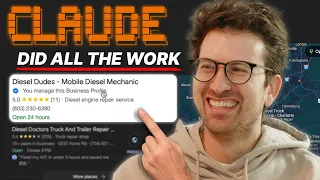
How Claude Code Ranked Me FIRST on Google (It’s OVER for SEO Agencies)
Current lesson
-
03
The Complete Guide to AI Search Optimization (SEO, AEO & GEO Explained)
13min
-
04
Complete SEO Course (3 Hours): Rank #1 AI Search | Prompts Included
3h 19min
-
05
The Complete SEO & AI SEO Course for 2026 (Full Beginner’s Guide)
50min
-
06
Full Course: How to Get Traffic From AI And ChatGPT | LLM SEO, GEO, and AEO
1h 30min
-
07
A Complete Guide to AI SEO in 2026 (AEO, GEO, LLMO)
9min
-
08
How To Do an AI Search Optimisation Audit (Step-by-Step Guide)
21min
-
09
How To Train Google’s AI to Send You Customers
12min
-
10
A Complete Guide to AI Search Optimisation for 2026 (AI SEO, AEO, GEO)
21min





Summary
The Local Service Market Opportunity
While the tech industry obsesses over AI agents and SaaS platforms, a massive blind spot exists in local service businesses. These "boring" enterprises—diesel truck repair shops, plumbing services, HVAC contractors—operate with outdated websites and minimal online presence. James, known as The Boring Marketer, identified this gap and partnered with a friend to build a complete digital presence for a mobile diesel repair business using Claude Code. The results were dramatic: within 24 hours of launch, the phone lines lit up with customer calls, generating thousands of dollars in revenue. This case study demonstrates that AI-powered tools can democratize web development and SEO optimization, allowing non-technical entrepreneurs to compete effectively against established local competitors.
Building a Professional Website in Four Hours
Traditionally, creating a professional website with 50+ optimized pages would require weeks of work and significant technical expertise or expensive agency fees. Claude Code compressed this timeline to just four hours. The website included service pages, location-specific content, technical SEO optimization, and mobile responsiveness—all the elements needed for search engine visibility and user conversion. The secret lay in leveraging Claude's ability to understand intent and generate structured content at scale. Rather than manually building each page, James provided the AI with keyword targets and content guidelines, allowing Claude to generate semantically rich, properly formatted pages automatically. This approach eliminated the typical bottleneck of manual page creation and allowed the entrepreneur to focus on business strategy rather than technical implementation.
The Barbell Strategy for Long-Term Business Resilience
James articulated a compelling investment philosophy for the AI era: build a portfolio with digital businesses on one side and local service businesses on the other. Digital services face existential disruption as AI capabilities advance—automation threatens to compress margins and eliminate competitive moats. Local service businesses, conversely, offer high defensibility because they require physical presence, personal relationships, and hands-on expertise. A diesel truck mechanic cannot be replaced by an AI model; however, the marketing and customer acquisition for that business can be dramatically improved with AI tools. This barbell approach protects entrepreneurs from total disruption while allowing them to benefit from AI's productivity gains. A founder building both a SaaS tool and a local service network hedges against uncertainty while capturing value across different market dynamics.
The Keyword-First SEO Process
Instead of relying on expensive SEO tools and consultants, James implemented a straightforward, AI-native SEO methodology. The process began with asking Claude to generate 25 to 50 relevant keywords for the diesel repair market. Each keyword was then mapped to user intent—distinguishing between emergency searches ("diesel truck repair near me"), service inquiries ("what is diesel engine maintenance"), problem-solving queries ("why is my diesel engine smoking"), and local modifiers. This intent mapping ensured that content addressed actual customer needs rather than chasing high-volume keywords without relevance. Dedicated pages were created for each major keyword cluster, ensuring semantic coverage of the market space. The entire approach bypassed analysis paralysis and overcomplicated SEO strategies, replacing them with a simple, repeatable process driven by AI assistance.
Technical SEO Automation with Claude's Deep Analysis
The turning point came when James used a powerful prompt strategy: "Go through this website in extreme detail. Ultra think about this. Find all technical and on-page SEO issues so I can dominate the local market." This instruction activated Claude's reasoning capabilities to perform comprehensive technical audits. Claude systematically identified missing technical files (robots.txt, sitemap configurations), loading speed bottlenecks, schema markup deficiencies, and internal linking opportunities. Rather than generating a list of recommendations for manual implementation, Claude automated the fixes directly within the codebase. This eliminated the friction between problem identification and resolution, a gap where many SEO efforts stall. The result was a technically optimized website that satisfied Google's Core Web Vitals and ranking factors without manual intervention.
Parallel Processing with Multi-Agent Architecture
One advanced technique James employed was launching multiple Claude agents to work on different optimization tasks simultaneously. While one agent refined the website's core structure, three sub-agents operated in parallel: one scanning for missing alt text on images, another analyzing competitor websites for content gaps, and a third identifying emerging opportunities in the local market. This parallelization dramatically accelerated the optimization timeline. Rather than sequential, serial improvements, the website benefited from concurrent enhancement across multiple dimensions. This approach demonstrates how modern AI tools can replicate the efficiency of large teams, allowing solo entrepreneurs or small teams to execute enterprise-scale optimization strategies.
The Google PageSpeed Insights Workflow
A surprisingly effective tactic involved integrating Google's free PageSpeed Insights tool directly into the Claude Code workflow. James ran the website through PageSpeed Insights, copied any performance errors or recommendations directly into Claude Code, and let the AI automatically implement the fixes. This eliminated manual interpretation of technical recommendations—Claude understood the Google-generated feedback and translated it into actionable code changes. Page speed is a confirmed Google ranking factor, and this streamlined workflow ensured that performance optimization happened systematically rather than being deprioritized. The tactic illustrates how combining free Google tools with AI code generation creates a powerful optimization pipeline accessible to non-technical operators.
Design Excellence Without Agency Costs
A common concern with AI-generated websites is that they appear generic or obviously machine-made. James solved this with a hybrid design workflow: a professional designer created mockups in Figma, the Anima plugin converted those designs into React components, and Claude assembled the components into a functioning website. This approach preserved design quality and visual distinctiveness while gaining the speed and cost benefits of AI development. The final website appeared professionally designed and custom-built, even though the underlying construction was AI-assisted. This workflow shows that AI tools work best when integrated with human expertise rather than replacing it entirely. The designer provided visual judgment and brand coherence, while AI handled the technical assembly and implementation.
From Concept to Revenue in Days
The entire project arc—from identifying the market opportunity to launching a revenue-generating website—compressed into days rather than months. The non-technical entrepreneur acquired a professional digital asset, achieved top Google rankings for local keywords, and began converting customer inquiries into revenue. This acceleration represents a fundamental shift in entrepreneurial capability. Previously, founders without technical backgrounds faced a stark choice: hire expensive agencies or learn to code themselves. Claude Code and similar AI development tools create a third path: leverage AI as an accessible, affordable co-developer. The case study validates that "boring" local businesses represent genuine entrepreneurial opportunity, and AI tools have lowered the barriers to capturing that opportunity.
What you will learn
- Identify high-opportunity local service markets with weak online competition
- Build 50+ SEO-optimized pages using Claude Code in minimal time
- Conduct technical SEO audits and fix issues automatically with AI prompts
- Implement a keyword-to-intent mapping strategy for local search dominance
- Combine Figma design with AI code generation for professional results
- Deploy websites to production using GitHub and Vercel integration
Concepts covered
Technologies used
Chapters 9 markers
Next suggested video
Reviews
No reviews yet. Be the first to rate this lesson.