-
01
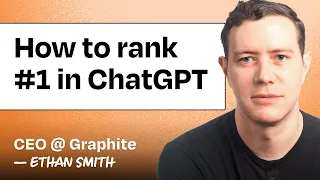
 The ultimate guide to AEO: How to get ChatGPT to recommend your product | Ethan Smith (Graphite)
Current lesson
The ultimate guide to AEO: How to get ChatGPT to recommend your product | Ethan Smith (Graphite)
Current lesson
-
02
How Claude Code Ranked Me FIRST on Google (It’s OVER for SEO Agencies)
32min
-
03
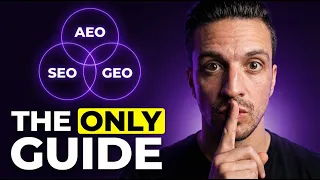
The Complete Guide to AI Search Optimization (SEO, AEO & GEO Explained)
13min
-
04
Complete SEO Course (3 Hours): Rank #1 AI Search | Prompts Included
3h 19min
-
05
The Complete SEO & AI SEO Course for 2026 (Full Beginner’s Guide)
50min
-
06
Full Course: How to Get Traffic From AI And ChatGPT | LLM SEO, GEO, and AEO
1h 30min
-
07
A Complete Guide to AI SEO in 2026 (AEO, GEO, LLMO)
9min
-
08
How To Do an AI Search Optimisation Audit (Step-by-Step Guide)
21min
-
09
How To Train Google’s AI to Send You Customers
12min
-
10
A Complete Guide to AI Search Optimisation for 2026 (AI SEO, AEO, GEO)
21min


Summary
Understanding Answer Engine Optimization
Answer engine optimization (AEO) represents a fundamental shift in how products and services gain visibility in the age of generative AI. Unlike traditional search engine optimization (SEO), which focuses on ranking in Google's organic results, AEO targets the recommendation systems built into large language models like ChatGPT, Claude, Gemini, and Perplexity. Ethan Smith, CEO of Graphite, a leading SEO growth agency with 18 years of industry experience, brings a crucial insight: ChatGPT traffic converts at six times the rate of Google search traffic. This dramatic difference stems from the nature of AI-driven answers—when an LLM recommends a product or service directly to a user, that user has already received validation and context from an authoritative source, making them far more likely to convert into a paying customer.
The opportunity is currently massive because most companies remain entirely unaware of AEO's existence and potential. While SEO takes years to build and requires sustained effort, AEO allows early-stage startups to gain traction immediately by understanding and leveraging how AI models source and cite information. This creates an unprecedented window for founders and growth leaders to establish dominance in their categories before competitors catch on.
The Three Proven Tactics for AEO Success
Ethan outlines three concrete tactics that demonstrably work for AEO: landing pages, YouTube videos, and Reddit comments. Each channel serves a specific function in the AI model training and retrieval process. Landing pages establish authoritative, original content on your domain that AI models can cite directly. YouTube videos extend reach through transcripts and descriptions, making your insights discoverable to models that index video platforms. Reddit comments, which might seem counterintuitive, work because they combine authenticity, organic discussion, and direct answers to user questions. The Reddit strategy succeeds precisely because it avoids looking like traditional marketing—it mirrors the conversational tone users expect in AI-generated answers.
What separates successful AEO from SEO is the absence of obvious optimization tactics. AI models, particularly those using retrieval-augmented generation (RAG), are trained to recognize and penalize hyper-optimized, keyword-stuffed content. Authenticity becomes the primary ranking signal. A genuine Reddit discussion about a problem and how a specific tool solved it carries more weight than a polished landing page filled with target keywords. This insight fundamentally changes how companies should approach content creation: instead of optimizing for search algorithms, teams should focus on solving real problems, answering genuine questions, and providing original insights that LLMs will naturally cite as authoritative sources.
Why AI-Generated Content Fails at AEO
A critical finding from Ethan's research reveals that AI-generated content consistently underperforms in answer engine optimization. This might seem counterintuitive—why would AI models favor human-written content over synthetic content?—but the reason is rooted in model behavior and recursive training collapse. When LLMs are trained on increasingly large datasets of AI-generated text, the model's output quality degrades. This phenomenon, documented in recent research, occurs because AI-generated content lacks the nuance, original perspective, and real-world problem-solving that characterizes authentic human writing.
Furthermore, AI models are increasingly sophisticated at detecting synthetic content, either through statistical markers or by recognizing patterns of derivative information. Companies that attempt to scale their AEO efforts through bulk AI content generation will find their domains penalized or deprioritized by modern LLMs. The competitive advantage belongs to companies willing to invest in original, human-created content that tackles questions from fresh angles, provides genuine insights, or documents real case studies and experiences.
Help-Center Content as Hidden High-ROI Investment
One of Ethan's most actionable discoveries involves help-center content optimization. Companies typically treat help centers as afterthoughts—necessary but not strategic. However, help-center articles represent some of the highest-converting traffic sources for AEO when optimized correctly. Help centers contain naturally structured answers to common user questions, are heavily cited by AI models (especially when a user is researching a product they're already considering), and benefit from the brand authority of the company domain. Help-center optimization also has immediate business value: if an LLM recommends your help center article to a user, that user is already in consideration and more likely to be qualified.
The strategy involves auditing help-center content for clarity, comprehensiveness, and original insights, then ensuring that answers directly address the questions your target customers are asking AI models. Unlike SEO, where help-center content ranks poorly due to low authority and high competition, AEO treat help-center pages as premium real estate because they combine brand authority, direct answers, and high relevance to the customer journey.
Building a Playbook and Measuring AEO Success
Ethan presents a seven-step playbook for implementing AEO: identify the questions your customers ask LLMs, map those questions to your content strategy, create or optimize original content across your owned channels, distribute through Reddit and other community platforms, measure share of voice in AI responses, track conversion quality and ROI, and iterate based on data. The measurement phase is critical because AEO operates differently from SEO—instead of tracking rankings and organic traffic volume, teams must track whether their content appears in LLM responses, how often it's cited, and whether that traffic converts at the expected six-to-one premium rate.
Share of voice tracking means monitoring how often your brand or content appears in AI model responses compared to competitors. Tools and methodologies for this measurement are still emerging, but the principle is sound: if you're winning at AEO, your content should appear in a disproportionate percentage of relevant AI-generated answers. Additionally, companies should implement control groups and experimentation rigorously, testing different content approaches, distribution channels, and messaging to identify which tactics drive the highest-value traffic for their specific business model.
Adapting AEO Across Business Models
While the core principles of AEO apply universally, their implementation varies significantly across B2B, e-commerce, and early-stage company contexts. For B2B companies, help-center optimization, case studies, and original research become particularly powerful because B2B buyers actively use LLMs to evaluate vendors and solutions. For e-commerce, product reviews, comparison content, and community-driven recommendations (similar to Reddit but on commerce platforms) generate the highest-converting traffic. Early-stage startups benefit most from AEO because they can establish authority and visibility far faster than through traditional SEO, often winning market share before better-resourced competitors realize the opportunity exists.
The Future Convergence of Search and AI
Ethan points toward a future in which the distinction between search and AI becomes meaningless. As Google integrates generative AI into its search results and standalone AI assistants become the default way users seek information, companies will need to optimize for both simultaneously. The winners will be those who build authentic, original content that appeals to both human readers and AI models—and who recognize that conversion quality, not traffic volume, defines success in the AEO era. This represents not just a tactical shift but a fundamental change in how growth leaders should think about distribution and brand visibility.
What you will learn
- Understand the core principles of answer engine optimization (AEO) and how it differs from traditional SEO
- Implement the three proven tactics: landing pages, YouTube videos, and Reddit comments for AEO visibility
- Measure and track share of voice in ChatGPT, Claude, Perplexity, and other AI assistants
- Optimize help-center content as a high-ROI investment for AI-driven traffic and conversions
- Build original, authentic content that avoids AI-generated derivation and appeals to LLM citation patterns
- Apply AEO strategies across different business models: B2B, e-commerce, and early-stage startups
Concepts covered
Technologies used
Chapters 15 markers
- Welcome and introduction
- The changing landscape of SEO
- AEO vs. GEO definition
- Impact of AEO and conversion rates
- AEO wins for early-stage startups
- Quality of AEO-driven leads
- Reddit strategy and avoiding spam
- How AI models use citations (RAG)
- Avoiding hyper-optimized content
- Seven-step AEO playbook
- Tracking and measuring share of voice
- AEO for B2B, commerce, and startups
- Why AI-generated content fails
- Future of LLMs and search convergence
- Help-center optimization strategy
Next suggested video
Reviews
No reviews yet. Be the first to rate this lesson.