-
01
 The ultimate guide to AEO: How to get ChatGPT to recommend your product | Ethan Smith (Graphite)
1h 11min
The ultimate guide to AEO: How to get ChatGPT to recommend your product | Ethan Smith (Graphite)
1h 11min
-
02
How Claude Code Ranked Me FIRST on Google (It’s OVER for SEO Agencies)
32min
-
03
The Complete Guide to AI Search Optimization (SEO, AEO & GEO Explained)
13min
-
04
Complete SEO Course (3 Hours): Rank #1 AI Search | Prompts Included
3h 19min
-
05
The Complete SEO & AI SEO Course for 2026 (Full Beginner’s Guide)
Current lesson
-
06
Full Course: How to Get Traffic From AI And ChatGPT | LLM SEO, GEO, and AEO
1h 30min
-
07
A Complete Guide to AI SEO in 2026 (AEO, GEO, LLMO)
9min
-
08
How To Do an AI Search Optimisation Audit (Step-by-Step Guide)
21min
-
09
How To Train Google’s AI to Send You Customers
12min
-
10
A Complete Guide to AI Search Optimisation for 2026 (AI SEO, AEO, GEO)
21min



Summary
Understanding SEO in the Modern Era
Search Engine Optimization has evolved significantly as we enter 2026, with the landscape shifting to accommodate both traditional Google rankings and emerging AI search platforms. This comprehensive tutorial from Surfer Academy provides beginners and experienced marketers with a practical roadmap for building sustainable organic visibility across search engines and AI-powered platforms like ChatGPT and Google's AI Overviews. The video breaks down the complete SEO process—from foundational concepts to advanced strategies—in a structured, actionable format that anyone can follow regardless of their starting point.
Decoding Search Intent for Better Rankings
Search intent represents one of the most critical pillars of modern SEO, yet it remains misunderstood by many content creators. Understanding what users actually want when they type a query into a search engine is fundamental to creating content that both ranks and converts. The tutorial emphasizes that search intent encompasses the user's true goal: whether they're looking for information, trying to make a purchase, seeking a specific website, or attempting to complete a local action. Matching content to search intent means analyzing the top-ranking results for a keyword, understanding the format and depth those pages provide, and creating something equally valuable or better. This approach ensures that the content serves real user needs rather than simply chasing keyword density or search volume metrics.
Strategic Keyword Research Methodology
Keyword research forms the foundation of any successful SEO strategy, and the video details how to identify opportunities that balance search volume, competition, and relevance to business goals. Rather than targeting only high-volume keywords—which typically face intense competition—the approach includes finding long-tail keywords and semantic variations that demonstrate clear user intent. The tutorial walks through evaluating keyword difficulty, analyzing competitor rankings for target terms, and building topic clusters that establish topical authority. This methodology helps content creators and business owners prioritize efforts on keywords they can realistically rank for while still driving meaningful traffic and conversions.
Content Creation That Achieves Rankings
Producing ranking-worthy content requires more than good writing; it demands a systematic approach to structure, depth, and relevance. The video outlines how to create content that matches the format and scope of top-ranking pages while adding unique value through original research, case studies, or different perspectives. Money pages and topic clusters emerge as key organizational concepts—money pages being high-intent pages designed to convert, while supporting cluster content builds topical authority around related keywords. The tutorial emphasizes covering user questions comprehensively, using data and examples, and organizing information in a scannable format that satisfies both search engines and human readers.
On-Page SEO Fundamentals and Best Practices
On-page optimization involves optimizing individual webpage elements to improve search visibility and user experience. This includes strategic placement of primary and secondary keywords in title tags, meta descriptions, headers, and body content, though modern SEO emphasizes natural integration over forced keyword repetition. URL structure, internal linking strategy, image optimization with descriptive alt text, and mobile responsiveness all contribute to on-page performance. The video demonstrates how to implement these elements without compromising content quality or user experience, recognizing that search engines increasingly prioritize pages that serve genuine user needs and provide excellent usability.
Building Authority Through Strategic Link Building
Backlinks remain a crucial ranking factor, but the approach has shifted from quantity toward quality and relevance. Link building strategies now focus on earning links from authoritative, relevant sources through valuable content creation, relationship building, and strategic outreach. The tutorial explains how to identify link opportunities, analyze competitor backlink profiles, and develop a sustainable link acquisition strategy. Rather than purchasing links or engaging in manipulative practices, the emphasis lies on creating content worthy of natural links and building genuine relationships within industry communities. This authentic approach to link building proves more durable and aligned with search engine guidelines.
Technical SEO and Site Architecture Excellence
Technical SEO ensures that search engines can crawl, index, and understand website content efficiently. Critical elements include site speed optimization, mobile-friendliness, proper URL structure, XML sitemaps, robots.txt configuration, and structured data markup. The video covers how technical issues can silently tank rankings—slow-loading pages, broken links, crawl errors, and poor site architecture all diminish search visibility. Implementing technical best practices creates a solid foundation that allows content quality and link authority to shine without being undermined by structural problems. Regular technical audits and monitoring help maintain site health as search engine requirements evolve.
AI Search Optimization and Future-Proofing Strategy
As AI-powered search platforms like ChatGPT, Google's AI Overviews, and other conversational AI search experiences gain prominence, SEO strategy must adapt accordingly. The tutorial addresses how to optimize content for both traditional search and AI search results, recognizing that AI systems may surface content differently than traditional ranking algorithms. This involves ensuring content is fact-rich, well-structured, and authoritative enough to be cited by AI systems when answering user queries. Rather than viewing AI search as a threat, forward-thinking marketers recognize it as an evolution of search behavior, requiring content that serves both human readers and AI language models effectively.
The 30-Day Action Plan for Immediate Progress
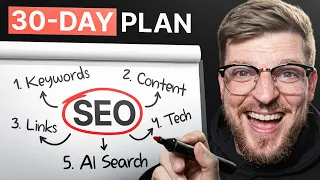
Moving from theory to implementation, the tutorial provides a concrete 30-day action plan that breaks SEO into manageable daily and weekly tasks. This structured approach helps beginners avoid overwhelm by providing clear priorities and sequential steps. The plan typically starts with foundational audit and strategy work, progresses through keyword research and content planning, and extends into execution and monitoring phases. By following a time-bound framework, business owners and content creators can establish momentum, see early results, and build sustainable SEO practices that compound over time.
What you will learn
- Understand search intent and its critical role in content creation and rankings
- Conduct keyword research using proper difficulty and competition analysis
- Create ranking-worthy content that serves user needs and search engine requirements
- Optimize on-page elements including titles, headers, meta descriptions, and internal links
- Build authority through strategic link acquisition and relationship building
- Implement technical SEO best practices for crawlability and indexation
- Optimize content for AI search engines like ChatGPT and Google AI Overviews
Concepts covered
Technologies used
Chapters 10 markers
Next suggested video
Reviews
No reviews yet. Be the first to rate this lesson.