-
01
 Complete Agentic AI Course In 10 Hours- Langchain, Langgraph, RAG,Vectorless RAG, Guardrails,Evals
11h 13min
Complete Agentic AI Course In 10 Hours- Langchain, Langgraph, RAG,Vectorless RAG, Guardrails,Evals
11h 13min
-
02
LangSmith Tutorial – LLM Evaluation for Beginners
36min
-
03
Complete Beginner’s Course on AI Evaluations in 50 Minutes (2025) | Aman Khan
51min
-
04
Guardrails with LangChain: A Complete Crash Course for Building Safe AI Agents
38min
-
05
Guardrails for LLM Applications | Complete Tutorial for AI Developers WIth Guardrails AI
1h 26min
-
06
AI Evaluations Clearly Explained in 50 Minutes (Real Example) | Hamel Husain
52min
-
07
Are you still babysitting AI coding agents? Build better guardrails!
37min
-
08
LLM Evaluation – Build Reliable AI Apps | LLM evaluation metrics | LLM evaluation techniques
Current lesson
-
09
A Practical Guide to LLM Evaluation – Michelle Yi
31min
-
10
How to Setup LLM Evaluations Easily (Tutorial)
17min









Summary
Understanding LLM Evaluation Fundamentals
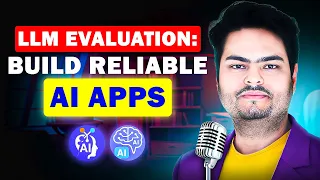
Evaluating large language models represents one of the most critical challenges in modern AI development. Unlike traditional machine learning models where evaluation metrics are well-established and standardized, LLMs introduce unique complexities due to their generative nature and the subjective quality of their outputs. This comprehensive video from Aman at Unfold Data Science explores the essential metrics and methodologies required to assess LLM performance reliably. The 40-minute session serves as a practical guide for data scientists and AI engineers who need to build production-ready applications using language models, ensuring that deployed systems maintain consistent quality and meet business requirements.
Core Evaluation Metrics for Language Models
The foundation of LLM evaluation rests on several critical metrics that measure different aspects of model performance. Traditional metrics like BLEU, ROUGE, and METEOR provide quantitative measures for text generation quality by comparing model outputs against reference texts. However, these metrics have significant limitations when applied to open-ended generative tasks where multiple correct answers exist. Beyond lexical similarity measures, semantic metrics such as BERTScore and embedding-based cosine similarity capture meaning preservation rather than surface-level text matching. The video explores how these metrics complement each other and where practitioners should apply each one depending on their specific use case, whether that involves machine translation, summarization, question-answering, or creative text generation.
Human Evaluation and Subjective Assessment
While automated metrics provide scalability and reproducibility, human evaluation remains essential for assessing LLM outputs reliably. The challenge lies in designing robust human evaluation frameworks that minimize bias and ensure consistency across raters. Techniques such as inter-rater agreement measurement, using Kappa or Fleiss' Kappa statistics, help quantify evaluation reliability. The video discusses how to structure human evaluation campaigns effectively, including the importance of clear rubrics, multiple annotators per sample, and systematic approaches to resolving disagreements. For many LLM applications, hybrid approaches combining automated metrics with targeted human review of edge cases and high-impact decisions offer the best balance between cost and reliability.
Benchmark Datasets and Standardized Testing
Publicly available benchmarks form the backbone of LLM evaluation in research and industry. Datasets like SQuAD for question-answering, GLUE for general language understanding, and specialized benchmarks for specific domains allow practitioners to compare models objectively and track progress over time. However, the video emphasizes that benchmark performance does not always translate to real-world application success. Models may overfit to specific benchmark characteristics or perform poorly on distribution shifts encountered in production environments. Understanding the composition, limitations, and appropriate use cases for each benchmark enables more informed model selection and realistic expectations about performance in deployed systems.
Task-Specific Evaluation Approaches
Different LLM applications require tailored evaluation strategies aligned with their specific objectives. For summarization tasks, metrics like ROUGE and human evaluation of informativeness and conciseness matter most. For dialogue systems, coherence, relevance, and user satisfaction become primary concerns. Question-answering evaluation focuses on exact match and F1 scores along with semantic correctness. Machine translation requires assessment of fluency, adequacy, and terminology accuracy. The video unpacks these domain-specific considerations, showing how evaluation frameworks must adapt to the particular challenge at hand while maintaining connection to the underlying business goals that justify the application's development.
Building Evaluation Pipelines for Production
Moving from academic evaluation to production-grade assessment requires establishing systematic evaluation pipelines that continuously monitor model performance. Automated evaluation scripts, dashboard monitoring, and alert systems help detect performance degradation before it impacts end users. The video discusses best practices for test set construction, including maintaining holdout sets separate from training data and periodically refreshing evaluation datasets to catch distribution drift. Implementing continuous evaluation allows teams to make data-driven decisions about model updates, retraining schedules, and rollback procedures when necessary. This operational perspective transforms evaluation from a one-time activity into an ongoing practice that supports reliable AI system maintenance.
Handling Edge Cases and Failure Modes
Robust LLM evaluation requires explicit attention to edge cases and failure modes that might not appear frequently in standard benchmarks but cause significant problems in production. These include adversarial inputs, out-of-distribution examples, toxic content generation, hallucination detection, and factual accuracy verification. The video emphasizes systematic approaches to identifying and measuring these failure modes, such as creating targeted test sets for known weaknesses and establishing metrics for detecting hallucination or factual incorrectness. Understanding the relative severity of different failure types helps prioritize evaluation efforts and engineering improvements toward the most impactful problems.
Practical Implementation and Decision Frameworks
The final sections synthesize evaluation concepts into practical decision frameworks that guide practitioners in their work. Choosing between metrics involves understanding trade-offs between computational cost, interpretability, correlation with human judgment, and alignment with application objectives. The video provides guidance on allocating evaluation budgets between automated metrics, human review, and monitoring infrastructure. Establishing baselines from existing models or simpler approaches provides context for interpreting new model performance. By following systematic evaluation approaches, teams can build confidence in their LLM applications and make informed decisions about deployment, scaling, and continuous improvement in production environments.
What you will learn
- Understand core LLM evaluation metrics including BLEU, ROUGE, BERTScore, and semantic similarity measures
- Design and implement human evaluation frameworks with inter-rater agreement measurement
- Select appropriate benchmark datasets and interpret their limitations for real-world applications
- Build production-grade evaluation pipelines with continuous monitoring and alert systems
- Develop task-specific evaluation strategies tailored to summarization, QA, dialogue, and translation
- Identify and measure edge cases, hallucinations, and failure modes in language model outputs
Concepts covered
Technologies used
Chapters 8 markers
Next suggested video

Reviews
No reviews yet. Be the first to rate this lesson.