Summary
The Core Concept of Automation in Job Hunting
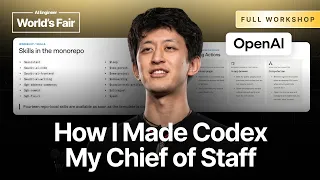
Tailoring a resume for each job application is widely acknowledged as a best practice but remains one of the most tedious parts of a job search. This tutorial demonstrates how to automate that exact process. It goes beyond a simple one-off script by leveraging OpenAI Codex to create a reusable, shareable skill. The video acts as a case study, moving from an initial idea—automating resume customization—to a polished AI tool that anyone can download and use immediately. The creator walks through the entire lifecycle of an AI-driven utility, starting from the planning phase to the final publication on GitHub. This approach ensures that the tool isn't just functional but is also packaged in a way that adheres to proper development practices, making it accessible to users who may not have deep technical coding experience.
Planning the Workflow with Natural Language
Before writing a single line of complex code, the development process begins with conversational planning. The creator uses ChatGPT as a thinking partner to sketch out the workflow. This step is critical because it translates a vague goal into a concrete sequence of operations. The architecture is broken down into logical steps: taking a user's comprehensive master resume profile, reading a target job description, and applying a set of ironclad rules to ensure the output remains truthful. The planning phase establishes the guardrails for the AI, known as "truth-protection rules," to prevent the model from hallucinating experience or skills the candidate does not possess. This natural language blueprint serves as the specification document for the Codex Skill, proving that high-level system design doesn't necessarily require a traditional coding background when working with LLM-first development tools.
Structuring the Project and Data Sources
With a plan in place, the tutorial moves into the technical structure of the project. The core of the system relies on establishing a volatile memory layer for the agent. The setup involves creating a clean project directory and populating it with Markdown files that Codex reads as context. The first file is a detailed master profile, the "single source of truth" about the candidate. This comprehensive document goes far beyond a standard one-page resume to include every potential skill, project, and metric. The second foundational file is a resume template that dictates the visual formatting and section order of the final document. A third component immediately addresses AI hallucinations: the explicit truth-protection rules. These are injected into the system's instructions to lock the model down, defining strict boundaries that prohibit the AI from adding unverified certifications or changing job titles, a crucial detail for applications that pass through ATS filters or background checks.
Instruction Design and Agent Configuration
The nuances of prompt engineering within a task-specific agent are explored through the creation of the Skill instructions and the `AGENTS.md` file. While the Skill instructions handle the logic of matching resume bullet points to a job description, the `AGENTS.md` file configures the agent's fundamental behavior, such as confirming file save locations and handling file naming conventions. The tutorial highlights the iterative nature of working with AI agents, particularly when facing formatting hurdles. Initially, the generated resumes suffered from broken markdown styling. The solution involved refining the instructions to force proper line spacing and em-dash formatting. This debugging loop is presented as a normal and essential part of building with Codex. Understanding how to rigidly constrain a language model to produce syntactically perfect markdown is a valuable lesson that applies to any Codex automation task.
Packaging as a Reusable Skill
The tutorial transitions from solving a personal problem to creating a public utility. The raw code and prompt logic are converted into a portable `skill.md` file, the standard packaging format for OpenHands/Codex Skills. This is a critical moment where the creator demonstrates that a Skill isn't just a prompt; it's a documented, linkable asset that includes metadata, dependency requirements, and step-by-step operational steps. The packaging phase enforces a level of discipline in documentation, ensuring the Skill can operate on a different machine with a different user. It encapsulates the master profile structure, the truth-protection rules, and the generation logic into a single coherent entity that can be initialized with a single command. This transforms the project from a personal hack into a community resource.
Automating File Management and Publishing
Beyond just generating text, the Skill implements logical filesystem operations. A standout feature is the auto-naming functionality, where Codex is instructed to parse the company name from the job description text and instantly rename the output file to include it—for example, `resume-tailored-OpenAI.md`. This attention to detail eliminates manual file management errors and keeps the user organized during high-volume job applications. The final segment covers the publication process to GitHub. The creator shows how to structure a repository with a clear Readme, explaining the four simple steps required for a non-technical user to clone the Skill and get it running. This focus on the open-source distribution part of the pipeline makes the video a valuable resource for developers interested in building their own AI agent ecosystems that can be shared and forked.
The End-User Experience and Community Impact
The result is a frictionless four-step interaction model: paste the link, upload the resume, upload the job description, and generate. This workflow is designed to be so simple that it rivals the ease of use of a commercial SaaS platform while being free and open source. By publishing the tool, the creator enables other job seekers to bypass the emotional drain of manual customization. The video effectively captures the new paradigm of "vibe-coding" for practical life automation, where natural language instructions replace extensive Python libraries. The community aspect is reinforced by the packaging format itself, suggesting that GitHub is becoming a distribution hub not just for software packages, but for shareable AI prompt-chains and agent behaviors that solve very specific, high-stakes human problems like finding a job.
Expanding the Skill into a Full Automation Pipeline
The underlying architecture presented here is extensible far beyond a single resume. The pattern of reading a JSON or Markdown profile, receiving a target variable input, applying strict constraint rules, and outputting a formatted document is a universal template for business automation. The same logic could be applied to generating customized cover letters in specific tones, adapting pitch decks for different investors, or crafting client proposals based on different RFPs. The practical lessons around truth-protection rules are particularly transferable to enterprise settings, where hallucination guardrails are non-negotiable. The video serves as a masterclass in observing a manual, high-effort human task—comparing requirements to personal attributes—and fully delegating the cognitive load to a specialized AI agent that functions with precise, deterministic constraints on factual data.
What you will learn
- Plan an AI automation workflow using natural language with ChatGPT
- Structure a Codex project with truth-protection rules to prevent hallucinations
- Write Skill instructions and AGENTS.md to control agent behavior
- Package a personal AI tool into a reusable Codex Skill for community sharing
- Publish a functional open-source AI Skill on GitHub with clear documentation
Concepts covered
Technologies used
Chapters 12 markers
- Introduction to the Codex Resume Skill
- Planning the workflow with ChatGPT
- Setting up the project structure
- Creating your master profile
- Implementing truth-protection rules
- Adding a resume template
- Setting up AGENTS.md rules
- Generating your first tailored resume
- Fixing formatting issues
- Auto-naming resumes by company
- Packaging into a Skill and publishing to GitHub
- How anyone can use this Skill
Next suggested video

Reviews
No reviews yet. Be the first to rate this lesson.