-
01
 Learn RAG From Scratch – Python AI Tutorial from a LangChain Engineer
2h 33min
Learn RAG From Scratch – Python AI Tutorial from a LangChain Engineer
2h 33min
-
02
OpenAI Embeddings and Vector Databases Crash Course
18min
-
03
What is a Vector Database? Powering Semantic Search & AI Applications
9min
-
04
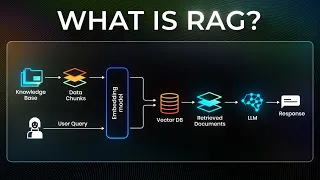
RAG Explained For Beginners
10min
-
05
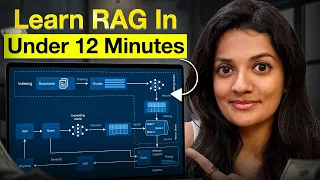
RAG Explained in 12 Minutes
12min
-
06
Vector Search RAG Tutorial – Combine Your Data with LLMs with Advanced Search
1h 11min
-
07
Complete RAG Crash Course With Langchain In 2 Hours
2h 08min
-
08
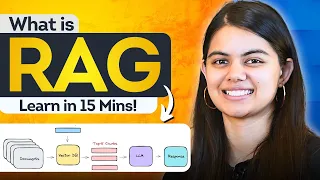
What is RAG ? | Completely Explained in 15 Minutes
17min
-
09
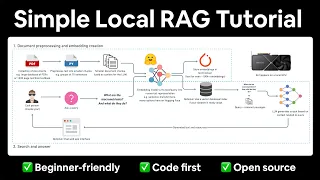
Local Retrieval Augmented Generation (RAG) from Scratch (step by step tutorial)
Current lesson
-
10
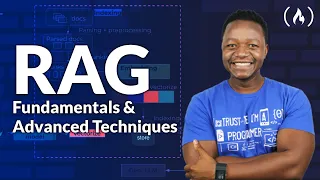
RAG Fundamentals and Advanced Techniques – Full Course
1h 36min




Summary
Understanding Retrieval Augmented Generation
Retrieval Augmented Generation (RAG) represents a powerful architecture that combines information retrieval with language model generation. Rather than relying solely on a model's training data, RAG systems fetch relevant documents or passages and use them to augment the prompt before generating responses. This approach addresses fundamental limitations of large language models: they cannot access real-time information, struggle with knowledge cutoff dates, and may hallucinate facts outside their training distribution. By grounding generation in retrieved context, RAG systems produce more accurate, factual, and verifiable outputs.
The tutorial builds NutriChat, a practical RAG application that allows users to ask natural language questions about a 1200-page nutrition textbook. Rather than memorizing the entire textbook, the system retrieves the most relevant pages or sections based on the user's query, then feeds this context to a language model to generate informed answers. This pattern scales to any domain: legal documents, technical manuals, medical literature, or proprietary knowledge bases. Understanding how to build RAG from scratch—without relying on frameworks like LangChain or LlamaIndex—reveals every component of the pipeline and enables customization for specialized use cases.
Why Local Execution Matters
Running RAG locally offers several critical advantages over cloud-based approaches. Privacy becomes paramount when working with sensitive documents: medical records, proprietary research, financial data, or confidential business information never leave the local machine. Latency improves dramatically when retrieval and generation occur on-premises, eliminating network round trips. Cost efficiency follows naturally—no per-token charges, no API rate limits, no ongoing subscription fees. For organizations processing large volumes of queries or managing sensitive data, local RAG becomes both a technical necessity and a business imperative. The tutorial demonstrates that modern open-source models and efficient vector databases make local execution feasible on consumer hardware, democratizing RAG technology beyond large enterprises.
The PDF Processing Foundation
Every RAG pipeline begins with ingesting source documents. The tutorial starts by loading a PDF file and extracting readable text. This step involves more than simple text extraction—it requires handling various PDF layouts, removing artifacts, preserving meaningful structure, and ensuring the resulting text is clean enough for downstream processing. The extracted text becomes the raw material from which the system will retrieve relevant passages. Poor quality extraction at this stage compounds errors throughout the pipeline, leading to retrieval failures and inaccurate generations. The code-first approach in the tutorial walks through practical challenges: parsing multicolumn documents, handling images and OCR, managing special characters, and validating extraction quality before proceeding.
Chunking: Breaking Text Into Retrievable Units
Raw extracted text must be divided into chunks—discrete passages that can be embedded and retrieved independently. The chunking strategy critically influences RAG performance. Chunks too small may lack sufficient context; chunks too large may dilute relevance scores by mixing unrelated content. The tutorial explores text splitting strategies, including fixed-size windows, semantic boundaries (sentences, paragraphs), and overlap strategies. Overlap between chunks ensures that relevant information spanning chunk boundaries remains retrievable. Implementing chunking properly requires attention to whitespace, special characters, and the trade-off between retrieval precision and coverage. The hands-on coding sections demonstrate how to balance these considerations, testing different chunk sizes against the actual nutrition textbook content to optimize for real-world performance.
Embeddings: Converting Text Into Vector Space
Embeddings transform text into dense numerical vectors that capture semantic meaning. An embedding model processes text chunks and produces fixed-dimensional vectors where semantically similar passages cluster together in vector space. The tutorial covers both commercial embedding services and open-source alternatives, comparing their strengths, latencies, and resource requirements. Creating embeddings locally requires loading a pretrained embedding model—often based on transformer architectures—and running inference on each text chunk. The decision between CPU and GPU computation affects both speed and memory usage. GPU execution dramatically accelerates embedding creation for large document collections but requires sufficient VRAM. The tutorial provides practical guidance on managing this trade-off, including strategies for batching, memory management, and monitoring computational resources during the embedding phase.
Semantic Search and Vector Retrieval
Once text chunks are embedded, the system can perform semantic search: given a user query, encode it into the same vector space, then find the most similar chunks using distance metrics like cosine similarity or Euclidean distance. Unlike keyword-based search, semantic search understands meaning, enabling retrieval even when query and document use different vocabulary. The tutorial explains similarity measures between embedding vectors, detailing how cosine similarity captures angular distance in high-dimensional space. GPU-accelerated vector search using libraries like FAISS enables near-instantaneous retrieval from millions of embeddings. The retrieval stage converts an unstructured natural language query into ranked chunks of context that become candidates for the language model. The tutorial demonstrates building this pipeline incrementally, validating that retrieved chunks actually address the user's information need before proceeding to generation.
Local Language Models for Generation
The final RAG component is a language model that generates answers conditioned on retrieved context. Rather than cloud APIs, the tutorial uses open-source models designed for local execution. Model selection balances quality, speed, and hardware requirements. Smaller models (7B parameters) run on consumer GPUs; larger models (13B-70B) require more VRAM but produce higher-quality outputs. The tutorial guides through model selection, quantization techniques that reduce model size, and inference optimization. Loading a model locally requires understanding VRAM constraints, batch processing, and token generation strategies. The hands-on sections cover practical concerns: which quantization level maintains quality while fitting available memory, how to structure prompts for consistent output, and monitoring generation time to ensure interactive response latency.
Augmenting Prompts With Retrieved Context
The final step integrates retrieval and generation: augment the user's query with retrieved context before sending it to the language model. This prompt augmentation is deceptively simple but critical to RAG performance. The system retrieves top-K relevant chunks, formats them as context in the prompt, then instructs the model to answer based on the provided material. Effective prompt engineering in RAG includes strategies like chain-of-thought reasoning, instruction clarity, and context presentation format. The tutorial demonstrates testing different prompt structures and measuring their impact on answer quality. Potential extensions include ranking retrieval results by confidence, filtering out low-relevance chunks, implementing multi-hop reasoning across chunks, and fine-tuning both the embedding model and language model on domain-specific data. Building RAG from scratch enables all these customizations that framework-based approaches might obscure.
What you will learn
- Build a complete RAG pipeline from scratch without high-level frameworks
- Extract and preprocess PDF documents for information retrieval
- Create embeddings and perform semantic search using vector databases
- Run open-source language models locally for text generation
- Integrate retrieval context into prompts for accurate, grounded responses
- Optimize RAG components for latency, privacy, and computational efficiency
Concepts covered
Technologies used
Chapters 15 markers
- Intro and NVIDIA GTC
- Resources and pipeline overview
- What is RAG and why use it
- Benefits of running RAG locally
- Building NutriChat: project overview
- Original RAG research paper
- Importing and processing PDF documents
- Text chunking and preprocessing
- Creating embeddings with open-source models
- Semantic search and retrieval implementation
- Similarity measures and vector mathematics
- Loading and running LLMs locally
- Text generation with local models
- Prompt augmentation with context
- Summary and extensions
Next suggested video
Reviews
No reviews yet. Be the first to rate this lesson.