-
01
 Learn RAG From Scratch – Python AI Tutorial from a LangChain Engineer
2h 33min
Learn RAG From Scratch – Python AI Tutorial from a LangChain Engineer
2h 33min
-
02
OpenAI Embeddings and Vector Databases Crash Course
18min
-
03
What is a Vector Database? Powering Semantic Search & AI Applications
9min
-
04
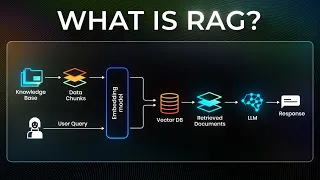
RAG Explained For Beginners
10min
-
05
RAG Explained in 12 Minutes
12min
-
06
Vector Search RAG Tutorial – Combine Your Data with LLMs with Advanced Search
1h 11min
-
07
Complete RAG Crash Course With Langchain In 2 Hours
2h 08min
-
08
What is RAG ? | Completely Explained in 15 Minutes
17min
-
09
Local Retrieval Augmented Generation (RAG) from Scratch (step by step tutorial)
5h 40min
-
10
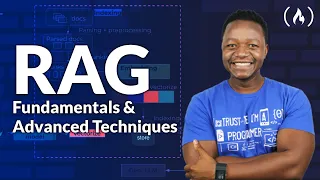
RAG Fundamentals and Advanced Techniques – Full Course
Current lesson




Summary
Understanding Retrieval-Augmented Generation
Retrieval-Augmented Generation (RAG) represents a transformative approach in artificial intelligence that combines the power of large language models with external knowledge sources. Unlike traditional LLMs that rely solely on their training data, RAG systems dynamically retrieve relevant information from external documents or databases and use that information to generate more accurate and contextually relevant responses. This course provides a comprehensive exploration of RAG architecture, starting from foundational concepts and progressing through advanced implementation techniques. The 97-minute course is structured to take learners from complete beginners to practitioners capable of building production-grade RAG systems that can interact intelligently with document collections.
Core Components and Architecture
The foundation of any RAG system rests on three essential components working in harmony. The retrieval component is responsible for searching through document repositories and identifying the most relevant passages based on user queries. The augmentation layer processes these retrieved documents and integrates them with the original query to create an enriched context. Finally, the generation component leverages this augmented context to produce coherent, accurate responses that are grounded in actual document content rather than hallucinated information. Understanding how these three elements interact is crucial for building effective RAG systems, as the quality of each component directly impacts the overall system performance. The course provides deep-dive explanations of each component, examining their individual roles and their collective behavior within the broader RAG pipeline.
Building Practical RAG Applications
The hands-on portion of the course guides learners through constructing a complete RAG application designed for chatting with documents. This practical segment covers the entire development lifecycle, from setting up the necessary libraries and frameworks to implementing the retrieval mechanism and integrating it with language models. Learners work with real code examples available in the accompanying GitHub repository, which includes starter templates and working implementations. The application development process demonstrates how to handle document ingestion, create appropriate embeddings for semantic search, implement efficient retrieval mechanisms, and connect everything to a language model API. By the end of this section, participants understand the complete workflow of taking raw documents and transforming them into a system where users can ask natural language questions and receive relevant, document-grounded answers.
The Naive RAG Problem
One of the course's critical contributions is explaining the limitations of naive RAG implementations. Many developers initially implement RAG systems using straightforward approaches that simply retrieve the top k most similar documents and pass them directly to the language model. However, this naive approach suffers from several significant drawbacks. The course breaks down these pitfalls in detail, explaining how simple retrieval-augmentation can fail when dealing with complex queries, ambiguous language, or when relevant information is scattered across multiple documents. Naive RAG systems struggle with query formulation, where the original user query may not align well with the semantic structure of the document embeddings. Additionally, they lack sophisticated mechanisms for handling multi-hop queries that require information synthesis across different document sections. Understanding these limitations is essential for developers who want to build RAG systems that perform reliably in production environments and handle real-world complexity.
Advanced Query Expansion Techniques
The course introduces advanced techniques designed to overcome naive RAG limitations, with particular emphasis on query expansion strategies. Query expansion with generated answers represents one of the most effective techniques, where the system generates multiple potential answers to a user's query and uses those generated answers as additional retrieval queries. This approach leverages the language model's ability to think through different interpretations and angles of a question, significantly improving the chance of retrieving truly relevant documents. The hands-on segment walks through implementing this technique, showing how to prompt the language model to generate alternative questions, use those questions to perform multiple retrieval operations, and synthesize results from all retrieval passes. This advanced technique transforms the RAG pipeline from a single-pass retrieval system into a multi-faceted information gathering process that better captures the nuances of complex user queries.
Multi-Query Expansion Strategy
Beyond single query expansion, the course explores query expansion with multiple queries, a technique that generates several semantically different queries from a single user input and performs parallel retrievals for each generated query. This approach acknowledges that different phrasings of the same information need may yield different retrieval results from the document database. By generating multiple query variations, the system casts a wider semantic net, improving the likelihood of finding relevant documents that might be missed by a single query formulation. The hands-on implementation segment demonstrates how to design effective prompts for generating diverse queries, manage multiple concurrent retrieval operations, and deduplicate or rank results intelligently across multiple retrieval passes. This technique is particularly valuable for handling ambiguous queries or when dealing with documents that use varied terminology for similar concepts.
Implementation and Best Practices
Throughout the course, participants gain exposure to practical implementation patterns and best practices for building robust RAG systems. The course emphasizes the importance of careful embeddings selection, as the quality of the retrieval component fundamentally depends on how effectively the embedding model captures semantic meaning relevant to the application domain. It covers considerations for chunking strategies, where documents are divided into meaningful passages for indexing and retrieval. The course also addresses practical concerns such as managing computational resources, handling rate limits with API services, and implementing error handling for real-world deployments. By examining both successful implementations and common pitfalls, learners develop the judgment needed to make appropriate architectural decisions for their specific use cases. The provided code examples on GitHub serve as templates that developers can adapt for their own RAG applications.
From Theory to Production Systems
The course structure moves deliberately from theoretical understanding to practical application, ensuring learners not only grasp RAG concepts but can implement them effectively. The progression begins with abstract concepts and architectural diagrams, then transitions to concrete code examples and hands-on exercises, and culminates in challenges that require applying learned techniques to novel problems. This pedagogical approach mirrors real-world development where understanding principles is essential, but the ability to translate those principles into working code is equally critical. The course challenges encourage learners to think critically about design decisions and experiment with different configurations, fostering the problem-solving skills necessary for adapting RAG systems to specific application requirements.
What you will learn
- Understand the core architecture and components of Retrieval-Augmented Generation systems
- Build a complete RAG application capable of intelligently chatting with document collections
- Identify and overcome the limitations and pitfalls of naive RAG implementations
- Implement advanced query expansion techniques to improve retrieval effectiveness
- Apply multi-query strategies for enhanced semantic coverage during document retrieval
- Design production-ready RAG systems with proper error handling and resource management
Concepts covered
Technologies used
Chapters 15 markers
- Intro
- RAG Fundamentals
- Components of RAG
- RAG Deep Dive
- Building a RAG System for Document Chatting
- Advanced RAG Techniques Overview
- Naive RAG Overview and Pitfalls
- Naive RAG Drawbacks Breakdown
- Query Expansion with Generated Answers
- Query Expansion with Generated Answers Hands-on
- Query Expansion Summary
- Query Expansion with Multiple Queries
- Multi-Query Expansion Hands-on
- Challenge Exercise
- Next Steps
Next suggested video
Reviews
No reviews yet. Be the first to rate this lesson.