-
01
 Learn RAG From Scratch – Python AI Tutorial from a LangChain Engineer
2h 33min
Learn RAG From Scratch – Python AI Tutorial from a LangChain Engineer
2h 33min
-
02
OpenAI Embeddings and Vector Databases Crash Course
18min
-
03
What is a Vector Database? Powering Semantic Search & AI Applications
Current lesson
-
04
RAG Explained For Beginners
10min
-
05
RAG Explained in 12 Minutes
12min
-
06
Vector Search RAG Tutorial – Combine Your Data with LLMs with Advanced Search
1h 11min
-
07
Complete RAG Crash Course With Langchain In 2 Hours
2h 08min
-
08
What is RAG ? | Completely Explained in 15 Minutes
17min
-
09
Local Retrieval Augmented Generation (RAG) from Scratch (step by step tutorial)
5h 40min
-
10
RAG Fundamentals and Advanced Techniques – Full Course
1h 36min







Summary
Understanding Vector Databases
Vector databases represent a fundamental shift in how modern AI systems store and retrieve information. Unlike traditional relational databases that organize data into rows and columns, vector databases are specifically designed to work with high-dimensional vector embeddings—numerical representations of data that capture semantic meaning. These databases excel at handling the types of queries that power contemporary AI applications, from chatbots to recommendation systems. The core innovation lies in their ability to understand not just what data contains, but what it means, enabling machines to find relevant information based on similarity rather than exact keyword matches.
The Power of Vector Embeddings
At the heart of vector databases lies the concept of embeddings, which transform complex data—whether text, images, or audio—into mathematical vectors that computers can efficiently process and compare. When an image of a sunset is converted into an embedding, it becomes a point in a high-dimensional space where similar sunsets are represented as nearby points. This mathematical representation preserves semantic relationships; a query for "warm landscape" will find sunsets, golden hour photographs, and similar visual concepts without requiring explicit keywords. Embeddings enable machines to grasp nuance and context, bridging what humans might call the semantic gap—the space between raw data and its deeper meaning.
Semantic Search in Practice
Semantic search leverages vector embeddings to deliver fundamentally smarter search results. Rather than matching keywords character-by-character, semantic search understands the intent and meaning behind a query. If someone searches for "images with warm color palettes and natural landscapes," a vector database can find exactly those images by comparing the embedding of that query to the embeddings of millions of images, ranking results by similarity. This capability transforms user experience across countless applications: finding visually similar products in e-commerce, discovering relevant articles in knowledge bases, or locating code snippets that solve similar problems in developer platforms. Semantic search proves particularly powerful when exact keywords don't exist or when users aren't sure how to phrase what they're looking for.
Retrieval-Augmented Generation and RAG
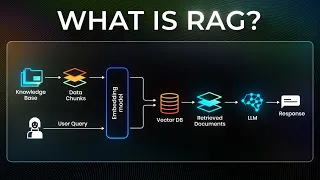
Retrieval-augmented generation, commonly abbreviated as RAG, represents one of the most impactful applications of vector databases in modern AI. RAG systems combine the generative power of large language models with the retrieval capabilities of vector databases to ground AI responses in factual, up-to-date information. When a user asks a question, the system first retrieves relevant documents or data chunks from a vector database based on semantic similarity, then feeds those retrieved results to a language model to generate an accurate, contextual response. This approach solves critical problems with traditional large language models: hallucinations (generating false information), outdated knowledge, and lack of access to proprietary data. RAG enables organizations to build AI assistants that can reason over their own documents, databases, and knowledge bases while maintaining accuracy and traceability.
Efficient Similarity Search at Scale
Vector databases are engineered for speed and efficiency when performing similarity searches across massive datasets. Traditional nearest-neighbor search would be computationally prohibitive with millions or billions of vectors, so vector databases employ sophisticated indexing techniques such as approximate nearest neighbor algorithms, clustering strategies, and tree-based structures. These optimizations allow queries to return relevant results in milliseconds rather than minutes, making real-time AI applications feasible. The efficiency doesn't come at the cost of accuracy; modern vector databases balance speed with precision, ensuring that the most semantically similar items consistently rank highest. This efficiency is crucial for production AI systems that must serve requests from thousands of concurrent users while maintaining low latency.
Real-World Applications Across Industries
Vector databases have become foundational infrastructure for diverse AI-driven applications across virtually every industry. In e-commerce, they power recommendation engines that suggest products based on visual similarity or past browsing behavior. In healthcare, they enable similarity searches across medical literature to support diagnosis and treatment decisions. Customer service teams use vector databases to instantly retrieve relevant documentation or past support tickets when answering inquiries. Content platforms leverage them to discover and surface similar articles, videos, or posts to users. Even in software development, vector databases help developers find code examples and solutions by semantic meaning rather than keyword matching. The versatility of vector databases stems from their ability to work with any data type that can be vectorized—text, images, audio, video, or even complex scientific data.
Bridging the Gap Between Data and Understanding
The fundamental value proposition of vector databases is their ability to bridge the semantic gap in data retrieval and AI applications. Human language and visual perception are inherently semantic; we understand concepts, relationships, and meaning. Traditional databases operate on exact matching, lacking this semantic understanding. Vector databases solve this mismatch by representing data in a form that aligns with how AI models process and understand information. This alignment enables more intuitive, powerful, and human-centered AI applications. As organizations increasingly embed AI into their products and services, vector databases have become indispensable infrastructure for powering next-generation search, recommendation, and knowledge management systems.
Future of Vector-Powered AI
The convergence of vector databases with large language models and other foundation models points toward a future where AI systems are more knowledgeable, accurate, and useful. As embeddings become more sophisticated and vector databases more efficient, the possibilities for semantic understanding and retrieval will expand further. Organizations that invest in understanding and implementing vector database technology position themselves to build more intelligent, responsive AI applications that truly understand their data and their users' needs.
What you will learn
- Understand how vector embeddings represent semantic meaning in data
- Explore semantic search techniques and their advantages over keyword matching
- Learn retrieval-augmented generation (RAG) and its role in accurate AI systems
- Discover similarity search optimization strategies for large-scale databases
- Apply vector databases to real-world AI applications across industries
Concepts covered
Technologies used
Chapters 7 markers
Next suggested video
Reviews
No reviews yet. Be the first to rate this lesson.