More from this course
OpenAI Codex Full Course: AI Coding Agent Tutorial with Python Examples
Lesson 2 of 7-
01
 Lesson 1 – OpenAI Codex Full Course: AI Coding Agent Tutorial with Python Examples
10min
Lesson 1 – OpenAI Codex Full Course: AI Coding Agent Tutorial with Python Examples
10min
-
02
Lesson 2 – OpenAI Codex Full Course: AI Coding Agent Tutorial with Python Examples
Current lesson
-
03
Lesson 3 – OpenAI Codex Full Course: AI Coding Agent Tutorial with Python Examples
21min
-
04
Lesson 4 – OpenAI Codex Full Course: AI Coding Agent Tutorial with Python Examples
34min
-
05
Lesson 5 – OpenAI Codex Full Course: AI Coding Agent Tutorial with Python Examples
27min
-
06
Lesson 6 – OpenAI Codex Full Course: AI Coding Agent Tutorial with Python Examples
30min
-
07
Lesson 7 – OpenAI Codex Full Course: AI Coding Agent Tutorial with Python Examples
11min
Summary
The core concept of AI agentic coding
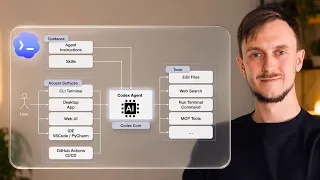
The lesson centers on using OpenAI Codex not merely as a code completion tool, but as an autonomous AI coding agent. The instructor, Artem Istranin, guides the viewer through a live, collaborative development session where Codex acts as a junior developer, receiving high-level instructions and generating the corresponding code. This agentic workflow represents a significant shift in modern software engineering, moving from manually writing every line to defining requirements and reviewing AI-generated implementations. The project's goal is to build a practical application from scratch, demonstrating how to translate a problem statement into a working backend system using natural language prompts and iterative refinement.
From problem definition to system design
The video begins by clearly defining the software requirements: a spinning wheel randomizer API that can accept a list of names and randomly select a winner. Before any code is written, a system design phase outlines the project's architecture. This demonstrates a crucial real-world practice where the AI agent's work is framed by a clear blueprint. The design includes the technology stack, centered on FastAPI for the Python backend, and defines the structure of the single API endpoint, POST /api/pick-winner. This structured approach ensures that the AI agent operates within a well-defined scope, reducing ambiguity and making its output more predictable and reliable.
Building the FastAPI backend with Codex
The practical coding section involves setting up the project environment with `uv`, a modern Python package manager, before interacting with Codex. The instructor demonstrates the entire workflow for building the FastAPI application. This includes generating the initial code structure, implementing the core random selection logic with Python's `random` module, and defining the Pydantic models for request and response validation. The live session shows how to prompt Codex to create files, write endpoint logic, and handle potential edge cases. The result is a fully functional REST API that can be run locally, showcasing the immediate productivity gains from an AI coding agent.
A comprehensive testing and review workflow
A significant portion of the tutorial is dedicated to code review and automated testing, treating these activities as integral parts of the agentic workflow. The instructor uses Codex to generate `pytest` unit tests for the FastAPI application, verifying the correctness of the random selection and the API's behavior. The process illustrates how to use the AI agent to not only build features but also to critically evaluate and ensure their quality. This segment highlights the importance of a feedback loop, where the developer reviews the AI's code for potential bugs or design flaws, and instructs the agent to refactor or fix issues, leading to more robust and maintainable code.
Refactoring and iterative improvement with AI
After the initial build and test phase, the lesson demonstrates code refactoring powered by Codex. The instructor identifies areas for improvement in the AI-generated code and uses natural language prompts to guide the refactoring process. This section is crucial for understanding how to evolve a codebase with the help of an AI agent. It shows techniques for cleaning up code, improving its structure, abstracting logic into separate modules, and enhancing the overall design. The ability to iteratively refine code with an AI agent mirrors real-world development cycles where software is continuously improved based on new insights and requirements.
Non-interactive mode and production considerations
The tutorial advances to cover Codex's non-interactive mode, a feature critical for integrating AI coding into automated pipelines and continuous integration systems. The instructor explains how to run Codex with prompts directly from the command line, without the live chat interface. This is essential for understanding how to scale the use of an AI coding agent and incorporate it into professional development workflows. The lesson covers the syntax for this mode and discusses practical use cases, such as generating code in a headless environment or integrating it with other scripting and automation tools.
Essential takeaways for the modern developer
The course episode concludes by summarizing the key takeaways from the live coding experience. It reinforces the mental model shift required to treat AI as a coding partner—a junior developer that needs clear, well-defined tasks. Effective communication through precise prompts, systematic code review, and a strong foundation in software architecture are identified as essential skills for this new paradigm. The final message is that tools like OpenAI Codex are force multipliers for developers who can guide them, turning high-level ideas into concrete, tested, and deployable code with unprecedented speed.
What you will learn
- Configure an OpenAI Codex agent for a live coding workflow
- Design and build a REST API with FastAPI using AI-generated code
- Generate automated tests with pytest directly from AI prompts
- Apply iterative refactoring techniques to improve AI-written code
- Execute Codex in non-interactive mode for automated scripting
Concepts covered
Technologies used
Chapters 11 markers
Next suggested video

Reviews
No reviews yet. Be the first to rate this lesson.