-
01
 Lesson 1 – Claude Certified Architect – Full Course
9min
Lesson 1 – Claude Certified Architect – Full Course
9min
-
02
Lesson 2 – Claude Certified Architect – Full Course
Current lesson
-
03
Lesson 3 – Claude Certified Architect – Full Course
32min
-
04
Lesson 4 – Claude Certified Architect – Full Course
33min
-
05
Lesson 5 – Claude Certified Architect – Full Course
12min
-
06
Lesson 6 – Claude Certified Architect – Full Course
45min
-
07
Lesson 7 – Claude Certified Architect – Full Course
24min
-
08
Lesson 8 – Claude Certified Architect – Full Course
38min
-
09
Lesson 9 – Claude Certified Architect – Full Course
1h 29min
-
10
Lesson 10 – Claude Certified Architect – Full Course
35min
-
11
Lesson 11 – Claude Certified Architect – Full Course
31min
-
12
Lesson 12 – Claude Certified Architect – Full Course
33min

Summary
The Foundation of Agentic Systems
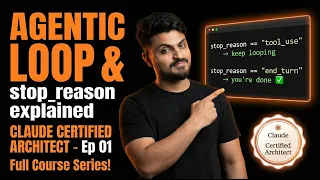
The shift from monolithic AI models to autonomous agents represents a significant leap in software architecture, and the Claude Certified Architect exam is designed to validate expertise in this area. This episode forms the bedrock of the full certification course, focusing on the fundamental engine behind any reliable Claude agent: the agentic loop. The agentic loop is not just a theoretical concept but the operational heart of systems that plan, use tools, and iterate until a goal is met. Understanding its lifecycle is the prerequisite for designing robust, production-grade AI applications. Without mastering this loop, developers often build brittle agents that fail silently, making the foundational knowledge presented here critical for passing the certification and for real-world implementation.
Environment Setup and Model Selection
Before diving into the loop itself, the course establishes a practical starting point with a concise four-step environment setup. This process takes the learner from zero to a functional API connection, ensuring that the theoretical discussions are immediately followed by hands-on coding. A crucial early decision lies in model selection, parsing the trade-offs between Haiku, Sonnet, and Opus. The choice is not merely about intelligence but about cost, latency, and suitability for different stages of the agentic loop. For instance, a fast, cost-effective model like Haiku might handle simple classification within a tool, while Opus is reserved for high-level reasoning steps. This segment demystifies the initial configuration, ensuring that the agent’s brain is wired correctly to the Anthropic API from the start.
Dissecting the Roles in a Conversation
A deep technical discussion explores the User, Assistant, and System roles, which form the triadic foundation of every API call. The system prompt acts as the agent's constitution, setting behavioral boundaries and persistent instructions, while the alternating user and assistant messages constitute the dynamic conversation. A significant point of confusion for many developers is explicitly addressed: the use of the 'user' role for tool results within the messages array. This design choice is often counter-intuitive, as one might expect tool outputs to have their own role, but it is essential for maintaining the structural integrity of the conversation history. Misunderstanding this leads to malformed state that corrupts the agent's context window, causing erratic behavior. The course clarifies this architectural nuance, ensuring a correct mental model of how Claude processes sequential data.
The Agentic Loop Lifecycle in Detail
The core of the episode is a granular breakdown of the four-stage agentic loop lifecycle, moving beyond simple definitions to an operational blueprint. The cycle begins with the LLM reasoning about the next step, then deciding to call a tool, followed by executing that tool in an external environment, and finally feeding the result back into the LLM for further thought. This discussion highlights the critical function of stop_reason as the loop's master control switch. The stop_reason 'tool_use' signals that the model has decided an action is needed and is waiting for a tool's output, whereas 'end_turn' is the only valid terminal state indicating the agent has completed its reasoning and produced a final answer. A deep understanding of these two stop signals is non-negotiable, as misinterpreting them is one of the quickest ways to create infinite loops or prematurely terminated tasks.
A Practical Code Walkthrough
Moving from theory to practice, the episode provides a comprehensive hands-on code walkthrough, translating the lifecycle into a tangible Python reference implementation. This section demonstrates how to manage the conversation state, parse tool use requests, execute mock functions, and append the results back into the messages array using the correct user role. The walkthrough meticulously connects each line of code to the previously discussed abstract concepts, like using a conditional check on stop_reason to decide whether to loop or break. Following this implementation gives the learner a fully functional agent skeleton, revealing that the core loop is a surprisingly simple yet powerful deterministic structure. This reference code serves as the template that every subsequent project and advanced technique in the course will expand upon.
Critical Anti-Patterns for the Exam
No foundational lesson is complete without highlighting the pitfalls that fail even experienced developers, and this episode culminates with three anti-patterns explicitly tested in the certification exam. These are not simple syntax errors but architectural mistakes that silently degrade agent performance, such as incorrectly accumulating message history or mishandling stop_reason edge cases. For each anti-pattern, a specific code fix is provided, turning common vulnerabilities into robust patterns. The focus here is on defensive design, training the architect to anticipate and prevent the most frequent failure modes in agentic systems. Mastering these corrections is a direct investment in both the exam score and the durability of any application built on the Claude API, transforming a basic agent into a resilient, production-ready service.
What you will learn
- Set up the Anthropic SDK and API key to build your first agent in four steps
- Differentiate between Haiku, Sonnet, and Opus to select the right model
- Implement the complete four-stage agentic loop lifecycle in Python
- Diagnose and fix the three most common anti-patterns that break agent implementations
Concepts covered
Technologies used
Chapters 8 markers
Next suggested video

Reviews
No reviews yet. Be the first to rate this lesson.