-
04
 Lesson 4 – Claude Certified Architect – Full Course
33min
Lesson 4 – Claude Certified Architect – Full Course
33min
-
05
Lesson 5 – Claude Certified Architect – Full Course
12min
-
06
Lesson 6 – Claude Certified Architect – Full Course
45min
-
07
Lesson 7 – Claude Certified Architect – Full Course
24min
-
08
Lesson 8 – Claude Certified Architect – Full Course
Current lesson
-
09
Lesson 9 – Claude Certified Architect – Full Course
1h 29min
-
10
Lesson 10 – Claude Certified Architect – Full Course
35min
-
11
Lesson 11 – Claude Certified Architect – Full Course
31min
-
12
Lesson 12 – Claude Certified Architect – Full Course
33min
-
13
Lesson 13 – Claude Certified Architect – Full Course
51min
-
14
Lesson 14 – Claude Certified Architect – Full Course
31min
-
15
Lesson 15 – Claude Certified Architect – Full Course
34min

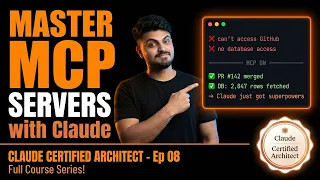





Summary
The Hidden Danger of Silent Agent Failures
When an AI agent crashes or throws a visible exception, the problem is immediately obvious and a developer can start debugging. But the most dangerous failures in agentic systems are the silent ones. An agent runs to completion without any red flags, yet the final output is subtly incorrect, a tool was never triggered, or a critical piece of data was simply ignored. This phenomenon represents the bleeding edge of reliability engineering for large language model applications. The system looks healthy on the surface, but the logic underneath has diverged from the intended path, often due to unhandled tool errors or poor execution routing.
Understanding this silent killer requires a shift in mindset from traditional software debugging. You are not just looking for stack traces. You need to trace the reasoning path of a non-deterministic model. The challenge is compounded by the fact that an LLM will often try to "help" by hallucinating a fix for a failed tool call rather than reporting the failure upstream. This lesson establishes that the primary defense against these silent corruptions is a rigorous, standards-based approach to error signaling using the Model Context Protocol, or MCP, and strict execution control.
Decoding the MCP isError Flag
The cornerstone of reliable error handling in this ecosystem is a simple Boolean flag called `isError`. When a tool fails, either because of a network timeout, a validation issue, or a business logic constraint, the MCP server must respond not just with a text description of the failure but with this structured flag set to `true`. This allows the coordinating Claude agent to programmatically detect a failure state without relying on fragile string parsing of an error message. Without this flag, the agent might treat the error text as a perfectly valid, successful result, leading directly to silent failure.
The lesson demonstrates how this flag acts as a contract between your worker tools and the host agent. By inspecting the `isError` property in the response object, the coordinator can immediately branch into recovery logic. This is the foundation of an intelligent recovery system, enabling the architect to build agents that automatically distinguish between a successful data retrieval and a "404 Not Found" type of response that might otherwise be hallucinated into a factual answer by a less cautious model.
Mapping the Four Categories of Tool Failure
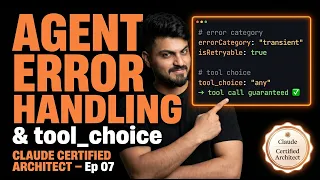
To build an intelligent error recovery system, you must classify failures into distinct categories. This course defines four essential types that any architect should model in their metadata. The first is a transient error, which represents a temporary issue like a rate limit or a network timeout where a simple retry of the exact same request is the correct strategy. The second is a validation error, which indicates that the input parameters provided by the agent were malformed, missing, or out of range, requiring the agent to reformulate its request.
The third category is a business logic error, where the request was technically valid but violates a domain rule, such as attempting to book a flight for a past date or deleting a user that does not exist. The final category is a permission error, where the agent simply lacks the credentials or scope to execute the tool. By encoding this category into the structured error metadata returned alongside the `isError` flag, you empower the coordinator agent to make high-quality decisions on how to recover without escalating every minor hiccup to a human operator.
Structuring Metadata for Intelligent Recovery
Simply knowing that an error occurred is not enough to recover from it gracefully. The coordinator agent needs context. The practice of returning structured error metadata turns a chaotic failure into a machine-readable event. Instead of returning a raw stack trace or a generic "Something went wrong" string, the tool should return a JSON object containing fields like `error_type`, the specific parameter that failed, and a list of `suggested_fixes`.
This highly structured approach serves a dual purpose. For the agent, it provides concrete instructions on how to fix the request and retry. For the developer, it creates traceable, loggable data points that make debugging an opaque autonomous system much more predictable. The lesson walks through a code implementation that shows how to wrap a tool function to catch exceptions and bubble them up as this rich, structured metadata, effectively creating a local recovery layer that prevents minor issues from propagating up to the global orchestrator and causing a full session failure.
The Architecture of Scoped Access
A critical insight from this module is the inverse relationship between the number of available tools and the agent's reliability. As the tool list grows, the probability that the model selects the wrong tool for a vague prompt increases dramatically. This is known as the tool overload problem. The solution proposed isn't a more clever prompt; it's a fundamental architectural constraint called scoped access. In a multi-agent system, a single monolithic agent should not be able to see all available tools.
By breaking down a monolithic agent into specialized sub-agents that only have access to a narrow, functionally cohesive set of tools, you drastically reduce the cognitive load on the LLM at each decision step. For example, a "Database Agent" might only see `read_query` and `write_query` tools, while a "Marketing Agent" only sees tools for generating copy. This prevents the model from accidentally calling a destructive database function when it meant to search for marketing data. This scoped architecture is the practical bridge from a prototype to a production-grade system.
Mastering Execution with tool_choice
Even with scoped tools, you sometimes need to force the agent's hand. The lesson explores the critical `tool_choice` parameter, which dictates how the API decides to execute a tool. The default `auto` mode lets the model decide if a tool should be used at all, which is useful for open-ended chat but dangerous for deterministic pipelines. The `any` mode forces the model to use a tool but lets it choose which one from the available set. The `tool` mode is the most powerful and restrictive, allowing the developer to specify the exact name of the tool that must be used, bypassing the model's routing logic entirely.
Understanding these modes is essential for building deterministic chains where you cannot afford variability. For instance, in a data extraction pipeline, you should set the `tool_choice` to specifically target your extraction function, ensuring that a general-purpose chit-chat model doesn't decide to ignore the tool and just "guess" the data. This synthesis of MCP error handling, scoped access, and deterministic tool choice creates a robust architectural pattern—the Synthesis Architecture—that forms the bedrock of the most reliable Claude-deployed agents.
Preparing for the Certification Exam
The practical knowledge taught here directly maps to sample questions on the Claude Certified Architect exam. The assessment tests not just the ability to memorize the `isError` flag, but the architectural judgment to know when to apply local recovery versus global escalation. The exam tips highlight common tricks, such as distinguishing between a business logic failure and a validation failure to answer retry-policy questions correctly. The walkthrough of sample question Q8 provided in the lesson demonstrates that the certification validates real-world design sensibility, ensuring that certified architects can anticipate agent failure modes and design systems that degrade gracefully rather than collapsing into silent, erroneous outputs.
What you will learn
- Implement the isError flag to signal tool failures explicitly
- Categorize errors into transient, validation, business, and permission types
- Return structured error metadata for automated agent recovery
- Apply local recovery logic to prevent unnecessary escalation
- Architect scoped tool access to prevent the tool overload problem
- Control model execution deterministically using tool_choice modes
Concepts covered
Technologies used
Chapters 12 markers
- Introduction to Silent Failures
- The Silent Killer of Agentic Systems
- Understanding the isError Flag
- Four Categories of Tool Failure
- Passing Structured Error Metadata
- Code Implementation Walkthrough
- Local Recovery Before Escalation
- The Tool Overload Problem
- Scoped Access Example
- Controlling Execution Using tool_choice
- The Synthesis Architecture
- Exam Tips and Tricks
Next suggested video

Reviews
No reviews yet. Be the first to rate this lesson.