-
02
 Lesson 2 – Claude Certified Architect – Full Course
49min
Lesson 2 – Claude Certified Architect – Full Course
49min
-
03
Lesson 3 – Claude Certified Architect – Full Course
32min
-
04
Lesson 4 – Claude Certified Architect – Full Course
33min
-
05
Lesson 5 – Claude Certified Architect – Full Course
12min
-
06
Lesson 6 – Claude Certified Architect – Full Course
Current lesson
-
07
Lesson 7 – Claude Certified Architect – Full Course
24min
-
08
Lesson 8 – Claude Certified Architect – Full Course
38min
-
09
Lesson 9 – Claude Certified Architect – Full Course
1h 29min
-
10
Lesson 10 – Claude Certified Architect – Full Course
35min
-
11
Lesson 11 – Claude Certified Architect – Full Course
31min
-
12
Lesson 12 – Claude Certified Architect – Full Course
33min
-
13
Lesson 13 – Claude Certified Architect – Full Course
51min

Summary
The Enforcement Layer for AI Agents
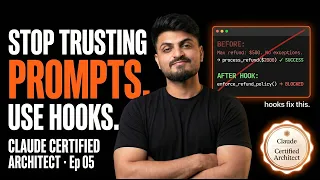
Most AI agent demonstrations look flawless in a controlled demo environment, but they shatter the moment they touch real-world, business-critical workflows. The root cause is relying solely on system prompts which are probabilistic by nature. A prompt suggests what the model should do, but it does not guarantee anything. For production systems handling payments, customer data, or infrastructure, a suggestion is not enough. This course episode defines the true dividing line between a prototype and a production system: deterministic enforcement. It introduces hooks as the mechanism that transforms a polite suggestion into a rigid, unbreakable contract, ensuring that business logic is executed exactly as defined, regardless of the model's statistical leanings.
Why Prompts Are Not Enough for Production
The course begins by dissecting the fragility of probabilistic instructions. When you write a system prompt telling a model to "always verify the user's ID before proceeding," you are fundamentally issuing a statistical nudge, not a software constraint. Under high load, complex contexts, or adversarial user inputs like prompt injection, the model can simply forget or be tricked into ignoring the instruction. This section contrasts the fluid nature of natural language processing with the absolute nature of programmatic control. In production, you need a machine-level guarantee that a specific function runs, that its return value is checked, and that the process halts completely if a condition is not met. Hooks provide this by executing in a separate, non-negotiable layer outside the model's direct cognitive process.
Understanding PreToolUse and PostToolUse Hooks
The core architecture introduced here relies on two strategic interception points in the agentic loop. The first, the PreToolUse hook, acts as an immutable gatekeeper that fires before any external tool call is executed. This is where you validate parameters, check user permissions, or enforce prerequisite steps programmatically. The model can request a tool, but the gate can reject the request entirely, returning a controlled error message. This prevents the model from calling a dangerous API with hallucinated parameters. The second strategic point is the PostToolUse hook, which intercepts the raw response from an external tool before the language model ever sees it. This is critical for data sanitization, formatting standardization, and preventing sensitive information from leaking back into the conversational context window.
Practical Implementation of Hooks and Gates
Moving from theory to practice, the walkthrough details the exact implementation of these mechanisms. The demonstration of the PostToolUse hook focuses on cleaning up raw API JSON payloads, stripping out verbose status codes and timestamps that would confuse the model and waste tokens. It shows how to translate a chaotic machine response into a concise, readable summary for the LLM. The segment on the PreToolUse hook dives deeper into the concept of "prerequisite gates." This is a programmatic ordering system that ensures a sequence of events is followed strictly. For instance, a customer service agent might be required to open a ticket before it is allowed to issue a refund; the gate verifies that the ticket creation tool was successfully called in the conversation history, blocking the refund tool otherwise.
Task Decomposition Strategies for Real Workflows
The later part of the episode addresses how to break down complex objectives. It draws a sharp distinction between prompt chaining and dynamic decomposition. Prompt chaining is suitable for linear, predictable workflows where Step B always follows Step A, like a CI/CD pipeline that must build, test, and then deploy. Dynamic decomposition, on the other hand, is for messy, unpredictable enterprise scenarios like customer support, where the agent must dynamically decide between checking order status, processing a return, or escalading based on the user's initial query. Choosing the wrong strategy leads to brittle agents or inefficient token usage. The lesson provides a decision framework for picking the right approach for any given workflow topology.
Structured Handoffs and Human Escalation
No production agent is an island; eventually, it will need to escalate to a human operator. This section covers the critical failure point of most agent systems: the handoff. Without structure, a human agent receives a garbled chat transcript with no context and must spend minutes reading the history to catch up. The solution presented is the "structured handoff summary." Using hooks, you can enforce the generation of a machine-readable escalation payload containing the exact state of the problem, attempted solutions, and the specific reason for escalation. This transforms the human from a detective into a decision-maker, significantly reducing mean time to resolution.
Preparing for the Claude Architect Certification
The material is explicitly mapped to Domain 1 of the Claude Certified Architect exam, specifically task statements 1.4, 1.5, and 1.6. By framing the technical content within the context of a Customer Support Agent and a CI/CD Pipeline scenario, the episode bridges the gap between abstract API knowledge and the scenario-based questions found on the certification test. The session concludes with common question patterns and exam tricks designed to highlight the critical differences between stated model behavior and enforced system behavior, ensuring that students can identify the correct architectural pattern under the time pressure of the examination.
What you will learn
- Distinguish between probabilistic prompts and deterministic enforcement layers
- Implement PreToolUse hooks to validate inputs and enforce prerequisite gates
- Filter and standardize raw tool outputs using PostToolUse hooks
- Select the appropriate task decomposition strategy for linear vs dynamic workflows
- Design structured handoff summaries for seamless human agent escalation
- Apply hook-driven patterns to real-world customer support and CI/CD scenarios
Concepts covered
Technologies used
Chapters 11 markers
Next suggested video
Reviews
No reviews yet. Be the first to rate this lesson.